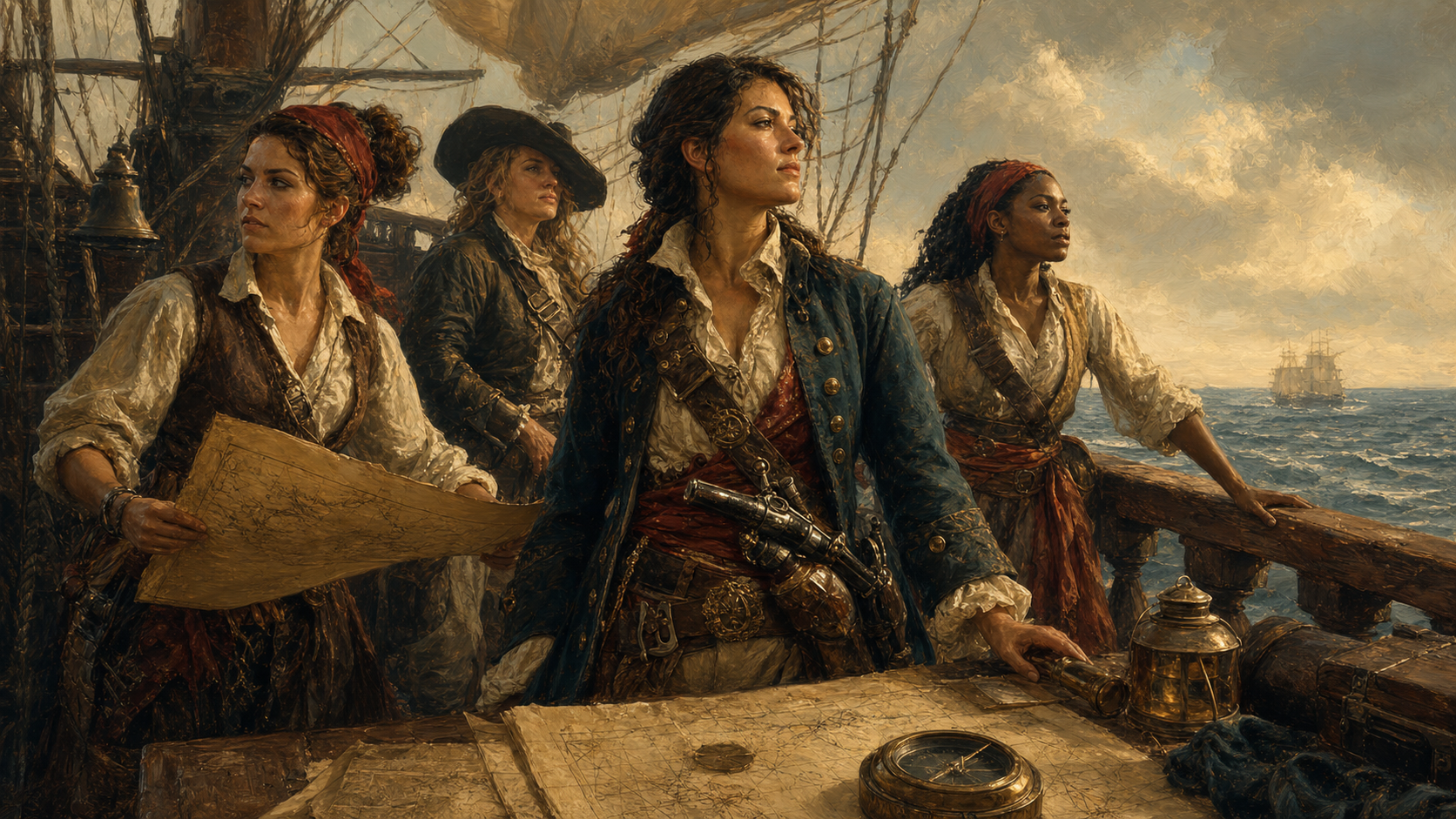
Women pirates are often forced to do two jobs at once: be real historical people and carry every fantasy later writers forgot to fact-check.
They become proof that pirates were secretly progressive. Or proof that women at sea were shocking exceptions. Or proof that a good story can survive indefinitely on boots, pistols, loose hair, and a defiant look toward the horizon.
None of that is fair to the women.
It is also not the most interesting version.
The better story begins with the record and admits where the record is thin. Anne Bonny and Mary Read are visible mainly through the 1720 trial of Calico Jack Rackham’s crew and through later retellings that love a dramatic flourish. Zheng Yi Sao, often called Ching Shih, operated in the South China Sea at a scale that dwarfs most Atlantic legends. Grace O’Malley belonged to the sixteenth-century Irish world of clan politics, shipping, negotiation, and English pressure. Jeanne de Clisson sits between history and a revenge legend so sharp it practically cuts the page.
They were not the same figure in different hats.
That is the first rule.
Evidence first, scandal second
The phrase “female pirate” sounds simple until the sources arrive.
Some women are strongly documented in specific contexts. Some are known through trial records, hostile reports, official correspondence, local tradition, or later printed histories. Some appear in stories that may preserve real events but have clearly been polished by repetition. Some are called pirates because enemies used the label. Some were commanders, smugglers, raiders, political actors, privateers, or maritime rulers whose relationship to piracy depends on who is doing the naming.
The excitement is real. The caution is necessary.
Women at sea attracted attention because they disrupted expectations. That attention could preserve names, but it could also distort them. Writers might exaggerate sexuality, disguise, cruelty, romance, temper, or defiance because those features made the story easier to sell. A woman who stepped into maritime violence was rarely allowed to remain ordinary in the record. She had to become a scandal, a monster, a miracle, or a lesson.
A better article refuses the shortcut. It lets each woman stand in her own evidence.
Anne Bonny: the woman history refuses to finish
Anne Bonny is famous because her story does not close properly.
She was connected to John Rackham’s crew, tried in Jamaica in 1720, convicted, and reportedly pleaded pregnancy, which delayed execution. Rackham was hanged. Mary Read died in prison. Anne Bonny then slips into uncertainty. Later stories give her release, family rescue, remarriage, escape, or a quiet life elsewhere. The record does not settle the matter cleanly.
That uncertainty is not a flaw in the story. It is the story.
Anne Bonny has often been turned into pure attitude: temper, sword, scandal, lover, rebel. Those details may be vivid, but they can make her less real. Her actual power as a historical figure comes from the pressure around her: gender expectations, Atlantic mobility, pirate prosecution, sensational print culture, and the fact that the legal system seemed ready to make an example of her before the surviving record lost its grip.
She does not need a perfectly solved ending. The unsolved ending is why she still feels alive.
Mary Read: disguise, trial, and the archive’s narrow door
Mary Read is usually paired with Anne Bonny, but she should not be swallowed by that pairing.
Read is most securely tied to Rackham’s crew, the Jamaican trial, the pregnancy plea, and her death in prison. Much of her earlier life comes through a lively but complicated source tradition, especially stories of dressing as male in childhood, military life, and seafaring contexts. Those stories may preserve real experience, later embellishment, or both.
The important point is not disguise for costume’s sake.
Clothing could be access. In a world where many forms of labor, movement, pay, and protection were closed to women, passing as male could make survival possible. It could also create danger. Read’s story becomes stronger when disguise is treated as a practical and social problem, not a cheap trick before a duel scene.
Her ending is grim and narrow: prison, pregnancy, illness, death. Later legend wanted more room for drama. The record gives less. That restraint should be honored.
Mary Read matters because she shows how hard history makes us work when a woman enters a violent archive built by courts, printers, enemies, and storytellers.
Zheng Yi Sao: command at scale
Zheng Yi Sao, widely known in popular writing as Ching Shih, should end any lazy idea that women pirates were only decorative exceptions.
After the death of Zheng Yi, she helped preserve and command a massive South China Sea pirate confederation. The scale matters. This was not one flamboyant ship drifting through Caribbean legend. It was a maritime organization with fleets, rules, revenue, alliances, coercion, coastal relationships, and enough power to force serious state response.
Her story is astonishing because she survived the endgame. Many famous pirates ended with ropes, gunfire, trials, or disappearance. Zheng Yi Sao negotiated. In 1810, many pirates under the confederation accepted amnesty, and she emerged with wealth and status in later accounts.
That does not make the violence admirable. It makes the political result extraordinary.
She should not be reduced to “pirate queen,” though the phrase is hard to resist. Her achievement was not merely being a woman in a male world. Her achievement was command, discipline, alliance, economic pressure, and negotiation under conditions that broke many lesser leaders.
Blackbeard got the posters.
Zheng Yi Sao got terms.
Grace O’Malley: sea power, clan politics, and Elizabeth I
Grace O’Malley, or Gráinne Ní Mháille, belongs to a different world again.
She was not a Golden Age Caribbean pirate. She was a sixteenth-century Irish maritime leader operating in a world of clan politics, local power, shipping, raiding, negotiation, and Tudor expansion. Calling her a pirate can be useful if the word is handled carefully. It can also flatten her into the wrong costume.
Her famous meeting with Elizabeth I survives because it gives history a scene too good to ignore: two powerful women, two political worlds, one encounter heavy with pressure and performance. But Grace’s importance is not only that she faced a queen. It is that she used maritime power as part of regional authority in a world where the English state was pushing harder into Ireland.
She belonged to ports, ships, kinship, tribute, violence, bargaining, and survival. Her story widens the pirate map because it shows that maritime raiding and political authority could overlap outside the familiar Caribbean script.
Grace O’Malley was not an accessory to pirate history.
She was a reminder that the sea was power.
Jeanne de Clisson: revenge, legend, and the black sails problem
Jeanne de Clisson is the sort of figure legend loves too much.
The story goes that after her husband Olivier de Clisson was executed by the French crown in the fourteenth century, Jeanne turned violently against France, sold property, armed ships, painted them black, and waged a revenge campaign in the Channel. The image is magnificent: a noblewoman turned sea avenger, black sails cutting through enemy water.
It is also exactly the kind of story that requires careful handling.
The broad frame belongs to the political violence of the Hundred Years’ War and Breton conflict. The revenge tradition has power, but details can become sharper in retelling than the evidence deserves. Jeanne de Clisson should not be discarded as fiction, but neither should every dramatic flourish be nailed down as if witnessed by a court stenographer with excellent sea legs.
Her value lies in the tension. She shows how widowhood, war, noble politics, revenge, and maritime violence could become a legend strong enough to cross centuries.
Sometimes history gives us a record. Sometimes it gives us a blade-shaped shadow. Jeanne belongs near the shadow, and the shadow should be labeled.
The trap of making every woman a rebel icon
There is a modern temptation to turn every woman pirate into the same story: she broke the rules, therefore she was a feminist hero in a tricorn hat.
That is too easy.
Some women did defy gender expectations dramatically. Some used disguise. Some commanded. Some negotiated. Some were violent. Some benefited from systems that harmed others. Some were remembered by enemies. Some were enlarged by later readers hungry for symbols. They do not all fit one moral poster.
The more respectful approach is to let them remain difficult.
Anne Bonny may be powerful because she vanishes from certainty. Mary Read may be powerful because her record is narrow and gendered. Zheng Yi Sao may be powerful because she commanded at scale and survived. Grace O’Malley may be powerful because she belonged to maritime politics rather than pirate costume. Jeanne de Clisson may be powerful because revenge legend and political history refuse to separate neatly.
Different women. Different seas. Different evidence.
The wider lesson
Women pirates matter not because they are cute exceptions, but because they expose the assumptions built into pirate history.
They force questions. Who gets documented? Who gets believed? Who becomes scandalous? Who is called pirate by enemies and ruler by supporters? How does gender change the way violence is reported? Why are women so often remembered through disguise, sexuality, temper, or romance before command, strategy, or law?
They also make the subject larger. Pirate history is not only Blackbeard smoking in the Atlantic. It is the Caribbean courtroom, the South China Sea confederation, the Irish coast, the Channel in wartime, the Mediterranean ruler, the smuggling network, the clan leader, the captive, the sailor, the woman whose name survived because someone found her too strange to leave alone.
The point is not to make pirate history nicer.
The point is to make it wider and truer.
Let them be real
Women pirates do not need to be smoothed into saints or inflated into flawless legends.
They need room. Room for evidence. Room for doubt. Room for violence. Room for ambition. Room for exploitation. Room for the ways later storytellers polished them into whatever symbol the next century wanted.
The real stories are better when the women are allowed to be different. Anne Bonny is not Mary Read. Mary Read is not Zheng Yi Sao. Zheng Yi Sao is not Grace O’Malley. Grace O’Malley is not Jeanne de Clisson. Their worlds overlap only if the reader is willing to draw the map broadly enough.
That is the useful version of female pirate history.
Not one legend in different boots.
A set of lives, records, rumors, and reputations that prove the sea was never as simple, or as male, as the costume rack suggested.


