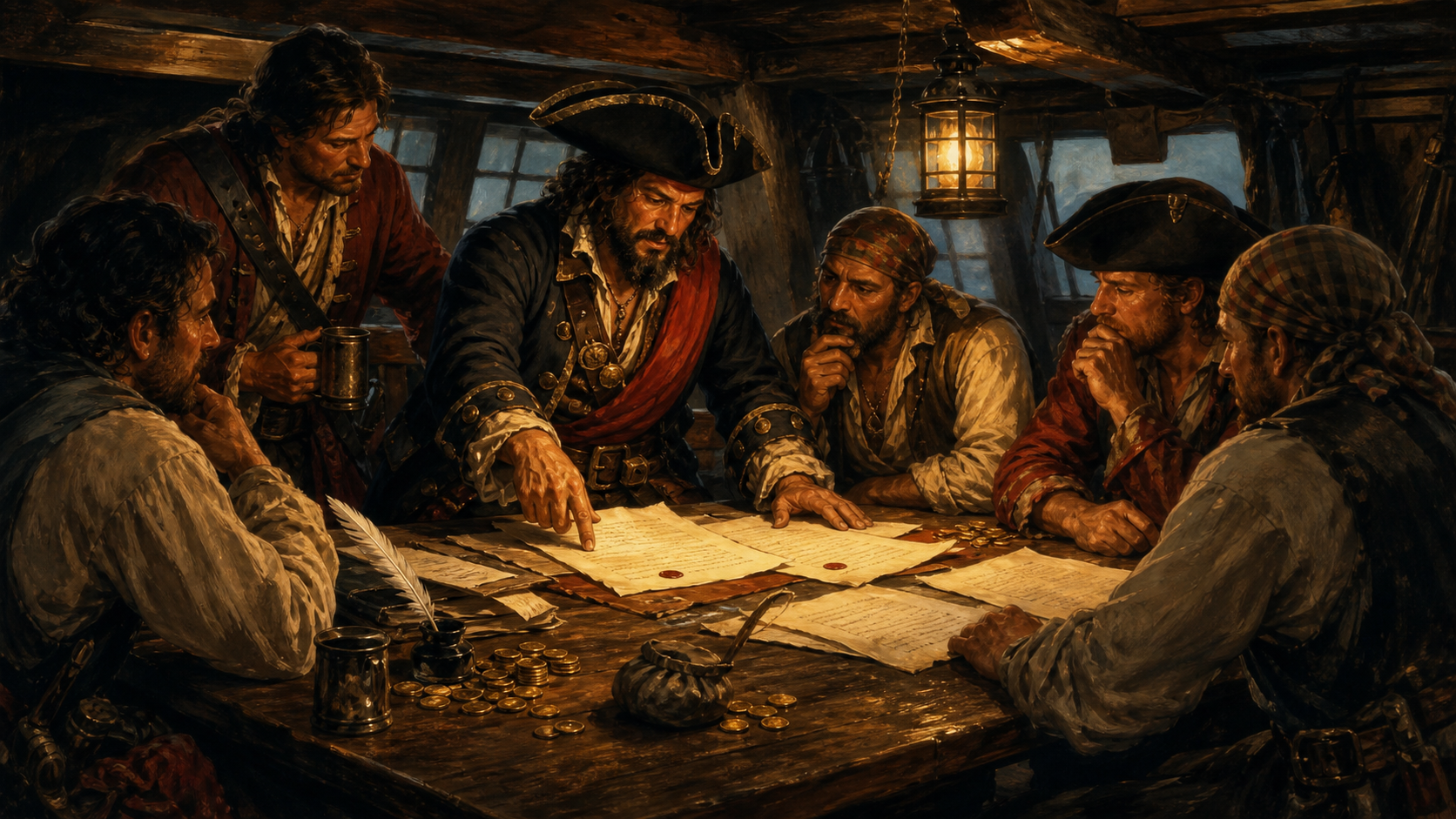
A pirate ship sounds like freedom until twelve armed men disagree about money in a room full of powder.
Then freedom discovers voting.
Pirate articles were not cute rules for charming rogues. They were working agreements for violent crews who needed to divide loot, settle disputes, control weapons, compensate injuries, limit chaos, and keep the whole criminal enterprise from eating itself before the navy arrived.
That is the funny part and the serious part at once. Pirates rejected a lot of legal authority, but they did not reject order. They could not afford to. A ship was a cramped workplace full of danger, greed, hunger, alcohol, weapons, suspicion, and men who expected payment. Without rules, the crew would become the first victim.
Pirates did not write articles because they secretly loved bureaucracy.
They wrote them because robbery required cooperation.
A pirate crew was a company, not a mob
The movie pirate ship is often pure disorder: shouting, drinking, knives in tables, someone swinging from a rope for no useful reason.
Real pirate crews could be chaotic, but successful piracy needed structure. Ships had to be sailed, repaired, supplied, armed, guarded, and navigated. Prizes had to be chosen, chased, intimidated, boarded, searched, stripped, burned, released, or taken. Captives had to be handled. Shares had to be divided. Arguments had to be controlled before they became murders at the wrong time.
A pirate captain could not simply command like a naval officer. Pirate crews often expected a voice in leadership and division of plunder. Captains could be elected or removed. Quartermasters could hold serious authority. Articles gave the crew a framework before money, fear, and rum made everyone inventive.
This does not make pirates noble democrats. It makes them practical criminals. Internal rules made outward violence more efficient.
That is the uncomfortable lesson. Order does not always serve goodness. Sometimes order helps bad men work together.
Shares mattered because greed needed math
Plunder was the point.
A crew that could not agree on division would not last. Pirate articles often set rules for shares: how much went to the captain, quartermaster, officers, specialists, ordinary crewmen, and sometimes the common fund. These arrangements varied, but the principle was consistent: everyone needed to know what the bargain was before the next prize came over the rail.
That mattered because pirate crews were not ordinary wage labor. The promise of a share was one of piracy’s great recruitment tools. Compared with brutal merchant or naval service, a pirate crew might offer more direct participation in profit. A sailor could risk hanging for a chance at a bigger return than legal work was likely to provide.
The share system also limited suspicion. If the rules were known, a captain had less room to quietly pocket too much. A pirate captain who cheated the crew was not a visionary leader. He was a man standing among armed employees with grievances.
Piracy was illegal, but payroll still mattered.
Injury compensation was grimly sensible
Pirate articles sometimes included compensation for injuries: a lost arm, a lost leg, an eye, or other wounds might be assigned a payment.
This detail is often presented as charming proof that pirates invented rough workers’ compensation. The truth is harsher. Pirate crews needed experienced fighters and sailors to risk their bodies. If a man knew injury meant abandonment, his enthusiasm for boarding actions might reasonably decline. Compensation helped make danger bearable enough for the next dangerous thing.
It also recognized a brutal reality: an injured sailor could lose his livelihood. A missing hand or leg in the eighteenth-century maritime world was not merely a medical problem. It was an economic catastrophe. Pirate compensation did not make the enterprise humane, but it did show that crews understood the cost of violence in practical terms.
A crew that paid for wounds was not gentle.
It was preserving confidence in the bargain.
Rules controlled weapons, drinking, and quarrels
A pirate ship was full of tools that could become murder very quickly.
Articles could regulate weapons, lights, gambling, drinking, fighting, and disputes. Some rules required quarrels to be settled ashore. Some restricted candles or open lights after certain hours, because fire aboard ship was not a metaphor. It was a catastrophe waiting for one careless flame.
These rules can sound almost domestic until one remembers the setting: wooden vessel, tar, canvas, powder, cramped quarters, armed men, stolen goods, and nowhere to step outside except the ocean.
The ship needed discipline because disorder was expensive. A drunken fight could kill a useful sailor. A careless pistol could start panic. Gambling debts could become personal enemies. Theft from the common stock could destroy trust. Desertion could weaken the crew. Fire could end everyone.
The pirate code was not a moral philosophy. It was risk management with cutlasses nearby.
Captains had power, but not unlimited power
Pirate captains were not always absolute tyrants.
In many crews, the captain’s strongest authority came during chase and battle. In those moments, hesitation could kill. The crew needed quick decisions. Outside battle, authority could be more negotiated. The quartermaster might represent crew interests, distribute provisions, settle disputes, or act as a check on the captain.
This is one reason pirate articles fascinate modern readers. They show men rejecting the harsh hierarchy of naval and merchant ships while building another kind of hierarchy for themselves. That hierarchy was rough, self-interested, and violent, but it was not always simple dictatorship.
Again, this should not be romanticized. Pirates could be cruel to captives and ruthless to outsiders. But internally, many crews understood that men who joined for shares and autonomy would not tolerate the same command culture they had fled.
A pirate captain had to lead men who were already in the business of rejecting authority.
That required tact, terror, success, or all three.
Bartholomew Roberts gives the clearest famous example
The articles associated with Bartholomew Roberts are among the best-known examples of pirate rules.
They describe shares, gambling, lights, weapons, desertion, quarrels, and compensation. They are not the constitution of all piracy, and they should not be treated as a universal pirate law code. Pirate crews varied. Sources vary. Some details survive because later printed accounts preserved them in forms shaped by their own purposes.
Still, Roberts’s articles matter because they reveal the kind of problems pirate crews had to solve.
How do armed criminals divide money? How do they prevent theft from each other? How do they reduce internal violence? How do they keep men ready for battle? How do they stop gambling, drinking, or private grudges from undermining the voyage? How do they make injury survivable enough for men to keep taking risks?
The answers were not always kind. They were practical.
Roberts is often remembered for scale and success. His articles help explain why scale was possible. Repeated piracy required repeatable order.
Democracy, but do not get carried away
Pirate democracy is one of the most attractive ideas in pirate history.
It is also one of the easiest to over-polish.
Yes, some pirate crews used voting, articles, shared decision-making, and limits on captain power. Yes, this could compare favorably with the brutal discipline ordinary sailors faced in merchant or naval service. Yes, it helps explain why piracy could be appealing to men who had experienced legal maritime labor as dangerous, underpaid, and humiliating.
But pirate democracy existed inside a criminal enterprise. It distributed power among robbers so they could rob better. It did not give votes to the crews they attacked. It did not protect captives from fear. It did not turn stolen goods into honest wages.
The interesting truth is not that pirates were secretly modern reformers.
The interesting truth is that even violent outlaws needed rules, and some of those rules answered real abuses in the legal maritime world.
That is more complicated than a slogan and much more useful.
Why the code became legend
The pirate code survived in memory because it gives piracy a strange dignity.
Without rules, pirates are only thieves. With articles, they become a society. A dangerous society, a predatory society, a society that might hang if caught, but still a society with expectations, rights, penalties, and rituals of agreement.
That is why the idea appears so often in books and films. It lets pirate stories feel like an alternative world rather than random crime. The code gives the black flag a constitution. It makes the ship into a rough republic, and audiences love rough republics when they do not have to live in one.
But the real code is better than the polished myth because it is more specific. It is not vague freedom. It is shares, wounds, candles, cards, pistols, quarrels, punishment, and profit. It is the daily mechanics of keeping men alive, dangerous, and pointed outward.
The romance says pirates had rules because they were colorful.
The record says they had rules because they were armed.
The rulebook under the black flag
Pirate articles reveal something larger about piracy itself.
The subject is often sold as rebellion against order. In practice, piracy was often rebellion against one order and the creation of another. Sailors rejected merchant captains, naval discipline, poverty, or national authority, then built shipboard systems that could support their own violent work.
That is why the code matters. It shows piracy as labor, organization, risk, and negotiation, not just attitude. It also reminds us that order and morality are not the same thing. A pirate crew could be more internally fair than a merchant ship and still be terrifying to everyone it attacked.
A pirate ship sounds like freedom until the loot is on the deck.
Then someone has to count.


