History feature
Historical route
Mediterranean corsairs brought ports, ransom, diplomacy, captivity, state power, and a serious shortage of movie posters.
Paperwork made the system durable
The Barbary corsair story is often simplified into a familiar maritime scene: armed ships, dangerous coasts, and raiders moving between commerce and war. That version is easy to recognize, but it hides the most important part of the history. The Barbary system was not only a matter of attacks at sea. It was also a Mediterranean system of captives, ransom money, treaties, safe-conduct passes, naval threats, religious pressure, state ambition, and governments deciding how to protect trade without spending more than protection was worth.
The distinction matters from the first paragraph because the labels are not interchangeable. A pirate is usually imagined as an outlaw acting for himself. A privateer acts under a commission. A corsair could be a raider whose violence was licensed, protected, or tolerated by a ruler. A state actor uses force as part of policy. In the Barbary world those categories could overlap, blur, and be argued over by everyone involved. The argument did not make captivity gentle. It made the system harder to dismiss as simple crime.
A Mediterranean system, not a stage set
When people say "Barbary corsairs," they are usually pointing toward the North African coast and ports such as Algiers, Tunis, Tripoli, and Sale. Those places were not one identical empire with one neat policy. Algiers, Tunis, and Tripoli lived in different relationships with Ottoman power and local rule; Sale belonged to a Moroccan Atlantic world with its own politics. They shared a broad maritime environment, but the details mattered. The Mediterranean was crowded with merchants, pilgrims, diplomats, naval officers, fishing boats, smugglers, captives, and crews who knew that law at sea depended on who could enforce it.
That is why the corsair story belongs beside diplomacy rather than only beside robbery. Raiding could bring goods, but captives were often the more durable form of pressure. A captured ship created an immediate loss. Captured people created a continuing negotiation. Families, religious redemption orders, consuls, merchants, rulers, and naval commanders could all be pulled into the process. A sailor taken at sea might become labor, ransom claim, diplomatic problem, propaganda, and financial burden at the same time. The violence was immediate, but its consequences moved through offices, letters, treasuries, and negotiations.
European states did not respond with one mind. Some paid. Some negotiated treaties. Some tried naval force. Many did all three at different times, depending on money, politics, naval strength, and what they could tolerate in public. Tribute and treaty gifts could look shameful, but they could also be cheaper than war and safer than leaving merchant crews exposed. A ruler who denounced piracy in one speech might quietly authorize payment in another room. The paper trail is not a side detail. It is the mechanism.
The geography helped make that mechanism possible. The western and central Mediterranean were full of short crossings, busy approaches, and coastal communities that lived by trade as much as by war. A ship leaving Spain, France, Italy, the Low Countries, Britain, or the young United States moved through a sea where flags, passports, treaties, and naval protection could decide whether a voyage looked ordinary or suddenly became a diplomatic emergency. The map was not just background. It was part of the pressure system.
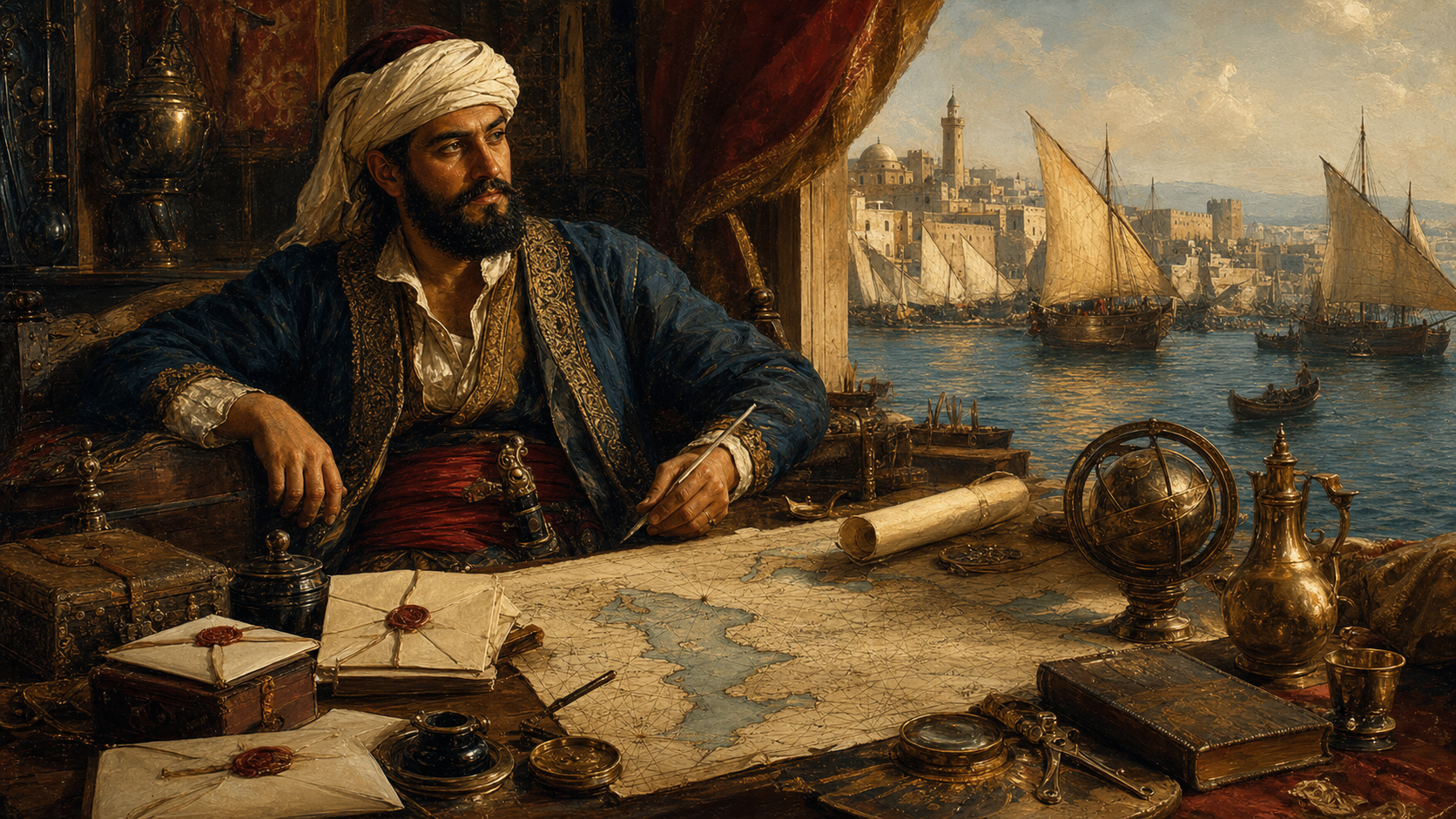
Ports also needed people who could translate violence into administration. Captains and crews carried out raids, but rulers, deylical courts, consuls, brokers, merchants, interpreters, shipowners, clerics, and family networks helped turn capture into money or leverage. That is why the story needs room. The drama is not only in the taking of a ship. It is in the weeks, months, or years afterward, when letters moved, envoys bargained, accounts were checked, and captives waited to learn whether anybody with money and authority could get them home.
Ransom made violence repeatable
Cargo could be sold once. A captive could keep producing pressure until the money, exchange, or policy concession arrived. That practical fact sat underneath the Barbary system. Captivity was not simply an accidental byproduct of raiding; it was one of the reasons raiding could become politically durable. The captive was a person in danger, but also a message sent to a family, a town, a consul, a king, a republic, or a church network. The system worked because the consequences of capture traveled far beyond the place of imprisonment.
That does not mean every captive had the same experience, and it does not mean every captivity account should be treated as neutral evidence. Some accounts were written to raise ransom money, stir religious feeling, sell books, justify retaliation, or emphasize the cruelty of an enemy. The record is real, but it comes through interested voices. A careful reading keeps both truths in view: captivity was brutal and politically useful, and the sources describing it often had agendas of their own. That distinction matters. We can say the system existed and mattered without pretending every later story is equally reliable.
Redemption networks show how ordinary people were dragged into the machinery. Catholic orders such as the Trinitarians and Mercedarians raised funds for captives. Protestant states developed their own diplomatic and financial channels. Consuls became negotiators, letter-writers, and accountants of misery. Families tried to gather money. Merchants and shipowners calculated risk. Governments weighed the cost of ransom against the cost of naval action. The captive in chains was the center of the story, but the system around that person reached into ports, treasuries, pulpits, and parliaments.
The sources can be strikingly administrative. Ransom was not only a moral appeal; it was a price, a schedule, a list, a promise, a delay, a dispute over who counted as valuable and who could be left waiting. Captivity narratives could become fund-raising documents. Official correspondence could turn suffering into numbers. Treaty language could speak politely about people whose lives had been made precarious. The result is a record in which human danger becomes paperwork without ceasing to be human danger.
It also shows why the word "empire" needs care. This was not one centralized pirate empire in the storybook sense. The stronger meaning is structural: a connected world of ports, rulers, raiders, payments, fear, and negotiated protection. Calling it an empire is useful only when the machinery beneath the metaphor stays visible. Otherwise the phrase becomes less precise than the history deserves.
Treaties did not make the sea orderly
A treaty could protect one flag while leaving another exposed. A payment could buy safer passage for a season, a route, or a group of ships without changing the larger balance of power. Safe-conduct papers, consular arrangements, tribute, gifts, and naval patrols all belonged to a world where maritime law was negotiated through force as much as principle. The result was not tidy. A merchant captain might care less about moral categories than about whether his papers would be honored before his crew was taken.
European powers had their own uncomfortable record here. Privateering, colonial violence, naval coercion, and commercial war were not inventions of North Africa. Christian states condemned corsair raiding while using licensed maritime violence when it suited them. That does not excuse captivity or ransom. It explains why the moral map is more complicated than a simple story of civilization attacked by pirates. The Barbary corsair system sat inside a larger Mediterranean argument over sovereignty, trade, religion, empire, and who had permission to use violence at sea.
The United States learned that lesson quickly after independence. American merchant ships no longer moved under British protection, and the new republic had to negotiate, pay, threaten, and eventually fight. The Barbary Wars are often told as a clean birth-of-the-navy story, but they also show the same hard arithmetic that older powers already knew. A flag did not protect itself by being morally confident. It needed money, treaties, ships, credibility, and the will to use them.
That American episode is useful because it strips away the idea that Barbary corsairing was a distant medieval leftover. This was an early modern and modern diplomatic problem that reached into the age of printed newspapers, national budgets, naval appropriations, and public argument. Americans debated payments, honor, commerce, and force. European states had been making similar calculations for generations. The pattern was embarrassing because it made sovereignty measurable: how much protection could a state actually provide once its merchant ship was beyond the horizon?
Treaty language could be humiliating, but naval force had its own costs. Bombardment might punish a port and still fail to solve the deeper system. Blockade could be expensive. War could interrupt the trade it was supposed to protect. Payment could look cowardly and still return captives faster than a campaign. The choices were rarely pure. That is what makes the subject more useful than a simple raider story. It is a study in limited options, which is where much of maritime history lives.
Why the labels still matter
Calling every Barbary raider a pirate is understandable and sometimes legally convenient, but it can hide the political structure that made the system last. Calling every raider a privateer can make captivity sound too polite, as if a commission settled the moral problem. Calling them corsairs is more historically useful, but even that word needs context. It points to licensed or semi-licensed maritime raiding, not to innocence. The word helps us see the machinery; it does not soften the damage.
Popular retellings often prefer the raid to the negotiation. A treaty is harder to dramatize than a duel. A ransom negotiation is less tidy than a treasure map. A consul counting captives does not offer an easy hero. Yet the paperwork is exactly what makes the Barbary story historically important. It shows violence passing through offices, ledgers, letters, seals, and public policy. The raid did not end when the ship was taken. In many cases, that was when the administrative part began.
The same point helps avoid a crude clash-of-civilizations version of the story. Muslim North Africa and Christian Europe were not fixed blocks staring at each other across a blue map. They traded, fought, negotiated, threatened, bribed, prayed, misrepresented each other, and calculated. Some people profited from the system. Some tried to escape it. Some used moral language while making practical deals. The careful version is sharper because it does not need simplified sides.
It also keeps the victims from turning into scenery. Captives were not just proof that a policy had failed. They were sailors, passengers, workers, and family members whose lives became entangled with decisions made far away. Some returned and told their stories. Some did not. Some accounts were shaped by memory, religion, politics, or the need to raise money. None of that makes captivity less real. It means the reader deserves clear language about what the record can support and where later retelling has added heat.
The ending was pressure, not enlightenment
The Barbary corsair system did not fade because everyone involved suddenly became gentler. It weakened under changing naval power, state pressure, treaties, bombardments, and imperial expansion. The nineteenth century brought heavier European intervention, including major naval attacks and, eventually, French conquest in Algeria. Those events changed the balance of power, but they did not turn the story into a simple moral victory. Empires that condemned captivity were also capable of building their own systems of coercion. The history moves through power, not moral improvement in a straight line.
That ending matters because it keeps the story from becoming costume history. The point is not that Barbary corsairs were secretly more glamorous than ordinary pirates, or that paperwork made them respectable. The point is that maritime violence can become a system when ports, rulers, merchants, captives, diplomats, and navies all have roles inside it. That system could be profitable, frightening, negotiated, condemned, and normalized at the same time.
The strongest telling leaves the reader with a calmer but sharper understanding than the headline alone can provide. The corsairs mattered because they forced states to show what their protection was worth. The captives mattered because the whole machine rested on human vulnerability. The treaties mattered because violence at sea often ended, not in a clean victory, but in negotiated paperwork. The paperwork mattered because it proved that the violence was not random noise. It was organized enough to be argued with.
That is the part that simplified versions often miss. A sea raid can look like a single event, but a ransom system is slower and more invasive. It reaches into households that must raise money, governments that must explain weakness, merchants who want predictable passage, and ports that depend on the threat remaining credible. The Barbary story matters because it joins the immediate violence of capture to the long patience of institutions. The ship, the treaty, the account book, and the person waiting for release all belong to the same history. None of those parts explains the system alone.
For the legal side of this problem, continue to the history of piracy, treaties, and maritime law. For an earlier Mediterranean ransom story with a famous hostage at its center, read Julius Caesar and Roman-era piracy. The useful lesson is the same in both directions: pirate history becomes clearer when we stop asking only who looked dangerous and start asking who had power, who paid, who wrote the agreement, and who was left waiting for a ransom letter.
<!-- Codex notes: - Import as draft only. Do not publish automatically. - Preserve attribution decision exactly as specified in frontmatter. - Review internal links against current Umbraco paths before publishing. - Source queue bucket: Blank-author, needs attribution decision - Audit note: Review for small clarity, evidence, and ending improvements without stretching the topic. -->


