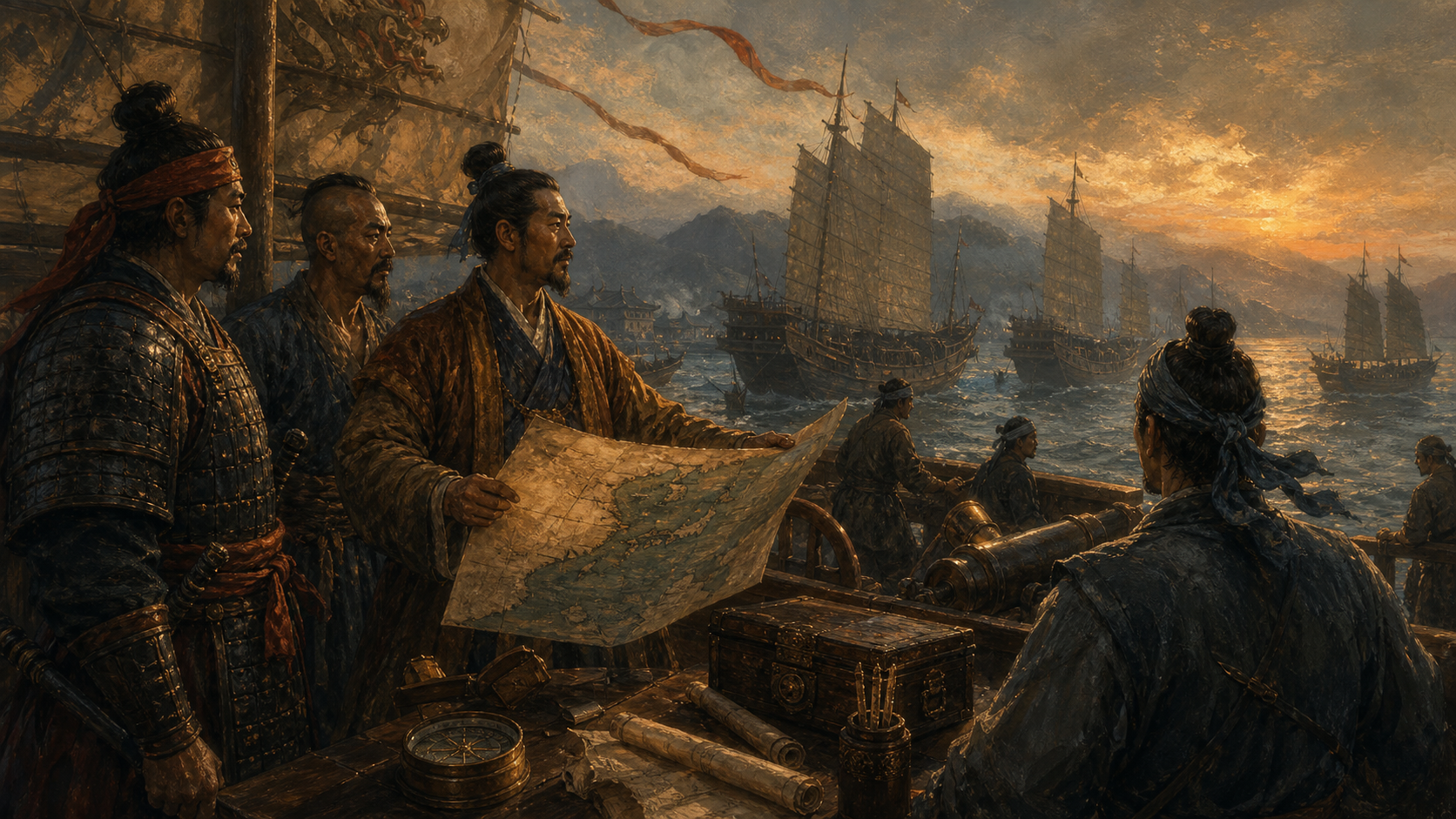
History feature
Historical route
Wokou pirates raided East Asian coasts, but many later groups were Chinese, mixed, or tied to smuggling, trade restrictions, and maritime politics.
Calling the wokou “Japanese pirates” is easy.
That is the problem.
The word itself points toward Japan, and Japanese islands did matter, especially in earlier phases of the story. But the label later covered something far messier: mixed maritime groups, smugglers, traders, Chinese participants, coastal networks, and a trade system that had started producing criminals because official policy had made ordinary commerce harder than appetite could tolerate.
Names are not neutral.
They preserve fear, geography, official language, and blame. They do not automatically give us a crew list.
So the better question is not “Were the wokou Japanese?”
The better question is why so many different people ended up sailing under a label that made the answer sound simpler than it was.
The name did real work
Wokou is often translated as Japanese pirates or dwarf pirates, reflecting a Chinese term associated with raiders from the direction of Japan.
In earlier periods, that association had real substance. Raiding from Japanese-linked bases and maritime actors did affect the Korean and Chinese coasts. Coastal communities suffered, and officials had reason to fear attacks that seemed to come from across the sea.
But the label kept traveling after the history grew more complicated.
By the sixteenth century, many so-called wokou groups included large numbers of Chinese participants and other maritime people working inside regional networks of smuggling, trade, violence, and evasion. Some were raiders. Some were merchants outside the law. Some were both depending on the day, the cargo, and who was describing them.
That is why the title matters.
The “Japanese pirates” were not always mostly Japanese.
The name had outlived its simplicity.
Trade restrictions helped make the problem
Piracy rarely appears from nowhere.
It grows where value, opportunity, weak enforcement, and blocked legal routes meet.
East Asian coastal piracy cannot be separated from trade policy. Ming restrictions on maritime trade created strong incentives for smuggling, illegal exchange, and collaboration between merchants and armed groups. When legal commerce narrows, illegal commerce learns to sail.
That does not make the violence imaginary.
Coastal communities suffered raids, kidnapping, extortion, and fear. People lost property, safety, and sometimes their lives. But the system was not only men with weapons. It was policy, markets, forbidden demand, weak enforcement, local survival, and coastal knowledge.
From the capital, a group might look like pirates.
From a shoreline village, the same men might look like smugglers, business partners, protectors, threats, or all of those before breakfast.
The coast made enforcement difficult
The Chinese coast was not a clean line on a classroom map.
It was a working world of islands, ports, fishing communities, trading routes, hidden anchorages, officials, families, merchants, and local powers. Geography mattered. Islands could shelter. Channels could conceal. Distance from central authority could turn enforcement into negotiation.
The best pirate places are rarely just hideouts.
They are ecosystems.
Wokou history shows this clearly. If there is demand for goods, a route to move them, people willing to risk punishment, and officials who cannot fully control the shoreline, piracy begins to look less like an exception and more like a symptom.
Ships did not only carry criminals.
They carried contradictions.
Smuggler, trader, pirate
One reason the wokou story is hard is that maritime categories shift under pressure.
A trader outside official rules may become a smuggler. A smuggler with armed protection may look like a pirate. A pirate may also trade. A local community may denounce raiders while buying from the same networks that keep them alive. Officials may call a group pirates because the word helps justify punishment, even when the underlying problem is bigger than robbery.
This is not special pleading for pirates.
It is how maritime systems work when law, geography, and market demand do not agree.
The violence was real. The victims were real. The official fear was real. But the ethnic shorthand hides the economic and political machinery that made the raids possible.
The phrase “Japanese pirates” turns a regional system into a foreign invasion story.
The stronger history shows policy failure, illegal trade, mixed crews, coastal collaboration, and violence feeding one another.
Why the correction matters
Correcting the label is not a footnote.
It changes the meaning of the story.
If the wokou were simply Japanese pirates, then the solution seems obvious: repel outsiders. But if many later wokou were Chinese smugglers, merchants, and mixed maritime groups working through regional networks, then the problem becomes more uncomfortable. It points back toward demand, regulation, enforcement, corruption, coastal poverty, and the limits of state power.
That is a much better pirate story.
Not because it is cleaner.
Because it is messier in the right direction.
Piracy often reveals where official systems are lying to themselves. The wokou problem exposed a gap between what governments wanted the sea to be and what coastal economies were willing to make of it.
The better truth
The wokou were not one simple people in one simple pirate costume.
They were a changing maritime problem attached to Japan, China, Korea, trade restrictions, smuggling, local economies, coastal geography, and official language.
Some were Japanese. Many later participants were not. Some were raiders. Some were smugglers. Some were traders who became criminals because the legal route had narrowed. Some were criminals using trade as cover.
That is the point.
The sea did not care about neat labels. It carried goods, fear, opportunity, and blame in the same hull.
The lazy version gives us “Japanese pirates.”
The better version gives us a coastline where policy failed loudly enough to put sails on the failure.


