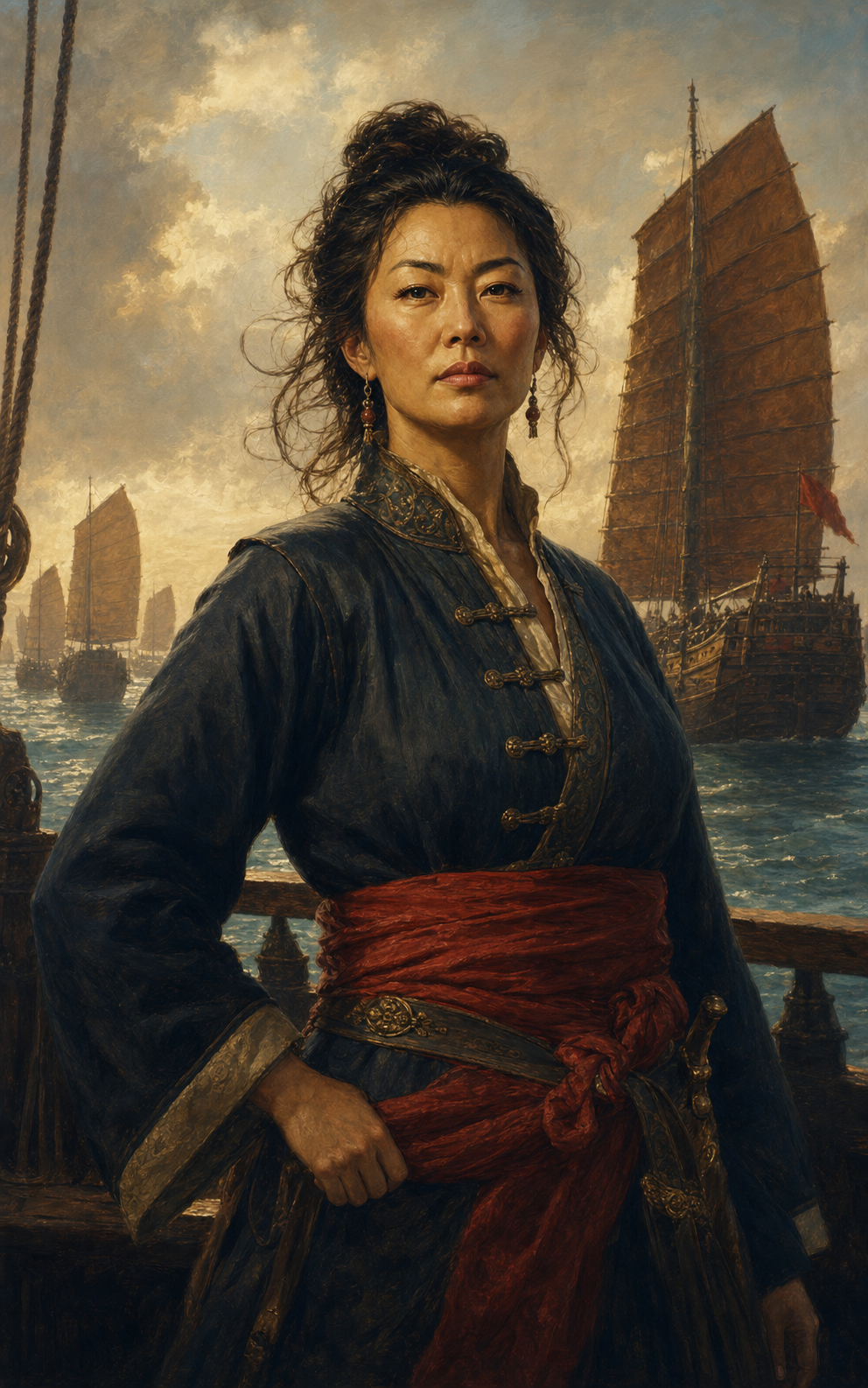
The story
Zheng Yi Sao Commanded Pirates at Scale. Then She Negotiated the Ending
By Krzysztof Wilczyński
Most pirate careers end with rope, wreck, prison, or a nervous official pretending the matter is closed.
Zheng Yi Sao’s story ends differently.
She did not become famous because she looked good in a hat. She became famous because she helped command power at a scale that makes many better-known pirates look like men causing trouble in a rowing boat. In the early nineteenth-century South China Sea, she was tied to a vast pirate confederation with fleets, rules, revenue, punishment, alliances, coastal pressure, and enough force to make governments bargain.
Blackbeard got smoke. Bartholomew Roberts got numbers. Zheng Yi Sao got terms.
That is why her story deserves more than the usual “pirate queen” label. The phrase is catchy, but it can make her sound like a decorative exception: a woman standing on a deck while history politely claps. The better story is colder and more impressive. Zheng Yi Sao was part of maritime organization under outlaw conditions. She survived a leadership crisis, helped preserve a dangerous coalition, and exited with wealth and status when many pirates were lucky to exit with a head.
Name, Record, and Reputation
Readers often meet her as Ching Shih, a Cantonese-style rendering that helped her travel through older English-language accounts. Zheng Yi Sao is the more historically useful name: “wife of Zheng Yi,” referring to her husband, the pirate leader Zheng Yi. That name itself tells us something. She entered the record partly through relationship, but she did not remain important because she was someone’s widow.
After Zheng Yi died in 1807, the organization could have shattered. Pirate coalitions are not made of romance. They are made of profit, fear, habit, family ties, personal ambition, discipline, and the shared belief that staying together is safer than breaking apart. Remove the central figure, and every rival suddenly discovers a strong interest in his own future.
Zheng Yi Sao’s importance begins there. The story moves the wrong way for a simple pirate legend. Instead of collapsing after the famous man dies, the confederation remains dangerous. She helped preserve authority through alliance, negotiation, marriage politics, and partnership with Zhang Bao, Zheng Yi’s adopted son and a major commander. That is not a tavern anecdote. That is political survival at sea.
The record is not perfect, and some details come through later retelling, translation, and the interests of officials who had reasons to make the pirates look either monstrous or manageable. That does not weaken the central claim. It sharpens it. The secure shape is already astonishing: Zheng Yi Sao was associated with a huge South China Sea pirate confederation, especially the Red Flag Fleet, and became part of an 1810 settlement that allowed many pirates to surrender under terms.
This Was Not One Ship With a Famous Flag
The usual pirate story is built around one captain, one ship, one flag, and one spectacular ending. Zheng Yi Sao’s world was larger and more difficult.
South China Sea piracy was not a single swaggering vessel appearing in moonlight. It involved fleets, coastal communities, ransom, markets, fishing and trading networks, officials, rival powers, families, informers, buyers, and ordinary people caught between fear and necessity. A confederation had to do more than frighten targets. It had to feed people, divide plunder, maintain discipline, manage information, punish betrayal, reward loyalty, and decide when violence helped and when it merely created expensive enemies.
That scale changes the story.
A lone pirate can survive for a while on boldness and luck. A maritime confederation needs structure. It needs rules about shares, stolen property, deserters, captives, sexual violence, and obedience. Accounts of Zheng Yi Sao’s organization often emphasize harsh discipline, and while individual regulations should be handled carefully, the broader point is hard to miss: order made the fleet more dangerous.
Romantic pirate freedom lasts until someone steals from the common store, abandons a vessel, hides loot, assaults a captive, or starts a private quarrel that threatens the whole operation. Then everyone suddenly discovers the value of administration.
The terrifying part is not that pirates had rules. The terrifying part is that rules made piracy work better.
Command After Crisis
Zheng Yi’s death created a test that destroys many violent organizations: succession.
A pirate confederation is full of people who know how to use force. That is useful when they are pointed outward and very inconvenient when they begin pointing at one another. Authority after a leader’s death has to be rebuilt quickly, visibly, and in terms that powerful subordinates will accept. Zheng Yi Sao’s achievement was not simply “being tough.” It was helping keep enough people aligned after the moment when alignment should have failed.
That required more than personal drama. It required coalition management. Zhang Bao mattered. Fleet commanders mattered. Coastal support mattered. Economic pressure mattered. The crews had to believe that obedience still paid. Rivals had to believe that defiance had costs. Officials had to believe that the organization was not collapsing quickly enough to ignore.
This is where the “pirate queen” label becomes too small. It gives the reader a crown when the better object is a ledger, a treaty, a punishment code, a chain of command, and a coastline full of nervous officials.
Zheng Yi Sao was not frightening because she was a woman in a man’s story. She was frightening because she helped make a maritime criminal system coherent enough that states had to treat it as a political problem.
Violence, Victims, and the Cost of Admiration
There is a temptation with Zheng Yi Sao to turn the whole page into applause. A woman commands at scale, negotiates survival, and refuses the usual gallows ending. It is a magnificent story.
It is also a story about predation.
The confederation’s power pressed on merchants, coastal communities, captives, officials, rival fleets, and ordinary people who had no reason to experience pirate organization as inspiring. Ransom and plunder are not harmless because the person managing them is impressive. A disciplined pirate fleet could be worse than a chaotic one precisely because it could keep returning.
That moral doubleness belongs in the profile. Zheng Yi Sao’s achievement is historically remarkable. It does not need to be morally polished into heroism. Pirate history becomes weaker when it mistakes effectiveness for virtue.
The better admiration is narrower and stronger: she understood power, maintained leverage, and helped convert danger into negotiation. That is enough. It does not need a halo.
The Negotiated Ending
The ending is the part that makes her almost rude to the usual pirate script.
In 1810, many pirates associated with the confederation accepted amnesty. Suppression alone had proved difficult enough that negotiation became useful. Officials wanted the pirate threat broken without endless expense. Pirates wanted survival, protection, wealth, rank, or simply an exit better than battle and execution. The settlement did not erase violence. It ended a maritime threat by making continued resistance less attractive than terms.
For a pirate leader, that was extraordinary.
Blackbeard died in a boarding fight. Bartholomew Roberts was killed off West Africa. Captain Kidd went to Execution Dock. Anne Bonny vanished into uncertainty after conviction. Zheng Yi Sao survived the ending. In later accounts, she kept wealth and lived beyond the violent collapse that consumed so many famous names.
That is not a sentimental conclusion. It is a practical one, which is more unsettling. She did not merely escape the law. She forced the world around her to make room for an exit.
Why Zheng Yi Sao Still Matters
Zheng Yi Sao matters because she widens the map and changes the scale.
She pulls pirate history away from a narrow Caribbean stage and into the South China Sea, where piracy could become confederation, coastal power, state pressure, and negotiated settlement. She also forces a better question than “Who was the fiercest pirate?” The better question is: who made governments adjust their behavior?
That is why she belongs beside, and in some ways above, the most famous Atlantic names. Blackbeard became the face of pirate terror. Roberts became the case study in repeated capture. Zheng Yi Sao became the case study in organized leverage.
For the wider gallery, return to Famous Pirates. For a comparison with theatrical terror, continue to Blackbeard. For the broader map of piracy beyond the Atlantic, the South China Sea belongs on the route through pirate geography.
The important thing is not that Zheng Yi Sao makes a better slogan than Blackbeard. She makes a better problem. Her story asks what piracy looks like when it stops being one ship and becomes a system. The answer is larger, harsher, and more impressive than the costume version ever allowed.
Most pirates hoped to survive the sea.
Zheng Yi Sao survived the ending.


