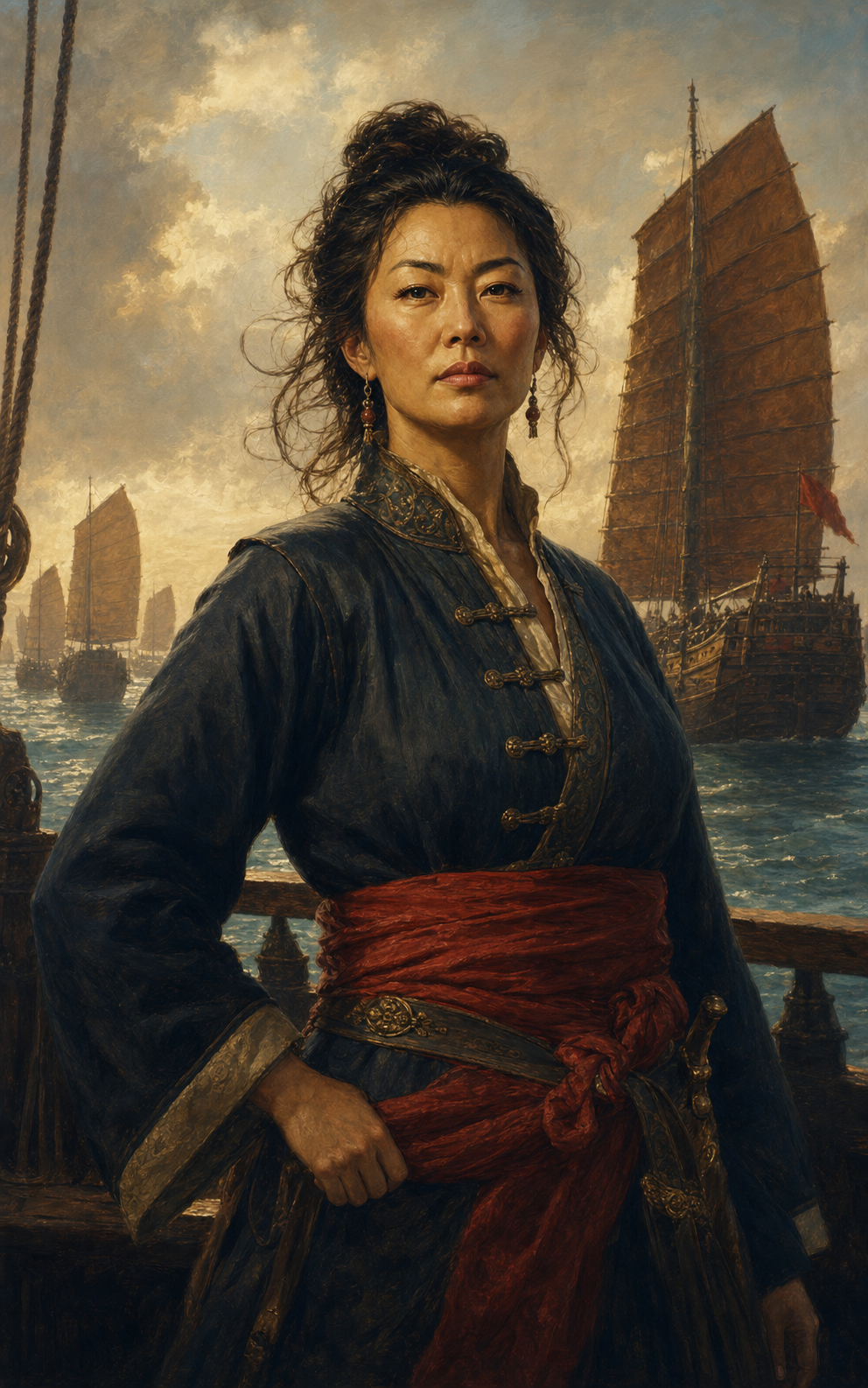
Most famous pirate stories know exactly where they are supposed to end.
There is a rope. There is a courtroom. There is a naval officer looking sternly satisfied. If the pirate is lucky, there is a last line good enough for later writers to steal. If the pirate is not lucky, there is a body placed somewhere public so everyone else understands the price of disobedience.
Zheng Yi Sao did not give history that ending.
Known in many older English retellings as Ching Shih, she became one of the most formidable figures in South China Sea piracy after the death of Zheng Yi. The story that survived is not just a tale of a woman entering a man’s world, though later readers have often reached for that easy frame. It is a story about coalition, discipline, coastal economies, state weakness, negotiation, and a pirate leader who helped turn danger into terms.
That is a much stranger ending than a rope.
Command After the Funeral
Zheng Yi’s death in 1807 could have shattered the organization he helped build. Pirate confederations were not tidy companies with neat replacement charts. They depended on loyalty, fear, profit, family ties, alliances, commanders, coastal support, and the continuing belief that cooperation was more profitable than betrayal.
Zheng Yi Sao’s achievement begins in that unstable moment. She did not simply inherit a romantic throne at sea. She helped preserve power after the death of the man whose name and network had anchored much of it. That required political intelligence as much as personal nerve.
Her alliance with Zhang Bao, Zheng Yi’s adopted son and an important commander, mattered. So did the wider organization around the Red Flag Fleet and the larger confederation of which it formed part. This was not one ship with a dramatic captain. It was a maritime system: many vessels, many crews, many incentives, many chances for the whole thing to split into smaller, weaker pieces.
Holding that together was the work.
Rules Made the Fleet More Frightening
Pirate romance loves freedom, but large pirate organizations run into a problem very quickly: freedom does not divide loot, feed crews, punish deserters, manage prisoners, or keep allies from stealing from one another.
That is why rules matter in Zheng Yi Sao’s story. Accounts of the confederation emphasize discipline around plunder, desertion, violence, and the treatment of captives. The exact wording and details require source caution, especially when later retellings sharpen them into legend. But the practical point is hard to miss. A fleet that large could not survive on swagger alone.
Order made piracy more durable.
That is the uncomfortable lesson. Discipline did not make the organization gentle. It made it harder to break. Rules gave commanders a way to control greed inside the fleet so that violence could be aimed outward. Romantic pirates drink, shout, and chase treasure. Dangerous pirates keep accounts, enforce obedience, and make sure everyone understands what happens when someone steals from the common store.
The terrifying part is not that pirates had rules. The terrifying part is that rules made piracy work better.
The South China Sea Was Not a Backdrop
Zheng Yi Sao’s world was not the Caribbean with different costumes. The South China Sea had its own routes, coastal communities, markets, officials, rival powers, fishing economies, smuggling systems, families, and political pressures. Pirate strength came from that environment.
Ships needed food, repairs, intelligence, buyers, shelter, and people on shore who could be frightened, paid, persuaded, or forced into cooperation. The line between sea and land was never as clean as legend makes it. A pirate fleet does not live on ocean spray. It lives on networks.
That coastal world also bore the cost. Ransom, robbery, intimidation, and disruption did not happen to abstract “trade.” They happened to crews, families, merchants, fishing communities, and local authorities trying to survive or profit inside the same system. A serious profile should not turn Zheng Yi Sao into a decorative pirate queen and leave the victims as scenery.
Her power was real because it touched daily life.
The State Had to Bargain
The Qing authorities, Portuguese forces, and rival fleets all belonged to the struggle around the confederation. Suppression was not simple. A fleet that could fight, flee, regroup, and draw from coastal networks was not easily erased by one expedition. The problem became political as well as military.
That is what makes the 1810 amnesty arrangements so important. Many pirates accepted terms. Zheng Yi Sao survived. In later accounts she retained wealth and lived beyond the kind of violent collapse that swallowed many Atlantic pirates. The ending was not sentimental. It was strategic.
A state bargains when the cost of continued fighting becomes high enough, or when negotiation offers a cleaner way to break a dangerous coalition. A pirate leader accepts terms when survival, wealth, and status look better than another season of risk. The result was not moral redemption. It was leverage converted into an exit.
Blackbeard got the posters. Zheng Yi Sao got terms.
Why the Legend Needs Restraint
The danger with Zheng Yi Sao is that the story is so large it invites lazy superlatives. “Most successful pirate” may be broadly defensible if success means scale, organization, and survival. But the phrase should carry evidence, not applause.
Her importance rests on more than gender. Her gender matters because women with authority at sea are too often treated as exceptions, miracles, or symbols before they are treated as political actors. But the better story is larger: she helped hold together a major maritime criminal organization, enforced discipline, navigated alliances, and participated in an ending that many famous pirates never came close to achieving.
That is more interesting than a flawless legend statue.
The record should be read carefully. Names vary across languages and older scholarship. Details move through translation and later retelling. Some episodes are firmer than others. None of that weakens the profile. It keeps the page honest.
The Ending That Changes the Whole Story
Zheng Yi Sao matters because she breaks the pirate script.
She does not simply teach us that a woman could be powerful in a violent maritime world. She teaches us that piracy could become administration, coalition, discipline, and negotiation. She forces the reader to look past the lone captain and toward fleets, rules, coastal economies, and the state’s practical limits.
For the shorter route through the facts, return to the main Zheng Yi Sao profile. For comparison, place her beside Blackbeard, whose career became immortal partly through performance, and Henry Every, whose disappearance turned absence into legend.
Zheng Yi Sao’s story is not clean, heroic, or morally comfortable. It is better than that. It is historically useful.
She did not become unforgettable because she escaped the pirate ending. She became unforgettable because she showed that, under the right conditions, a pirate leader could make governments sit down and bargain.
