The story
Blackbeard Used Fear Like a Weapon. Then the Legend Took Over
By Krzysztof Wilczyński
Blackbeard did not need a long career.
He needed a terrifying image, a useful coast, a powerful ship, and just enough time for fear to learn his name.
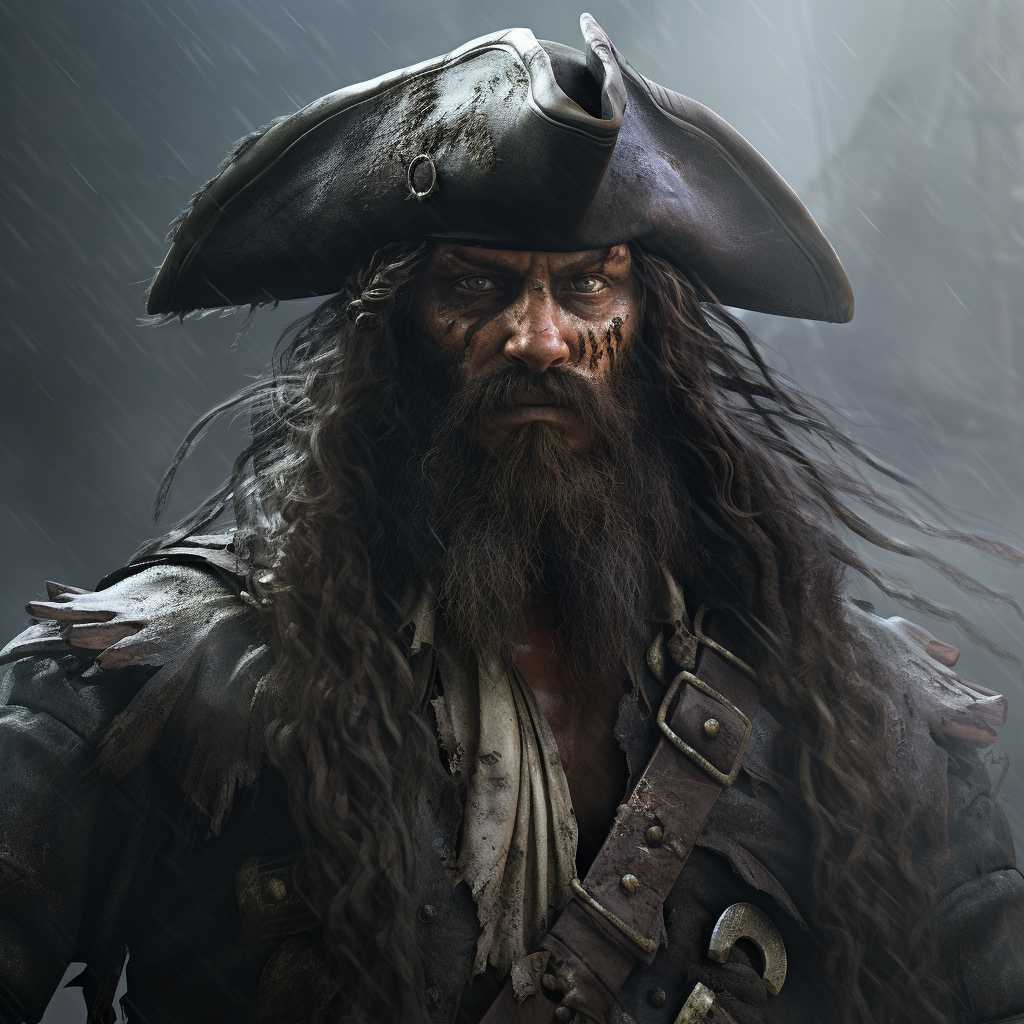
Edward Teach, or Thatch in some early records, was active as a major pirate captain for only a short period, roughly from 1716 to 1718. That should make him a footnote beside pirates who captured more ships, commanded larger forces, or shaped wider regions. It does not. Blackbeard became the pirate people picture first: beard, smoke, pistols, black flag, violent death, severed head, and a legend that kept adding fog after the body was gone.
The trick is that the legend did not come from nothing.
Blackbeard understood something practical about piracy: fear could do work. It could board a ship before the pirates did. It could make a merchant captain surrender before sails, rigging, cargo, and bodies were ruined in a fight. It could make governors nervous, ports embarrassed, and later writers reach for ink with both hands.
The famous image may be polished by retelling. The method was real enough to matter.
Edward Teach, or Thatch
The man behind the name is harder to see than the poster.
Edward Teach is the familiar form, though Thatch and other spellings appear in early material. That is not a mystery worth overdecorating. Names in eighteenth-century documents were often flexible, especially when they passed through officials, printers, sailors, and rumor. The uncertainty is useful because it reminds us that Blackbeard feels clearer in art than he does in the archive.
His early life is thin. Later writers often place him in Bristol, but the record does not hand us a neat childhood scene. There is no need to invent one. The documented shape is dramatic enough: he emerged from the Atlantic maritime world after years of war had trained sailors in armed violence, prize-taking, and rough command.
Queen Anne’s War had ended. Peace reduced legal opportunities for men who knew ships, guns, boarding, and risk. Some returned to merchant service. Some drifted. Some crossed from privateering habits into piracy, where the paperwork was worse but the shares could be better.
Blackbeard did not invent that world. He used it.
He appears in association with Benjamin Hornigold, one of the important pirate captains operating from the Bahamas. By 1717, Teach was rising into command. He had the useful mixture: maritime skill, nerve, theatrical intelligence, and a sense that reputation could be more efficient than slaughter.
Queen Anne’s Revenge
The capture of the French slave ship La Concorde gave Blackbeard the object his legend needed.
He renamed her Queen Anne’s Revenge and turned her into a heavily armed flagship. That ship gave him scale. A small pirate vessel could raid and run. A larger armed ship could intimidate, blockade, command attention, and make colonial officials sweat into their collars.
But the ship’s earlier life matters. La Concorde had been part of the Atlantic slave trade. Blackbeard did not step into a clean adventure story when he captured her. He stepped into a brutal economy of forced labor, disease, imperial trade, and human suffering, then repurposed one violence for another.
Pirate romance often borrows its treasure from uglier systems and then pretends the gold arrived wearing a cheerful hat. A serious profile should not let that happen. Queen Anne’s Revenge was dramatic, but it was not innocent.
The wreck believed to be Queen Anne’s Revenge was found off North Carolina in the 1990s, giving the Blackbeard story a rare material anchor. Cannons, fittings, and seabed evidence cannot explain his motives, but they pull him out of pure folklore. Blackbeard was not only a smoky beard in an illustration. He was a captain operating a real ship in a real coastal geography.
That geography mattered almost as much as the ship.
Fear Was Practical
The famous story of Blackbeard putting slow matches in or near his beard survives because it is almost too good. It gives the audience a devil at the rail, smoking before the gates of hell open.
The exact staging should be handled with caution. The practical lesson is stronger than the costume. Blackbeard cultivated terror because terror saved time.
A fight was expensive. It could damage rigging, hull, cargo, and men. It could waste powder and invite resistance. A frightened target might surrender quickly. A crew that believed Blackbeard would be worse if resisted might choose obedience before the boarding party arrived.
That does not make him harmless. Intimidation is not a clever brand strategy to the people being intimidated. It is armed coercion. Captains, crews, passengers, and port communities experienced the threat as danger, not theater.
The theater worked because the violence behind it was credible.
Blackbeard’s genius, if that is the right word for something so ugly, was making the imagined violence arrive early.
Charleston: The Pirate Outside the Door
Blackbeard’s blockade of Charleston in 1718 shows his method at full strength.
He and his vessels seized ships outside the harbor, held prominent prisoners, and demanded medical supplies. That demand can sound oddly small if someone is expecting diamonds and gold. It is more revealing than treasure. Pirate crews had bodies: sick bodies, wounded bodies, infected bodies, exhausted bodies. Medicine was not a punchline. It was operational.
Charleston mattered because it turned a wealthy colonial port into a hostage situation without requiring Blackbeard to conquer the city. Ships needed harbors. Ports needed traffic. Merchants needed routes. Governors needed authority to look real. Blackbeard pushed on all of those dependencies at once.
The city had to respond because visible weakness was itself dangerous. A colonial port that could be stalled by pirates had not merely lost goods. It had been seen losing control.
Blackbeard withdrew after the demand was met. That ending matters. The point was not random destruction. It was targeted coercion: obtain supplies, reinforce reputation, avoid unnecessary damage, and leave everyone telling the story.
The legend remembers the boldness. The event itself shows something colder: a pirate commander solving a practical supply problem while advertising his reach.
North Carolina and the Shore-Side Problem
After the grounding or loss of Queen Anne’s Revenge near Beaufort Inlet, Blackbeard’s story turned toward North Carolina, pardons, local politics, and the uneasy border between retirement and renewed crime.
He accepted a royal pardon, at least formally, and spent time around Bath. That does not mean he stepped politely into lawful life. The record and later interpretation have long raised questions about local protection, smuggling, and Governor Charles Eden’s circle. A careful article does not need to pretend every accusation is settled. It can say something firmer and more useful: piracy was never only offshore.
Pirates needed ports, buyers, information, repairs, food, water, and places where stolen value could become usable money. Coastal communities could be frightened, tempted, or compromised. Officials might lack resources. Merchants might prefer profit to purity. Neighbors might see a pirate as threat, customer, embarrassment, or opportunity depending on the day.
That shore-side world explains why Blackbeard irritated Virginia as well as North Carolina. A pirate who could rest in one colony could become another colony’s problem. Governor Alexander Spotswood of Virginia wanted him removed. That decision set the final hunt in motion.
Ocracoke and the Head on the Pole
On November 22, 1718, Lieutenant Robert Maynard led a force against Blackbeard at Ocracoke.
The fight was brutal, close, and useful to legend. Shallow water mattered. Smaller vessels mattered. Timing, local knowledge, deception, and boarding mattered. Blackbeard was not defeated by a clean duel in a dramatic spotlight. He was trapped in a hard practical fight where terrain and information mattered as much as courage.
Accounts of his wounds became part of the legend because they suited the ending. The monster had to be hard to kill. The body had to prove the story. His head was displayed from Maynard’s vessel as a warning, which is one of the grim symmetries of pirate history. Blackbeard had used visibility to terrify others. Authorities used his remains to announce that the performance had ended.
Then came the afterlife.
Stories claimed his headless body swam around the ship before sinking. That belongs to legend, not the firm record. It survives because the death needed to match the image. A man built out of smoke and terror could not simply fall down. Popular memory wanted one last impossible gesture.
History does not need it. The documented ending is already sharp enough: a feared pirate captain died in a violent boarding action, and the state turned his body into public messaging.
Why Blackbeard Still Matters
Blackbeard was not the most successful pirate by every measure. He did not command the largest confederation. He did not have the longest career. He did not need to.
He became the case study in terror as a tool, and then the tool became a legend.
His story joins several forces at once: postwar maritime labor, privateering habits, Atlantic slavery, colonial weakness, coastal geography, intimidation, pardons, local politics, naval pursuit, print culture, and supernatural aftertaste. Reduce him to a Halloween logo and the history disappears. Reduce him to a list of crimes and the cultural power disappears. The better profile keeps both: the violent operator and the legend factory that made him larger than his record.
For a comparison with material evidence and shipwreck, continue to Samuel Bellamy. For the strange comedy of bad command near Blackbeard’s orbit, read Stede Bonnet. For the wider gallery, return to Famous Pirates.
Blackbeard’s career was short. His reputation was efficient.
That may be the most frightening thing about him. He understood how fear travels, and history proved him right by carrying the image long after the man was gone.


