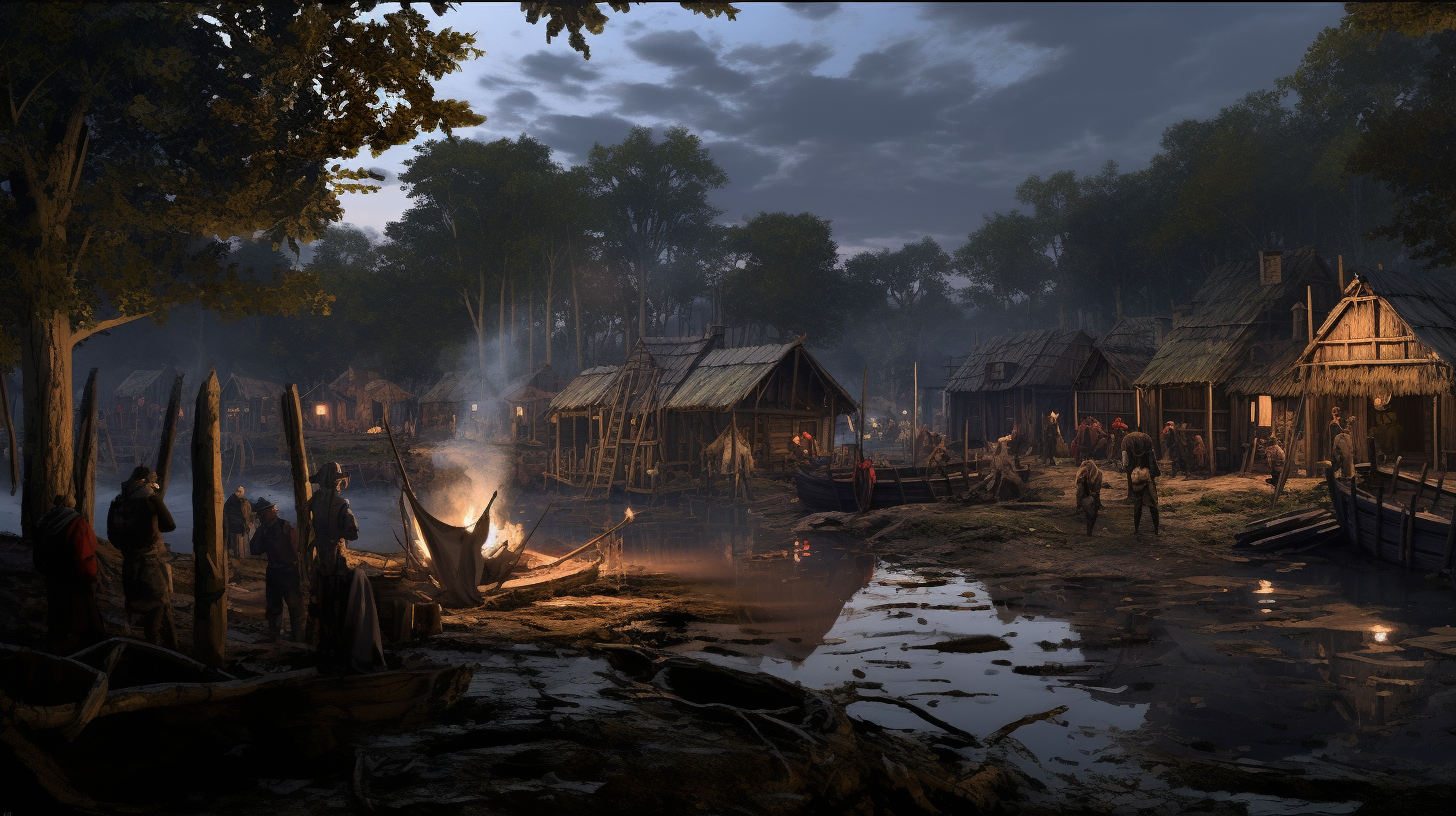
Blackbeard survives because he looks impossible.
The beard. The smoke. The pistols. The huge reputation packed into a career so short it almost feels like history is cheating. Edward Teach — or Thatch, as some early spellings have it — did not need decades to become the face most people imagine when they hear the word pirate. He needed about two years of serious terror, a captured slave ship turned flagship, a spectacular blockade, a bloody death, and later writers willing to keep adding smoke.
The result is one of the cleanest silhouettes in pirate history.
The trouble with clean silhouettes is that they hide machinery.
The Man Is Thinner Than the Image
Blackbeard’s early life is frustratingly difficult to pin down. Later writers often place him in Bristol and give him a birth around 1680, but the evidence does not let us build a neat childhood scene with confidence. That silence matters. It is tempting to invent the missing boy because the adult is so vivid. Good history resists the temptation.
What can be said more safely is that Teach emerged from the hard Atlantic world shaped by war, trade, privateering, harsh maritime labor, and uneven colonial authority. Queen Anne’s War had trained men in armed work at sea. Peace reduced legal opportunities without removing the skills, resentments, or appetite for prize-taking.
Piracy grew in that crack.
Teach appears clearly in the pirate world around Benjamin Hornigold and then rises into command. That rise suggests skill. Pirate captains did not survive by hats alone. They needed to find prizes, manage crews, judge danger, handle supplies, and make the next target believe surrender was wiser than resistance.
Blackbeard’s gift was making fear useful.
Terror Was Not Decoration
The famous image of Blackbeard with slow matches smoking around his face is usually treated as madness, theater, or proof that the man was half-devil by choice. The practical explanation is more interesting.
Pirates preferred surrender. A fight could damage cargo, rigging, hull, crew, and profit. A terrified merchant captain might strike colors before anyone had to die. Terror was not separate from the business. It was part of the business.
That does not make Blackbeard harmless. The threat worked because the violence was real. Armed coercion at sea is still coercion, even when the attacker understands stagecraft. Captives did not experience the smoking beard as clever branding. They experienced a dangerous man using reputation, weapons, and uncertainty to make resistance feel expensive.
The legend is useful when it points back to that practical truth. Blackbeard’s theatricality mattered because it solved problems: communication at distance, intimidation before boarding, crew confidence, and the conversion of reputation into compliance.
He did not simply look frightening. He made fear do work.
Queen Anne’s Revenge Gave the Legend a Body
The capture of the French slave ship La Concorde in 1717 gave Blackbeard the vessel most tied to his fame. Renamed Queen Anne’s Revenge, she became the physical center of his power for a brief but intense period.
The ship’s earlier role in the slave trade must stay visible. Pirate romance often likes to imagine treasure floating in from nowhere, as if wealth arrives wearing a sash and humming a sea shanty. La Concorde belonged to a violent Atlantic economy built on forced labor, disease, commerce, and imperial profit. Blackbeard did not step into a clean adventure. He repurposed one violence for another.
Queen Anne’s Revenge mattered because size mattered. A larger armed vessel could intimidate smaller ships, support a squadron, carry men and supplies, and make colonial officials nervous. It gave Blackbeard a presence that exceeded the ordinary raider.
But it was not a magical fortress. Ships required maintenance, pilots, crews, food, water, ammunition, and suitable waters. The flagship enlarged Blackbeard’s reach, but the man still depended on geography, information, crew discipline, and local weakness.
That is the shape behind the silhouette.
Charleston Was a Practical Humiliation
Blackbeard’s blockade of Charleston in 1718 is one of the clearest examples of his method. He did not need to conquer the city. He held ships and hostages outside the harbor and demanded medicine.
Medicine sounds almost disappointingly practical if one expects pirates to demand rubies and gold plate. That is exactly why it matters. Pirate crews were bodies: wounded, sick, feverish, hungry, exhausted, and exposed. Medicine could be more useful than a decorative treasure chest.
The blockade embarrassed colonial authority. Ships could not move freely. Prominent hostages were in danger. Officials had to decide whether delay was worth the risk. Blackbeard turned a harbor into a negotiation and made a wealthy colonial city feel the limits of its protection.
The episode shows why he mattered. He understood dependencies. Ports needed traffic. Merchants needed routes. Governors needed authority to look real. Blackbeard pushed on those weak points and made a short career feel larger than its calendar.
North Carolina and the Problem of Shore
After the loss or grounding of Queen Anne’s Revenge near Beaufort Inlet, Blackbeard’s story moved into North Carolina, pardons, local relationships, suspicion, and political irritation.
This part is less cinematic than the smoking beard, but it is essential. Pirates did not live only at sea. They needed places to trade, hide, repair, gather information, and turn stolen goods into usable value. Shore was not the opposite of piracy. Shore was part of the system.
Blackbeard accepted a pardon, at least formally, and spent time around Bath. Later interpretations have long raised questions about local officials and possible protection. The safest account does not need to pretend certainty where the evidence is contested. It can say something more useful: piracy often survived because coastal politics, local interests, weak enforcement, and profit did not always line up neatly with imperial law.
A wanted pirate was not always a stranger. He could be a customer, neighbor, threat, source of goods, political embarrassment, or opportunity.
That ambiguity helped make him dangerous.
Ocracoke Gave the State Its Answer
On November 22, 1718, Lieutenant Robert Maynard led a Virginia-backed expedition against Blackbeard at Ocracoke. The fight was close and bloody. Blackbeard was killed. His head was displayed as a warning.
That display was not an afterthought. It was communication.
Blackbeard had used visibility to make people afraid. Officials answered with their own spectacle: pursuit, battle, death, body, warning. Pirate suppression was not only practical. It was theatrical in its own right. The state wanted sailors, merchants, and coastal communities to see that the performance had ended.
Naturally, the legend refused to stay dead. Stories of the headless body swimming around the ship belong to the afterlife of the tale, not the firm record. They survive because the death of Blackbeard seemed to demand one more impossible image.
The documented ending is strong enough. A feared pirate captain died in a violent boarding action, and his enemies turned his body into public policy.
Why the Legend Won
Blackbeard’s legend won because it was efficient.
A name. A beard. Smoke. Pistols. A flagship. Charleston. Ocracoke. A severed head. History rarely gives popular culture such a ready-made package, and popular culture rarely declines a gift.
But the better story is not smaller than the legend. It is larger. Blackbeard shows how privateering skills, Atlantic commerce, slavery, colonial weakness, maritime labor, coastal geography, intimidation, print culture, and state spectacle all lashed themselves to one man’s image.
He was not the richest pirate. He was not the longest-running pirate. He did not command the largest pirate organization. His genius was different. He understood how fear travels.
Then history proved him right by carrying the image long after the man was gone.
