Blackbeard’s death did not need improvement.
History had already provided shallow water, a surprise attack, a wounded sloop, hidden men below deck, close combat, a severed head, and a coastline eager to turn violence into warning. Later legend added the headless body swimming around the ship, because apparently the ending was not theatrical enough for people who require their pirates to keep working after decapitation.
The documented story is better.
It is also more useful. Blackbeard’s final fight shows how pirate suppression actually worked: not through one grand navy scene, but through local politics, shallow-water tactics, intelligence, small vessels, brutal boarding, and the public display of a dead man who had made fear his business.
Why Virginia came for him
By 1718, Blackbeard was not simply a frightening man with a dramatic beard. He was a political problem.
After the grounding of Queen Anne’s Revenge and his period around North Carolina, Edward Teach — or Thatch, in some early records — occupied an uncomfortable space between pardon, suspected piracy, local protection, and coastal rumor. North Carolina’s inlets and sounds gave him room to move. Local relationships may have given him room to breathe. Neighboring Virginia had less patience for the arrangement.
Governor Alexander Spotswood wanted Blackbeard removed. That decision matters because it shows piracy as a land problem as much as a sea problem. Pirates needed shores: places to rest, repair, trade, gather information, and blur their legal status. Officials needed authority to look real. Merchants needed routes to feel usable. When a pirate became too visible near those interests, someone eventually had to turn rumor into action.
Spotswood sent Lieutenant Robert Maynard with small vessels suited to the shallow waters around Ocracoke. That choice was practical. A heavy warship looked impressive in deep water and useless in the wrong inlet. Pirate suppression often depended on matching the geography rather than simply bringing the biggest guns to the argument.
Ocracoke was not a clean duel
The popular imagination wants Blackbeard’s last fight to be a duel between two men: Teach and Maynard, villain and hunter, smoke and steel.
The real fight was messier.
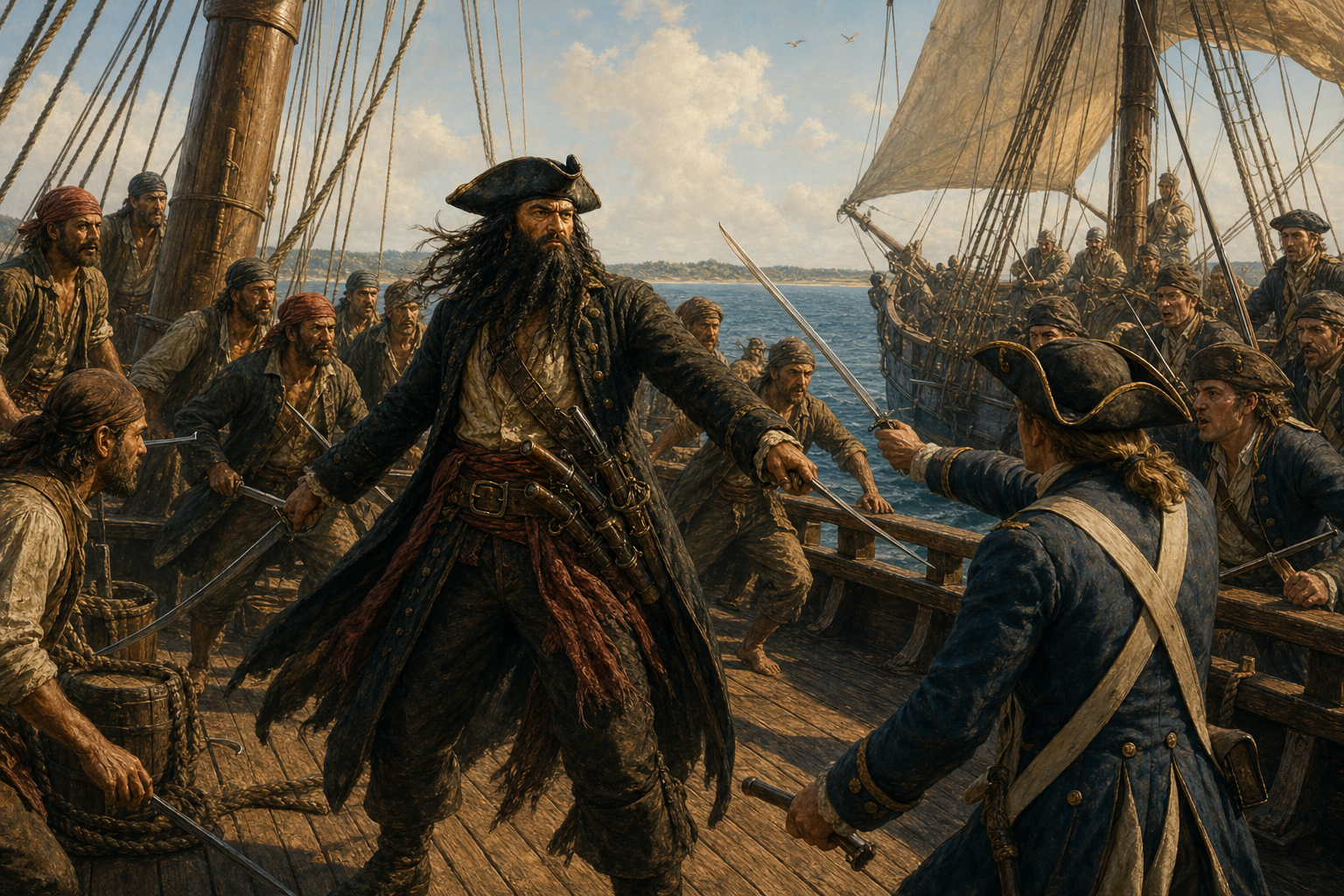
Maynard’s force approached Blackbeard near Ocracoke in November 1718. Accounts vary in detail, but the broad pattern is clear enough: shallow water, difficult maneuvering, gunfire, deception, boarding, and violent hand-to-hand combat. Blackbeard’s vessel had the advantage of cannon. Maynard’s vessels were smaller and lightly armed, but he used concealment and timing to draw the pirates into a fight they did not fully understand.
The famous tactic was hiding men below deck so Blackbeard’s boarding party would think the vessel had been devastated by fire. When the pirates came aboard, the hidden sailors emerged and the fight closed. At that range, romantic swordplay loses its manners. Pistols misfire or empty. Cutlasses become tools of survival. Men slip, shout, bleed, and die too quickly for speeches to remain tidy.
Blackbeard was killed in the melee. Reports of multiple wounds became part of the legend, because a man remembered as half-devil needed a death that looked hard to accomplish. The exact count matters less than the function of the story: he fell violently, in public action, under the force of men sent to end him.
The head was the message
Maynard did not bring Blackbeard’s head back as decoration.
He brought proof.
A pirate captain who had used visibility, terror, and reputation now became a visible warning himself. His severed head was displayed from Maynard’s vessel and later associated with the grim public messaging of suppression. This was not a private death. It was policy with blood still on it.
Pirates understood spectacle. Flags, reputations, violence, and rumor could make a victim surrender before a costly fight. States understood spectacle too. Trials, gallows, chains, displayed corpses, and severed heads told sailors and coastal communities that the law could still reach into the water.
Blackbeard’s head reversed his own method. He had made fear travel ahead of him. Authorities made his death travel after him.
The ghost story arrived on schedule
Naturally, legend was not satisfied.
One of the most famous after-stories says Blackbeard’s headless body swam around the ship before sinking. It is exactly the kind of detail pirate memory adores: impossible, visual, morbid, and perfectly tailored to a man whose reputation already smelled of smoke and brimstone.
It should be treated as legend.
That does not make it useless. Ghost stories often reveal what people wanted the death to mean. A normal corpse would have been too small for Blackbeard’s afterlife. The swimming body turns him into something beyond punishment, as if even decapitation could not persuade the legend to sit down.
But the documented ending is stronger. It shows a feared captain killed by tactical planning, local politics, and close violence. It shows a body turned into proof. It shows the state answering pirate theater with its own uglier stagecraft.
Why this ending stuck
Blackbeard’s career was short compared with many famous pirates, but his ending was almost perfectly built for memory.
There was the hunted outlaw. The dangerous coast. The small force entering difficult water. The trick. The boarding. The wounds. The head. The rumor afterward.
It compressed the whole Blackbeard problem into one scene: performance, violence, geography, politics, and legend. That is why the story keeps returning. A pirate who had made himself larger than life was finally reduced to a body part on a pole, and somehow that only made him larger.
The better route is not to drain the scene of drama. It is to put the drama where it belongs. Blackbeard did not die because a myth required a final act. He died because colonial authorities decided that his presence had become intolerable, and because Maynard’s men managed the ugly work of reaching him.
For the broader context, return to the main Blackbeard profile. For the ship that made his name visible, follow Queen Anne’s Revenge. For other endings where pirate bodies became public lessons, move toward pirate hangings and the machinery of punishment.
Blackbeard’s head went on a pole. The legend got worse because history had given it the one thing legends love most: an ending that already looked invented.
