History feature
Historical route
The Barbary corsair world was built on ransom, diplomacy, war, religion, commerce, and paperwork, not movie-style pirate anarchy.
Pirate empires are supposed to arrive with cannon smoke.
The Mediterranean version also arrived with forms.
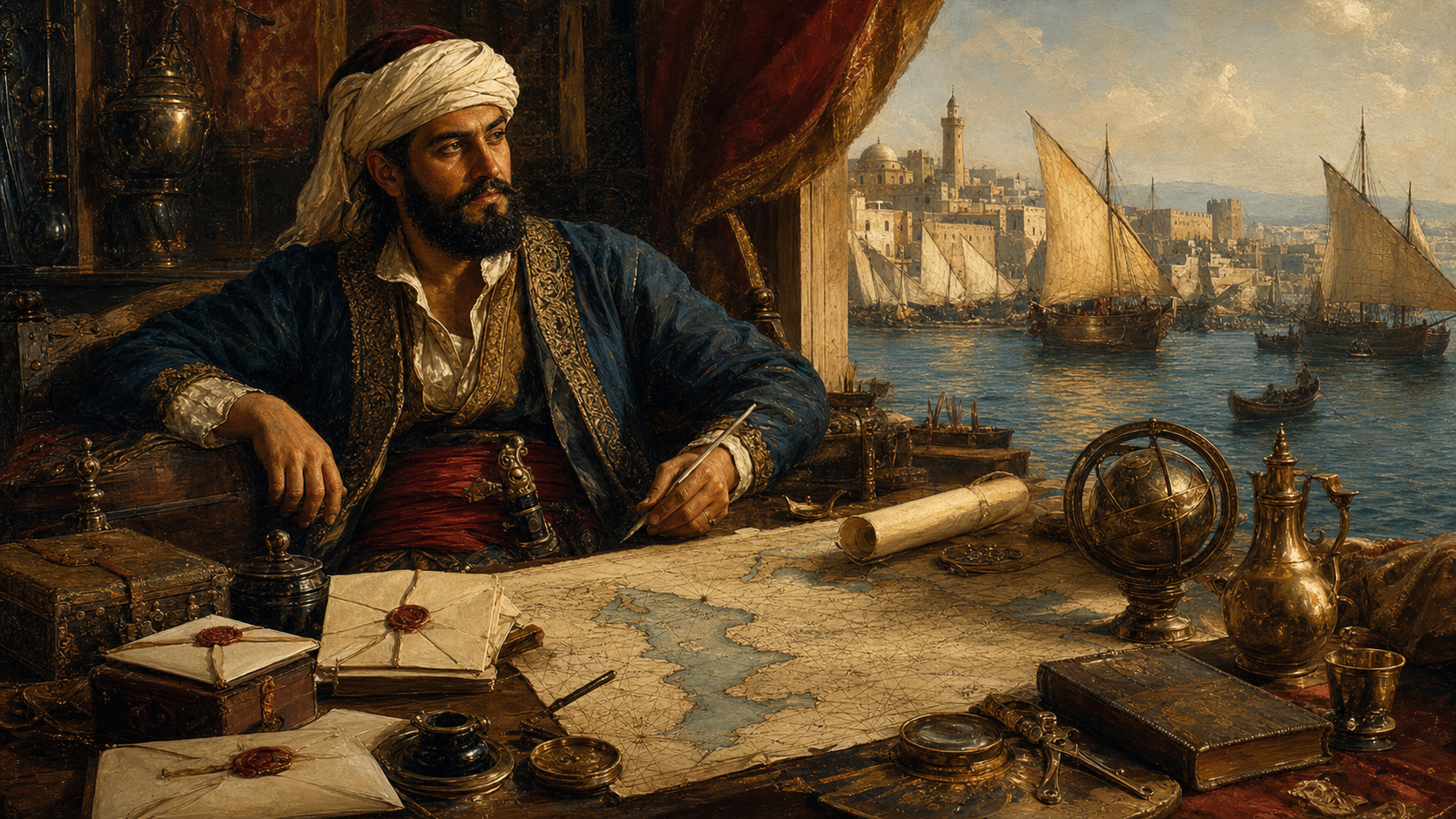
That is the part movies usually skip. They like the raid, the chase, the prison, the rescue, and the dramatic horizon. They are less interested in the petitions, consuls, letters, treaties, receipts, tribute payments, religious orders, diplomatic complaints, and ransom accounts that made the Barbary corsair world durable.
But that paperwork is not dull background. It is the machinery.
A captured sailor did not simply vanish into a dungeon-shaped adventure. He entered a system. His family might raise money. A consul might negotiate. A religious order might redeem captives. A ruler might use him as leverage. A government might complain, pay, threaten, bargain, or retaliate. The violence happened at sea, but the consequences moved through desks, ports, churches, courts, and state offices.
The movie version gives us pirate chaos.
The real version is worse: violence organized well enough to keep accounts.
The movie version
The familiar version turns the Barbary corsairs into exotic sea villains: fast ships, cruel captains, frightened captives, and a vague North African port where anything might happen.
There is truth buried in the fear. Corsair raiding was real. Captivity was real. Enslavement, forced labor, ransom, exchange, and violence were real. European coastal communities did fear raids, and sailors could be taken into a world that felt terrifyingly far from home.
But the movie-shaped version usually makes the system too simple. It treats the Mediterranean as a stage with villains on one shore and victims on the other.
The actual sea was crowded with powers using violence when it suited them.
North African corsairs operated from places such as Algiers, Tunis, Tripoli, and Salé within political worlds shaped by Ottoman authority, local rulers, European states, trade, war, religion, slavery, diplomacy, and retaliation. Christian privateers and naval forces also used licensed violence. European states condemned raiding when their people suffered and authorized similar methods when the flags changed.
At sea, law often arrived wearing national colors.
The real version
Calling the Barbary corsairs only “pirates” is too small.
Calling them simply naval officers is too clean.
The better word is usually corsair: a sea raider operating with some form of authorization or protection from a political authority. That did not make the experience gentle for victims. It did not turn captivity into a polite inconvenience. It did make the system more complicated than free-floating criminal anarchy.
A corsair could be a pirate to one shore, a commissioned raider to another, and a useful instrument to a ruler who understood that maritime violence could produce money, captives, bargaining power, and political pressure.
That is why paperwork matters.
A ship taken at sea might lead to ransom negotiations. Captives had names, statuses, families, trades, faiths, values, and possible buyers. A poor sailor and a wealthy passenger did not enter the same calculation. A captured merchant might be worth money. A skilled person might be useful. A noble or official might become leverage. A poor man might languish because no one could pay enough to move him.
The system was human suffering converted into administration.
Ransom made the machine run
Cargo mattered. Ships mattered. But captives gave corsair activity a recurring income stream.
A captured person could be enslaved, exchanged, ransomed, sold, held for labor, or used to pressure families and governments. Ransom created records because suffering had to be translated into requests and numbers. Someone had to write. Someone had to carry messages. Someone had to collect money. Someone had to bargain.
That is colder than a swordfight.
A swordfight ends. A ransom case can stretch across months or years, turning one seizure into a chain of appeals, debts, negotiations, and desperate waiting.
European families and communities sometimes organized collections to redeem captives. Religious institutions became involved. Consuls and agents negotiated. Governments alternated between payment, diplomacy, military response, and outrage. In some periods, tribute or treaty arrangements attempted to protect shipping. Those arrangements could be humiliating, practical, temporary, or all three at once.
The corsair system did not survive because everyone forgot it was violent.
It survived because enough people found ways to profit, negotiate, endure, justify, or fail to stop it.
The sea was a political workplace
The Mediterranean was not an empty blue space where ordinary trade was interrupted by colorful villains.
It was a political workplace.
Ships carried grain, oil, cloth, weapons, letters, pilgrims, diplomats, soldiers, captives, news, and money. Ports depended on maritime movement. Rulers measured power partly by whether their ships could move without humiliation. A raid could be a theft, a religious injury, a diplomatic insult, a commercial crisis, and a bargaining move at the same time.
That is what makes the Barbary corsair world so resistant to simple pirate storytelling.
It was not only about men behaving badly at sea. It was about states, semi-autonomous powers, ports, markets, captives, treaties, and the problem of controlling violence across water.
European powers were not innocent spectators. They also used privateering, reprisals, naval expeditions, blockades, diplomacy, and selective moral language. The same government that denounced one kind of sea violence might authorize another when the enemy flag changed.
The paperwork did not civilize the violence.
It organized the argument over who was allowed to use it.
Why Hollywood mostly forgot it
The Barbary corsair world is hard for simple pirate fiction because it does not fit the clean costume.
A Caribbean pirate with a skull flag can be turned into a rogue, a villain, a rebel, or a Halloween decoration. A Mediterranean corsair system built from captive labor, ransom networks, religious conflict, state power, diplomacy, and naval response is less cooperative.
It asks awkward questions.
When is a raider a pirate? When is he a privateer? When does a state-backed attack become respectable? Does paperwork make violence legal, moral, or merely better defended? Why did captives become accounts? Why did governments sometimes pay and sometimes fight?
Those questions are historically useful and dramatically inconvenient.
They also widen the map. Pirate history is not only Nassau, Tortuga, Blackbeard, and treasure chests. It includes the Mediterranean, North Africa, Ottoman politics, European diplomacy, Christian and Muslim privateering, ransom economies, and the grinding reality of captivity.
The pirate empire Hollywood forgot was not forgotten because it lacked drama.
It was forgotten because the drama came with ledgers.
The better truth
The Barbary corsair world was not movie pirate anarchy.
It was maritime violence with offices attached.
That does not make it better. It makes it more revealing. The raiding, ransom, captivity, treaties, and retaliation show piracy's larger truth: sea violence becomes powerful when it plugs into politics, money, law, faith, and fear.
The skull flag version is easier to draw.
The paperwork version is harder to escape.


