History feature
Historical route
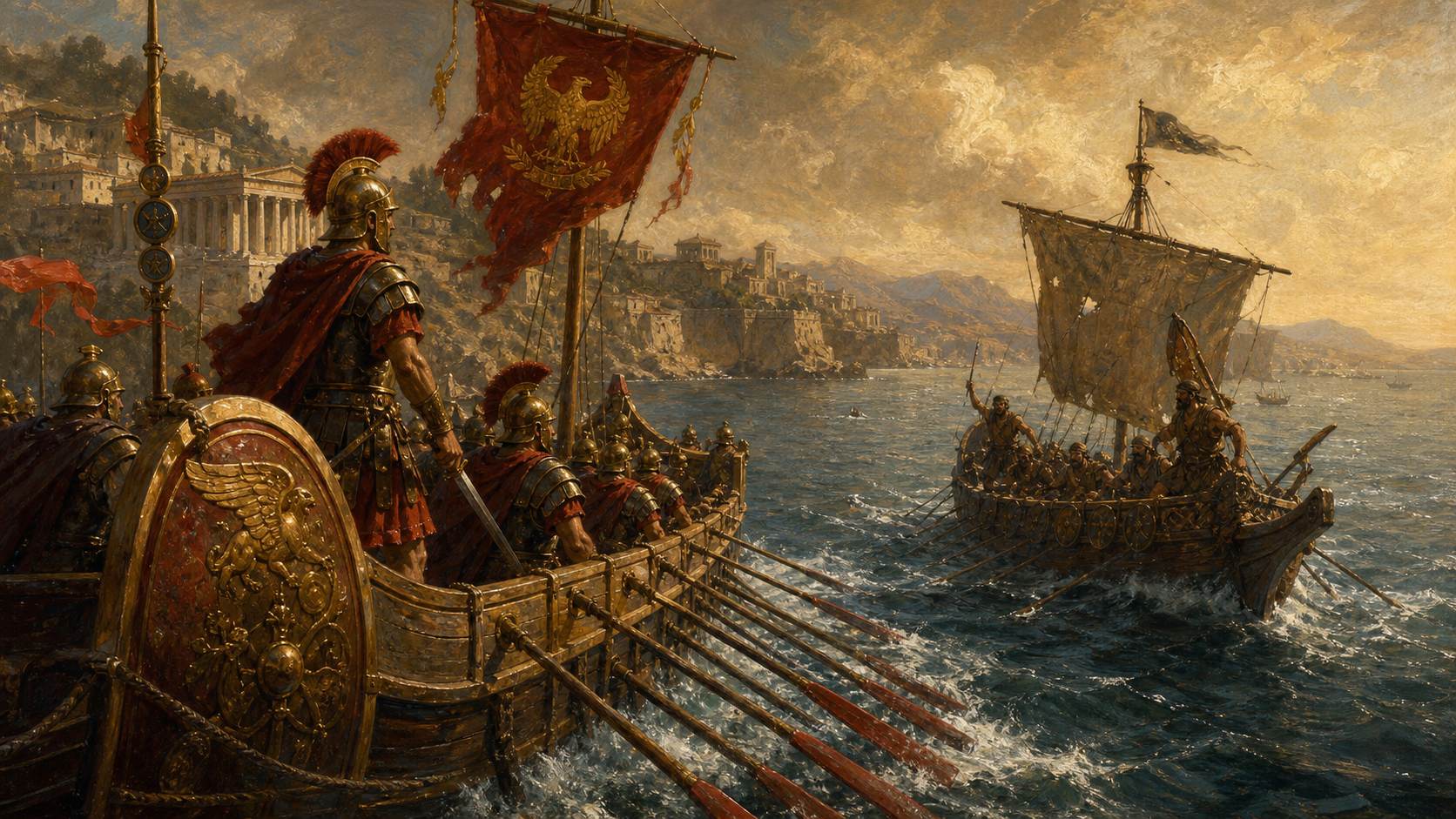
The Roman Empire, with its sprawling territories and vast seas, became a stage for the grand narrative of Mediterranean piracy. From audacious pirate lords who challenged Roman might, to the monumental naval strategies d...
Julius Caesar was not the sort of captive who improved the mood of his kidnappers.
The famous story says that as a young man he was seized by pirates in the eastern Mediterranean. When they demanded a ransom, Caesar supposedly mocked the amount as too low and told them to ask for more. During captivity he behaved less like a frightened hostage than a guest who had already decided he would later have everyone executed.
It is one of the most Caesar-shaped stories ever told.
That is exactly why it should be read with one eyebrow raised and both feet on the deck.
The Story Everyone Remembers
The basic tale comes from ancient biographical tradition. Caesar, still young and not yet the ruler whose name would become a title, was captured by pirates. They held him for ransom. He treated them with astonishing confidence, recited poetry, joined their activities, insulted them when they failed to appreciate him, and promised that once freed he would come back and crucify them.
Then, after the ransom was paid, he raised a force, pursued the pirates, captured them, and had them punished.
As character sketches go, it is almost too perfect. Caesar appears proud, theatrical, ruthless, personally offended by insult, and completely convinced that temporary powerlessness did not apply to him in any permanent way.
Ancient writers loved that kind of scene because it made personality visible.
What the Anecdote Can Safely Tell Us
The precise details may have been polished. Ancient biography was not modern documentary footage. Writers selected scenes that revealed character, morality, destiny, or political meaning. A good story could survive because it felt true to the person even when later readers should be careful with every decorative detail.
But the broader setting is historically useful. Piracy was a serious problem in the eastern Mediterranean during the late Roman Republic. Ships could be seized, captives ransomed, and even elite travelers threatened. Caesar’s story is memorable because the captive became famous, but the underlying danger was not invented for him.
The sea was full of opportunities for men willing to turn distance into leverage.
Ransom Was the Business
Pirates often preferred valuable captives alive. A dead aristocrat might satisfy rage. A living one could produce money. Ransom converted a body into negotiation, and negotiation pulled families, agents, cities, and political networks into the crime.
That is what makes Caesar’s kidnapping more than a comic anecdote. It shows how piracy could touch elite power. The pirates were not simply stealing cargo. They were exploiting the social value of a person.
Caesar’s alleged complaint that the ransom was too low is funny because it sounds arrogant. It is also revealing. In ransom economies, price expressed status. Caesar understood himself as expensive.
The pirates, according to the story, had underpriced the wrong man.
The Promise of Revenge
The famous promise that Caesar would return and crucify his captors is the part that gives the story its teeth. Whether delivered exactly as later writers report or shaped by tradition, the episode became a miniature of Roman power in one young man: humiliation answered by force, insult converted into punishment, personal danger turned into public authority.
Once freed, Caesar reportedly gathered ships, caught the pirates, and had them executed. Some versions say he had their throats cut before crucifixion as a grim mercy because they had treated him reasonably during captivity. That detail, too, feels very Roman in its disturbing mixture of gratitude, legality, and brutality.
A polite captive Caesar was never going to be the point of the story.
Why Pirates Could Threaten Rome
Rome’s power on land did not automatically make every sea lane safe. The Mediterranean was large, irregular, and full of islands, ports, and political complications. Pirates could operate where local authority was weak, where states were distracted, or where communities tolerated them for profit.
By the first century BCE, piracy had become a major Roman concern. It threatened trade, grain supply, coastal security, and political prestige. Pompey’s later campaign against Mediterranean pirates shows the scale of the problem. Rome had to treat piracy not merely as crime, but as a challenge to public order.
Caesar’s kidnapping sits inside that larger world. It is famous because of Caesar. It matters because it shows the problem reaching someone who later became impossible to ignore.
The Legend Works Because Caesar Works
The anecdote survives because it is funny, violent, and perfectly fitted to Caesar’s later image. A less famous captive would have become a line in a record. Caesar becomes a scene.
That does not mean the story should be thrown away. It means the reader should separate the secure historical frame from the polished character portrait. A young Roman aristocrat could be captured by pirates. Ransom was a real danger. Retaliation followed. The exact dialogue may owe as much to literary memory as to stenography.
The ancient world did not give us a transcript. It gave us a story that tells us how later readers understood Caesar.
Why It Still Belongs in Pirate History
Caesar’s kidnapping belongs in pirate history because it makes the old pirate problem visible in one memorable episode. Piracy was not always skull flags and tropical coves. It was ships, captives, ransom, weak enforcement, coastal networks, and the humiliation of powerful people caught too far from help.
For the wider ancient setting, continue to ancient piracy. For later ransom systems, compare the Barbary corsairs. The tools change, but the logic repeats: take the right person, name a price, and force the land world to answer a crime committed at sea.
The pirates who captured Caesar made one mistake larger than the ransom.
They treated him as a valuable hostage. He treated them as a future example.

