History feature
Historical route
Medieval piracy included Vikings, private war, coastal raiding, merchant violence, and blurred lines between legal and illegal sea power.
The Middle Ages did not have one clean pirate type.
That is the first useful thing to know. Medieval piracy was not a single uniformed profession drifting politely between the Vikings and Blackbeard. It was raiding, private war, coastal theft, opportunistic violence, smuggling, retaliation, and sea power conducted by people whose legal status could change depending on who wrote the complaint.
If the ancient Mediterranean gave piracy its old business model, the medieval sea world gave it many accents.
The Sea Was a Road and a Weak Point
Medieval trade depended heavily on water. Rivers, coasts, the North Sea, the Baltic, the Mediterranean, the English Channel, and the Atlantic approaches all moved goods, people, pilgrims, soldiers, fish, wool, wine, grain, timber, salt, metal, and news.
Every route was also a target.
A ship at sea could be isolated. A coastal village could be vulnerable. A merchant might not know whether the next sail belonged to a trader, a private enemy, a ruler’s agent, or a thief with a very flexible conscience. Authority existed, but it did not always arrive quickly enough to matter.
That is where piracy lived: in the delay between danger and response.
Vikings Were Not the Whole Story
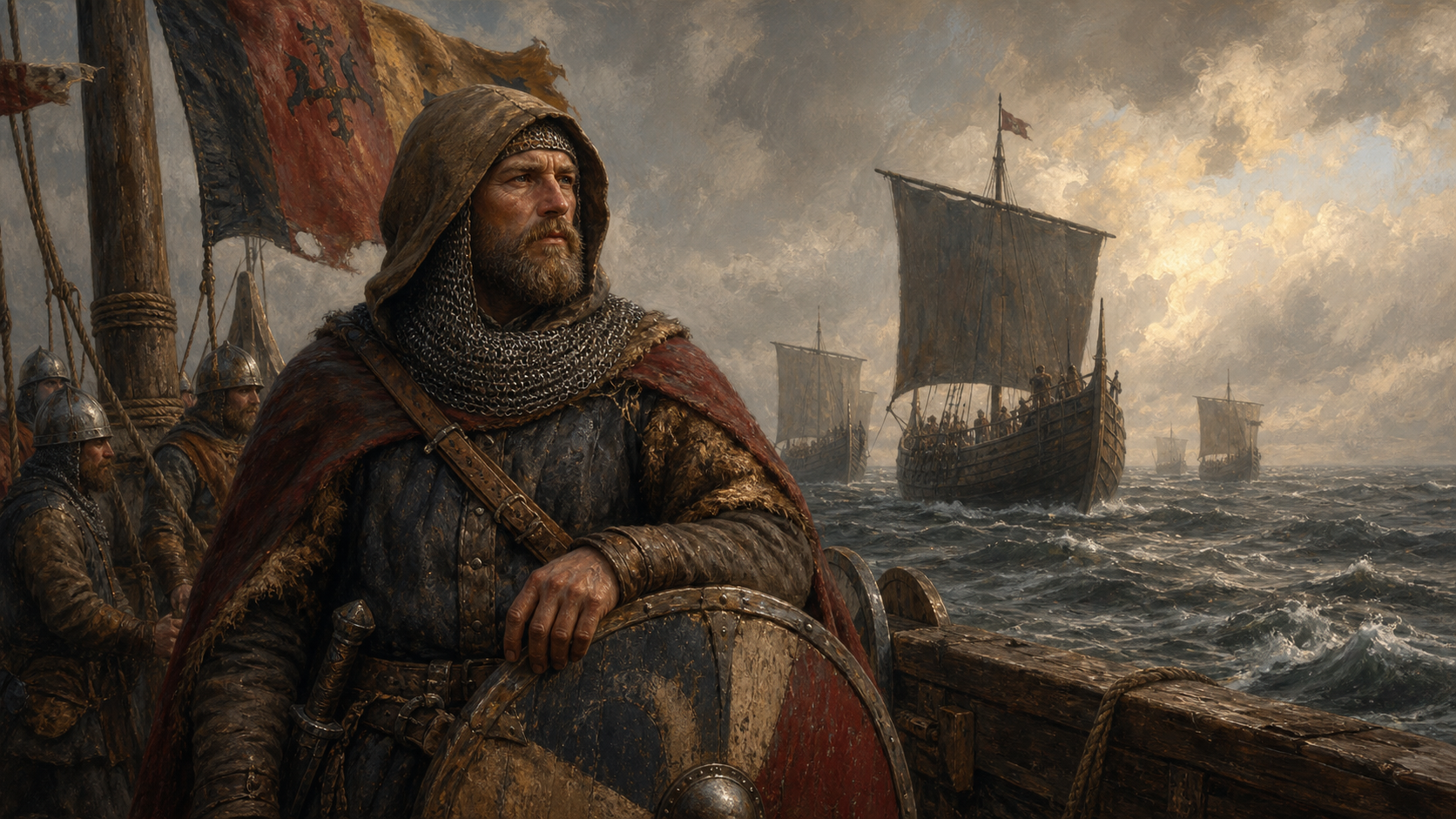
Viking raiders dominate many modern images of medieval sea violence, and for good reason. They raided, traded, settled, extorted, explored, and forced rulers to rethink defense. But medieval piracy should not be reduced to longships alone.
The wider period includes raiders and private warriors in many waters. Mediterranean corsair activity, Norman sea power, Baltic raiding, English Channel conflict, and local coastal violence all belong to the picture. Some attackers were outsiders. Some were neighbors. Some had patrons. Some had excuses. Some had only opportunity.
The word pirate becomes slippery here because medieval politics was slippery. A ruler might authorize violence against enemies. A town might tolerate attacks that benefited its merchants. A noble might conduct private war at sea. A victim might call the whole thing piracy, and he might not be wrong.
Private Violence With Public Consequences
Medieval rulers often struggled to control maritime violence because ships were useful tools in war, trade, and retaliation. A vessel could carry goods one season and armed men the next. Ports could profit from traffic that was not always clean. Local communities might shelter raiders if the money was good and the victims were conveniently foreign.
This makes medieval piracy hard to simplify. It was not always a gang of outlaws against a strong state. Sometimes the state was weak. Sometimes the state was involved. Sometimes the state approved until diplomacy made approval embarrassing.
That pattern appears again and again in pirate history. The line between piracy, privateering, reprisal, and war is often sharpest in theory and muddiest in practice.
The captured sailor did not need a legal lecture. He needed his ship back.
The Hanseatic and Channel Worlds
Northern Europe had its own maritime troubles. The Baltic and North Sea worlds connected merchants, fishing communities, cities, and political leagues. Where valuable trade moved, raiders followed. The Hanseatic world, English and French conflicts, and the shifting politics of ports created opportunities for authorized and unauthorized violence.
The English Channel could be especially messy. War between England and France, local rivalries, and prize-taking blurred the difference between patriot, privateer, and pirate. A ship seized under one ruler’s blessing might look like theft from the other shore.
That is why medieval piracy should be read as part of the history of commerce and law, not only as adventure. Merchants wanted predictable routes. Rulers wanted revenue and control. Sailors wanted pay and survival. Raiders wanted opportunity. The sea forced them into the same argument.
Mediterranean Continuity
In the Mediterranean, older patterns continued under new powers. Muslim and Christian states, Italian maritime cities, island powers, crusading routes, ransom economies, and regional rivalries all made the sea a place of profit and danger.
Captives mattered. Ransom mattered. Religious identity could sharpen conflict without making money irrelevant. A raid could be military, economic, symbolic, and personal at the same time. That combination would later become central to corsair warfare and early modern Mediterranean piracy.
The medieval sea was not a quiet gap between Rome and the Golden Age. It was a world in motion, and piracy followed that motion wherever law grew thin.
Why Medieval Piracy Gets Misread
Medieval piracy often gets flattened because it lacks one dominant popular costume. Vikings get helmets, though not the horned kind. Later pirates get tricorn hats and black flags. Medieval sea raiders in between are harder to package.
That does not make them less important. It makes them more useful for understanding piracy as a recurring condition rather than a single era. Piracy appears when trade is valuable, enforcement is uneven, war creates armed men, ports need money, and labels can be argued after the cargo is gone.
The medieval period had all of that.
The Better Map
Read medieval pirates as a series of overlapping sea problems: raiders, private warriors, smugglers, coastal predators, armed merchants, wartime opportunists, and men whose legality depended on the flag, the season, and the victim.
For the earlier roots, go back to ancient piracy. For the later explosion of Atlantic fame, move toward the Golden Age. Medieval piracy sits between them as a reminder that the sea did not wait for Blackbeard to become dangerous.
The Middle Ages did not give us one pirate myth. They gave us something more useful: centuries of ships proving that the line between trade and violence was never as far apart as merchants wanted it to be.

