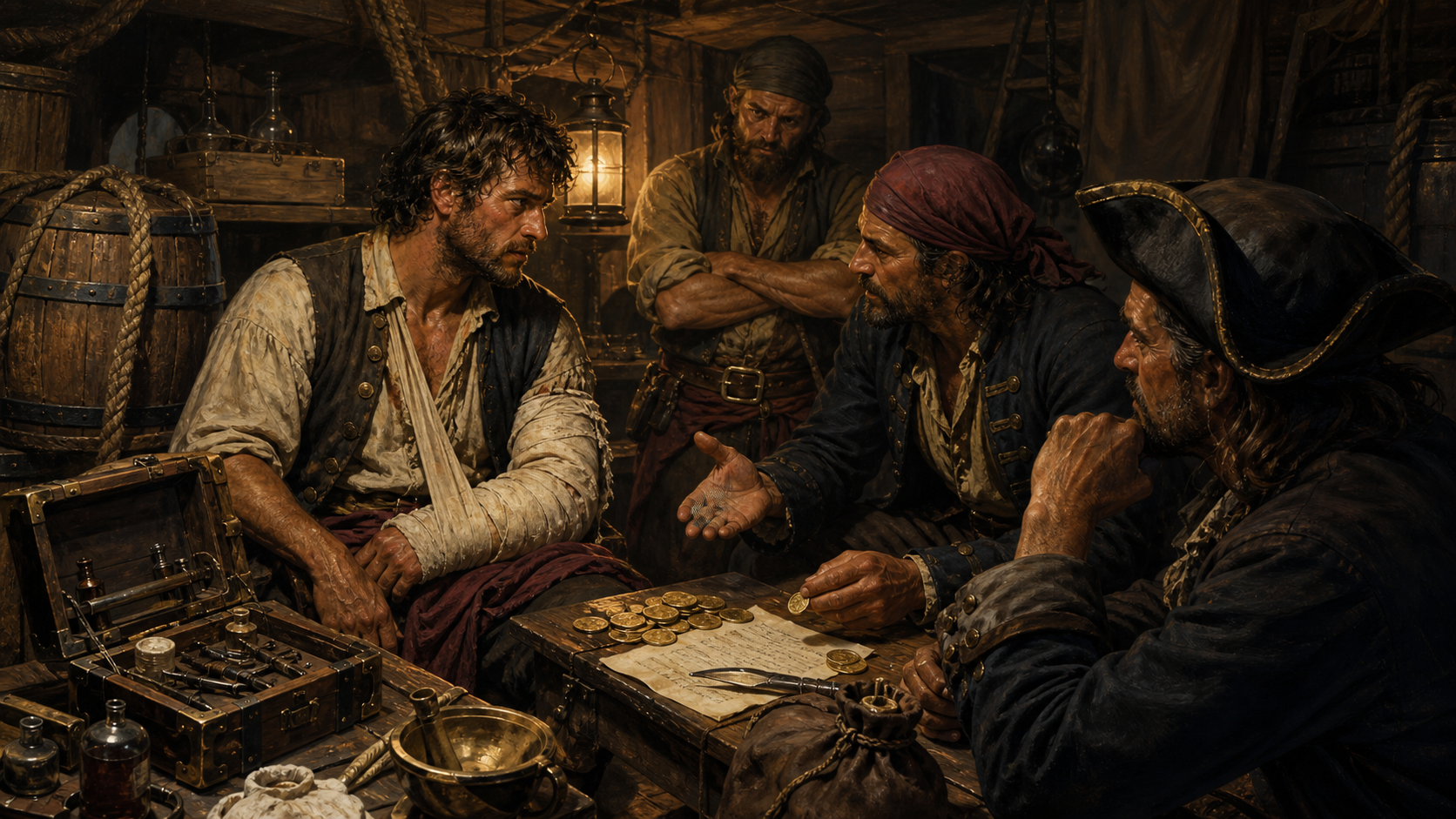
A pirate ship sounds lawless until somebody loses a hand and asks what the crew owes him.
Then even robbers discover accounting.
Pirate injury compensation is one of those historical details that looks almost modern for about five seconds. A lost arm might have a price. A lost leg might have a price. An eye, a finger, or a disabling wound could become an entry in a violent little ledger.
Then the rest of the ship comes back into view. These were not benevolent employers offering workplace protection. They were armed criminals trying to keep a dangerous enterprise functioning long enough to divide the loot and avoid the gallows.
Still, the compensation clauses matter. They show pirate crews thinking practically about risk. Boarding a defended vessel could mean cannon fire, splinters, musket balls, blades, falls, burns, infection, and surgery that was often another way for pain to introduce itself formally.
If a crew wanted men to fight, it had to answer the obvious question:
What happens to me if I survive, but not whole?
This was not modern insurance
Pirate injury compensation was not modern insurance with better hats.
It was closer to hazard pay inside a criminal partnership. A pirate crew needed men willing to stand in the most dangerous places at the most dangerous moments: at the rail, in the boat, on the boarding line, under fire, and on a strange deck where nobody had agreed to be robbed politely.
Courage is easier to request than to purchase. Pirate articles tried to purchase it.
If a man knew that losing a limb meant being useless, penniless, and abandoned, his enthusiasm for the next boarding action might reasonably decline. Compensation gave him a reason to believe that the crew recognized the cost. It also gave the rest of the crew a reason to believe that risk was being shared, or at least counted.
That did not make piracy humane. It made piracy more durable.
A ship full of armed men could not run on slogans forever. It needed terms.
The body had a price because labor had a price
A sailor’s body was his trade.
Hands pulled lines, climbed rigging, loaded guns, rowed boats, repaired damage, hauled cargo, and held weapons. Eyes judged distance, weather, coastlines, sails, shoals, and danger. Legs carried men across decks that pitched, lurched, flooded, and occasionally tried to fling everyone into the sea.
A serious injury was therefore not only pain. It was economic collapse.
In the eighteenth-century maritime world, a sailor who lost a hand, arm, leg, or eye could lose the means of earning his living. There was no clean recovery narrative waiting ashore. There might be a crutch, a stump, a begging place, a poorhouse, or the charity of people who had their own troubles.
Pirate compensation clauses recognized this in the bluntest possible way. They turned injury into a schedule of payments.
That sounds cold because it was cold.
It was also practical. A crew that expected men to gamble their bodies had to make the gamble legible.
Compensation protected the crew’s bargain
Pirate crews often worked under articles: agreements that laid out shares, discipline, authority, weapons, gambling, lights, quarrels, and sometimes compensation for injury.
Those rules did not make pirates respectable. They made them organized.
A pirate ship was a workplace under extreme strain. The men aboard were not simply obeying a captain because his coat was dramatic. They expected shares. They expected a say in some matters. They expected the bargain to be understood before the next prize was taken.
Injury compensation belonged to that bargain.
If a man suffered in the crew’s service, the crew owed him something. Not because the crew was gentle. Because the crew had made a working promise to itself. A promise about wounds helped preserve confidence before wounds happened.
That confidence mattered in battle. Men who believed the bargain might hold were easier to move toward danger than men who suspected they would be discarded the moment their usefulness was damaged.
Pirates were thieves, but they still understood morale.
The grim math of violence
The famous compensation lists are memorable because they seem almost absurdly specific. A sum for a lost arm. A sum for a lost leg. A sum for an eye. The details vary by crew and source, and they should not be treated as one universal pirate law carved into every mast.
That caution matters.
Pirate articles were not a single constitution for the sea. Crews differed. Periods differed. Sources differ. Some articles survive better than others because they were copied, printed, quoted, or used in legal and popular accounts. The safer historical point is not that every pirate ship used the same schedule. The safer point is that some pirate crews built injury compensation into their rules because the practical problem was unavoidable.
The work was dangerous. The men were armed. The profits depended on risk. The body was part of the cost.
That is the uncomfortable clarity of the system.
A pirate might reject the law of nations and still demand fair payment for losing a leg while breaking it.
Compensation did not erase victims
It is easy to admire pirate articles too quickly.
The compensation clauses can make pirate crews sound progressive, especially when compared with brutal naval discipline or abusive merchant service. There is truth in the comparison. Pirate ships could offer some sailors a rougher but more participatory bargain than legal maritime labor. Shares, voting, compensation, and elected leadership mattered.
But internal fairness does not erase external violence.
A crew could compensate its own wounded men while robbing, terrifying, beating, and sometimes killing people outside the crew. That is the moral knot in many pirate stories. Pirates could be less oppressive to each other than the systems they fled, while still becoming predators to everyone they boarded.
The injury ledger tells us how pirates treated risk among themselves. It does not make the people they attacked disappear.
That distinction keeps the article honest. Pirate compensation was interesting. It was not absolution.
Why these clauses still surprise us
Pirate injury compensation surprises modern readers because it interrupts the cartoon.
The cartoon pirate wants chaos. He wants drunkenness, swords, parrots, treasure chests, and a captain who shouts until geography gives up. Compensation clauses reveal something more difficult: pirates could be orderly when order served robbery.
That is a better story.
It shows men trying to build a working society inside an illegal one. It shows violence becoming bureaucratic. It shows a crew treating wounds as foreseeable costs rather than romantic accidents. It shows that the pirate ship was not pure freedom. It was a contract with teeth.
The sea did not reward fantasy. It rewarded systems that worked long enough.
The better truth
Pirate injury compensation was not kindness exactly.
It was a grim bargain among men who needed one another alive, useful, and willing to fight. It was an answer to the question every dangerous workplace eventually asks: who pays when the work takes part of your body?
On a pirate ship, the answer could be written into the articles before the next prize appeared.
That answer does not make pirates noble. It makes them more interesting than the costume version. They were criminals who sometimes understood labor risk better than the legal employers many sailors had escaped.
The lost limb got a number.
The number kept the next man moving toward the rail.


