Article
The legend, tested
Trade, pets, fiction, and an image that would not die.
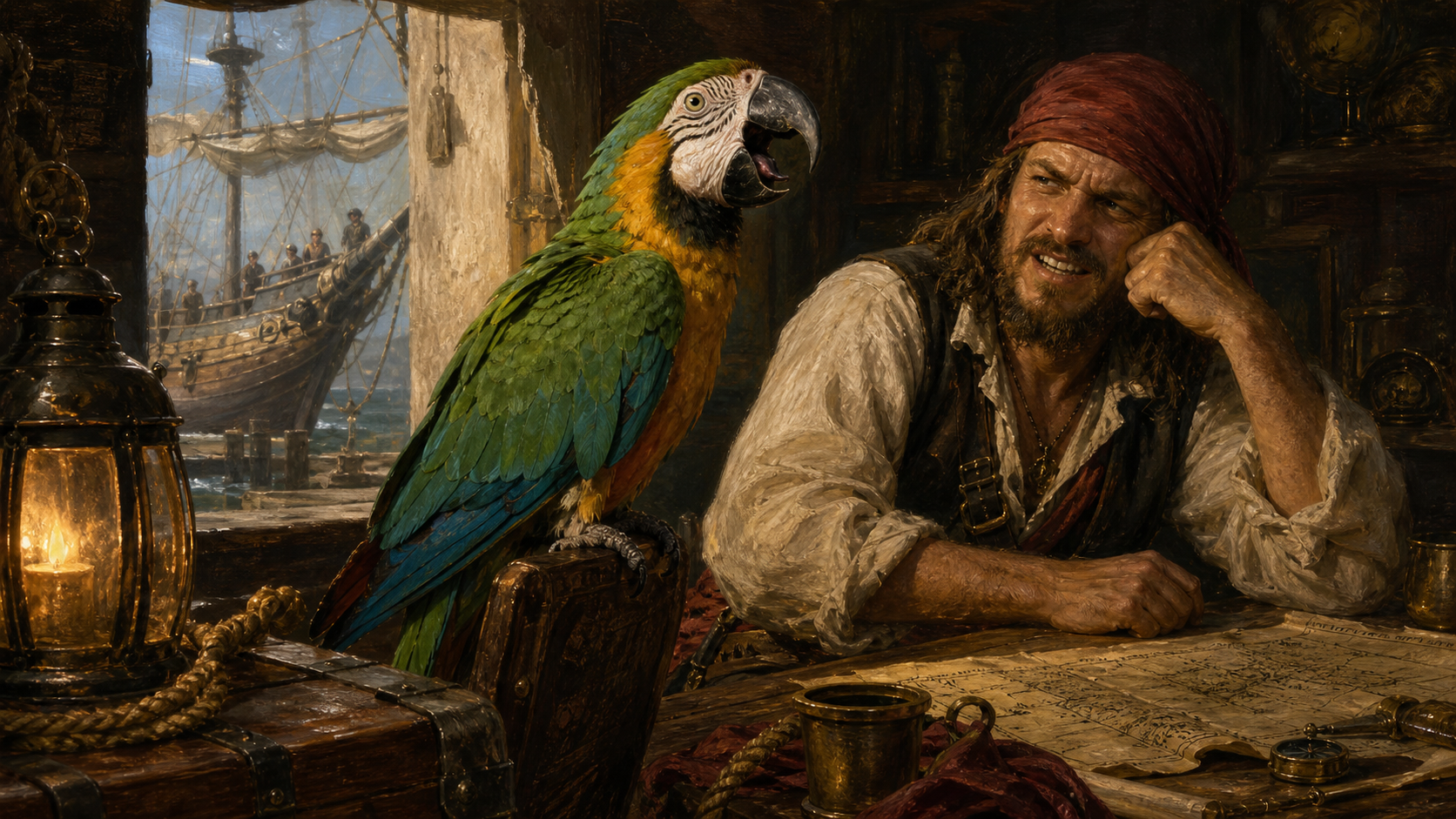
The pirate parrot is almost too good at being a pirate accessory.
It is colorful. It is noisy. It repeats things at the worst possible moment. It can insult a naval officer without understanding law. It gives the captain something alive to threaten, feed, misunderstand, and blame.
As fiction, the parrot is perfect.
As history, it needs to be kept on a shorter perch.
Pirates could encounter parrots. Sailors could transport exotic birds. A pirate might keep, sell, steal, or show off such an animal. None of that proves the familiar rule: pirate captain, shoulder, parrot, squawk, treasure joke.
The bird is plausible.
The uniform is not.
The movie version
The movie pirate has a parrot because the pirate needs color.
A criminal with a sword is dangerous. A criminal with a sword and a talking bird is a character. The parrot softens the pirate while making him stranger. It gives him a companion, a gag machine, and a portable splash of the tropics. It also lets the story turn a violent sea robber into someone a child can draw happily in the margin of a notebook.
The shoulder parrot says adventure, not armed robbery.
That is a very useful lie.
The real version
Parrots were real objects in maritime trade.
European sailors, merchants, privateers, and pirates moved through regions where parrots and other exotic animals could be seen, bought, captured, gifted, transported, or sold. Bright tropical birds attracted attention. They could function as curiosities, status symbols, living souvenirs, or trade goods. A sailor returning with a parrot was not impossible. A ship carrying animals was not impossible. A pirate handling such birds was not impossible.
The trouble begins when possible becomes typical.
A parrot on every pirate shoulder is not history. It is branding with feathers.
Why parrots made sense as goods
Parrots had value because they were vivid, portable, and strange to buyers far from the tropics. They could speak or mimic, which made them more entertaining than a sack of ordinary cargo and less useful than a barrel of food. People have always paid extra for objects that prove the world is larger than their street.
A pirate could steal a parrot from a captured ship.
A sailor could buy one in port.
A merchant could transport one as a luxury good.
A captain could keep one because vanity has never needed a better reason.
But the same logic that makes parrots plausible also makes them practical problems. Living birds need care. Ships are cramped, wet, noisy, dirty, unstable, and full of predators, disease, hunger, and men with limited patience. Fresh food and clean water mattered. Storms did not pause politely for pet maintenance.
A parrot could be carried.
That does not make it sensible ship’s equipment.
Long John Silver’s feathered witness
The most famous pirate parrot owes a great debt to fiction, especially Long John Silver’s bird in Treasure Island. That parrot helped attach the image to pirate memory so firmly that later culture stopped asking whether the bird had historical paperwork.
Fiction did what fiction does best: it chose the object that makes the character unforgettable.
A parrot gives Silver menace and comedy at the same time. It suggests old voyages, dead crews, repeated phrases, and a memory that keeps squawking after the crime is over. Once that image entered popular imagination, it became reusable. Pirates in later films, cartoons, books, and costumes inherited the bird because audiences already knew how to read it.
The parrot did not need to be common.
It needed to be memorable.
What the parrot hides
The parrot myth makes piracy look more playful than it was.
That is its real power. The bird chirps over the hard parts: coercion, hunger, disease, slavery, stolen cargo, frightened crews, shipboard labor, punishment, and death. A pirate with a bird seems eccentric. A pirate without one looks more like a man with weapons and victims.
This does not mean every pirate article must become joyless the moment a feather appears.
It means the feather should not be allowed to do all the work.
The parrot belongs to the border between real maritime exchange and later performance. It points toward trade routes, tropical ports, exotic goods, and the way fiction turns fragments of reality into standard costume.
That is useful.
It is just not a census of pirate pets.
The better truth
Did some pirates or sailors have parrots?
Quite possibly.
Did parrots become standard pirate companions?
No good reason says they did.
The better truth is that parrots were part of the wider maritime world as animals, goods, curiosities, and symbols. Fiction then placed one on the pirate shoulder because it looked wonderful there. The image stuck because it made piracy colorful, comic, and instantly recognizable.
So the parrot can keep its perch in pirate legend.
It earned that much through sheer cultural noise.
But history should keep one eyebrow raised.
A bird on a ship is plausible.
A bird on every pirate is marketing.
And if the parrot says otherwise, remember: it probably learned that from a novelist.


