Article
The legend, tested
A Florida legend, a Blackbeard connection, and just enough documentation to make certainty walk the plank.
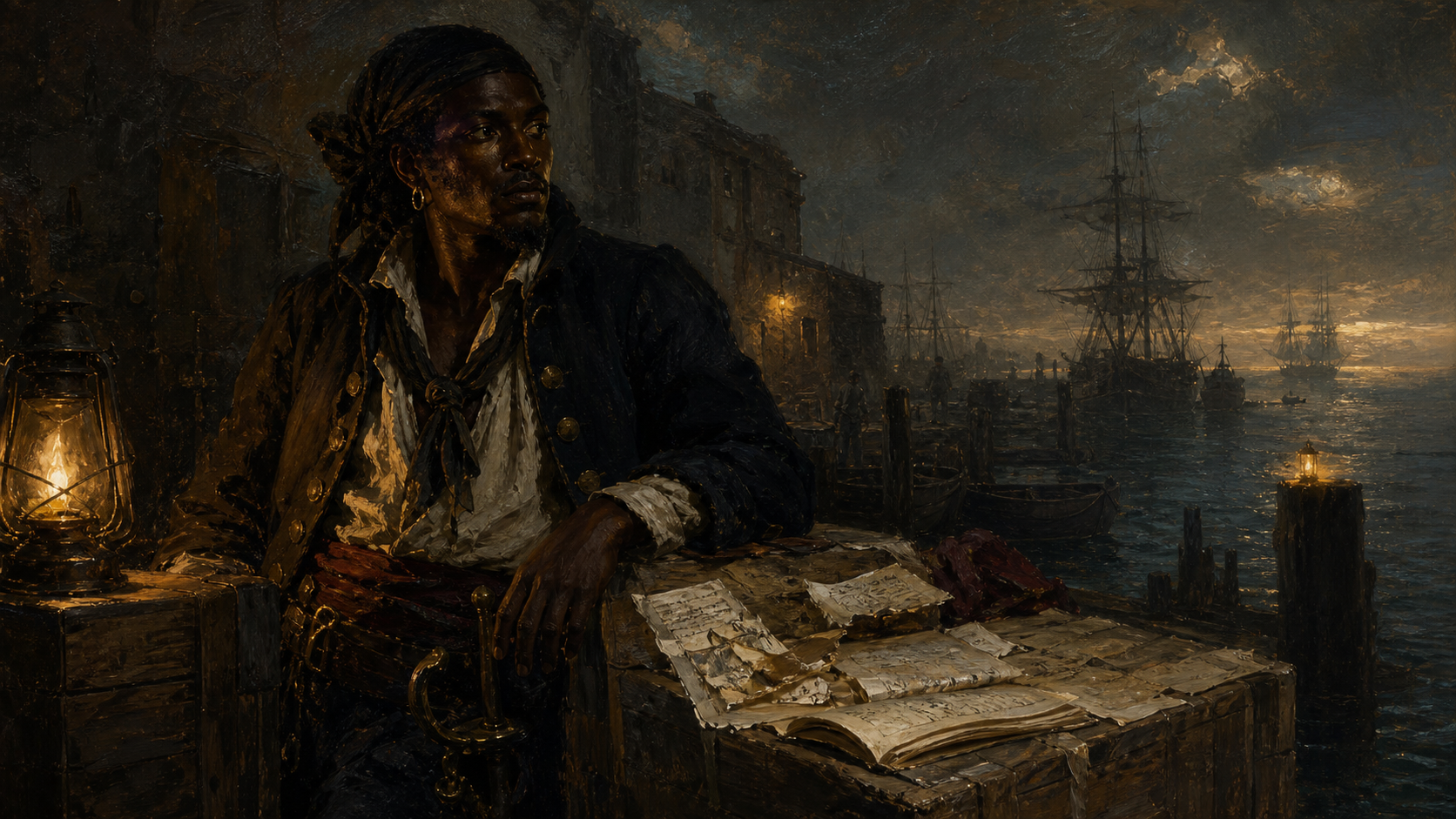
Black Caesar is a pirate name that arrives with a lantern in one hand and a fog machine in the other.
The story usually promises everything a legend wants: an African captive, escape, shipwreck, Florida Keys, buried treasure, raids, a hidden lair, and sometimes a final connection to Blackbeard. It is dramatic. It is memorable. It gives pirate history a powerful Black figure at the center of the frame.
It also rests on very thin evidence.
That does not mean the story should be sneered out of the room. Legends survive because they carry desire, fear, memory, and sometimes fragments of truth. But Black Caesar needs careful handling because the difference between a real historical context and a specific legendary biography is easy to blur.
The broader world is real.
The clean movie-ready life of Black Caesar is much harder to prove.
What the legend usually says
Versions differ, which is the first warning.
In many tellings, Black Caesar is an African man captured or deceived, carried into the Atlantic world, and eventually shipwrecked or stranded near the Florida Keys. He survives, becomes a raider, uses the islands and channels as a base, hides treasure, and gains a reputation for violence and cunning. Some stories connect him to Blackbeard's crew and the final fight at Ocracoke.
That is a tremendous story.
It is also the kind of story that grows in every direction because the archive does not hold it tightly. A well-documented biography usually narrows with research. A legend multiplies. Episodes shift. Motives improve. Geography sharpens. Treasure appears where the tale needs treasure. The hero becomes nobler or more monstrous depending on the teller.
The variation does not prove the legend false in every part.
It proves that the legend is doing more work than the evidence can safely carry.
What the record can carry
The Atlantic maritime world absolutely included people of African descent.
Black sailors, free and enslaved, moved through merchant ships, naval vessels, privateering, port labor, coerced maritime work, piracy, coastal economies, and escape routes. Some were forced aboard ships. Some used the sea to flee bondage. Some appeared in pirate crews. Some lived inside systems where status, race, violence, opportunity, and coercion overlapped in ways no simple adventure story can clean up.
That broader history is essential.
It means a Black pirate figure is not inherently implausible. The sea was not an all-white stage with an occasional symbolic exception. Atlantic ships were racially mixed in complicated, unequal, and often brutal ways.
The problem is not the idea of Black maritime participation.
The problem is the specific Black Caesar biography as it is often told.
Why the story is tempting
Black Caesar fills a space people want filled.
Pirate history has too often been narrowed into a handful of white Atlantic men: Blackbeard, Kidd, Roberts, Rackham, Bonnet. That version is incomplete. Readers want names that widen the frame, and they are right to want them.
But a thinly documented legend cannot be forced to do the work of a well-supported life.
That is the trap. If Black Caesar is presented as a fully documented pirate king of the Florida Keys, the page may feel satisfying for a moment while weakening trust. If the story is dismissed entirely, the page loses a chance to talk about Black seafarers, coerced labor, escape, piracy, and the way legend grows around archival silence.
The better path is harder and more honest.
Say what is known broadly. Say what is claimed specifically. Say where the record thins.
The Florida Keys made legends easy
Geography helped.
The Florida Keys are almost built for maritime rumor: channels, reefs, wrecks, mangroves, shoals, hidden passages, storms, salvage, smuggling, and islands that seem designed to hide a chest from someone with too much confidence and not enough evidence.
Places like that attract stories.
A difficult coastline can shelter real activity: wrecking, salvage, smuggling, raiding, fishing, evasion, and local economies that do not always fit neatly into official categories. It can also attract imaginary activity because the map itself feels secretive.
Black Caesar belongs partly to that geography of possibility.
The Keys make the legend feel plausible before the evidence has finished speaking.
The Blackbeard connection needs caution
Some versions connect Black Caesar to Blackbeard and the final fight at Ocracoke in 1718.
That connection is attractive because Blackbeard gives the story a famous anchor. Tie a thin legend to a famous pirate, and the whole thing suddenly feels more solid. But famous anchors can drag weak evidence into deeper water.
Blackbeard's crew did include men of different backgrounds, and Black sailors were present in the pirate world. That much fits the broader context. But a specific claim that the legendary Black Caesar stood beside Blackbeard in a particular way requires stronger evidence than repetition.
A responsible article should not pretend that every later association is a court exhibit.
The legend may point toward real possibilities.
It does not automatically prove its favorite scene.
Why thin records happen
Thin records are not neutral.
People at the margins of power were less likely to leave letters, official biographies, property records, portraits, or sympathetic testimony. Enslaved and formerly enslaved people often appear in archives through other people's needs: sale records, runaway notices, court documents, ship lists, punishment, complaint, or violence.
A missing clean biography does not mean a person like Black Caesar could not have existed.
It means the archive was never built to preserve such a life well.
That matters. But it does not give permission to invent certainty. The absence of evidence can explain silence; it cannot fill the silence with whatever story feels best.
The honest page must carry both truths.
The archive is unfair.
The legend is still not proof.
What the legend tells us anyway
Even if the specific Black Caesar story is thin, it tells us something about pirate memory.
It shows how people attach treasure, escape, revenge, hidden islands, and famous names to the places where the record is weakest. It shows the hunger for Black figures in pirate history, and the danger of making one legendary figure carry too much symbolic weight. It shows how coastal folklore can turn uncertain fragments into a biography that feels older and firmer than it is.
That is useful.
Not because every detail is true, but because the legend reveals what later audiences wanted pirate history to contain: freedom, power, danger, resistance, treasure, and a man who could not be easily controlled.
A better way to tell it
A strong Black Caesar page should not say, “This definitely happened.”
It should say something more interesting:
Black Caesar is a powerful pirate legend from a real Atlantic world that included Black sailors, coerced labor, maritime escape, and racially mixed shipboard life. The general world is historically solid. The specific tale is much less secure. The story should be read as folklore with historical pressure behind it, not as a clean biography.
That approach does not ruin the legend.
It makes the reader smarter than the legend expects.
The better truth
Black Caesar may be remembered as a pirate.
He should also be read as a test of how pirate history handles evidence, race, folklore, and the desire for a better cast than the old simplified version provided.
The thin record is not an embarrassment to hide. It is the subject. It lets the article ask why some names are preserved in court books and official papers while others survive in rumor, geography, and treasure stories.
The pirate myth with a thin record is still worth telling.
But it should be told with the fog visible, not painted over as sky.


