Article
The legend, tested
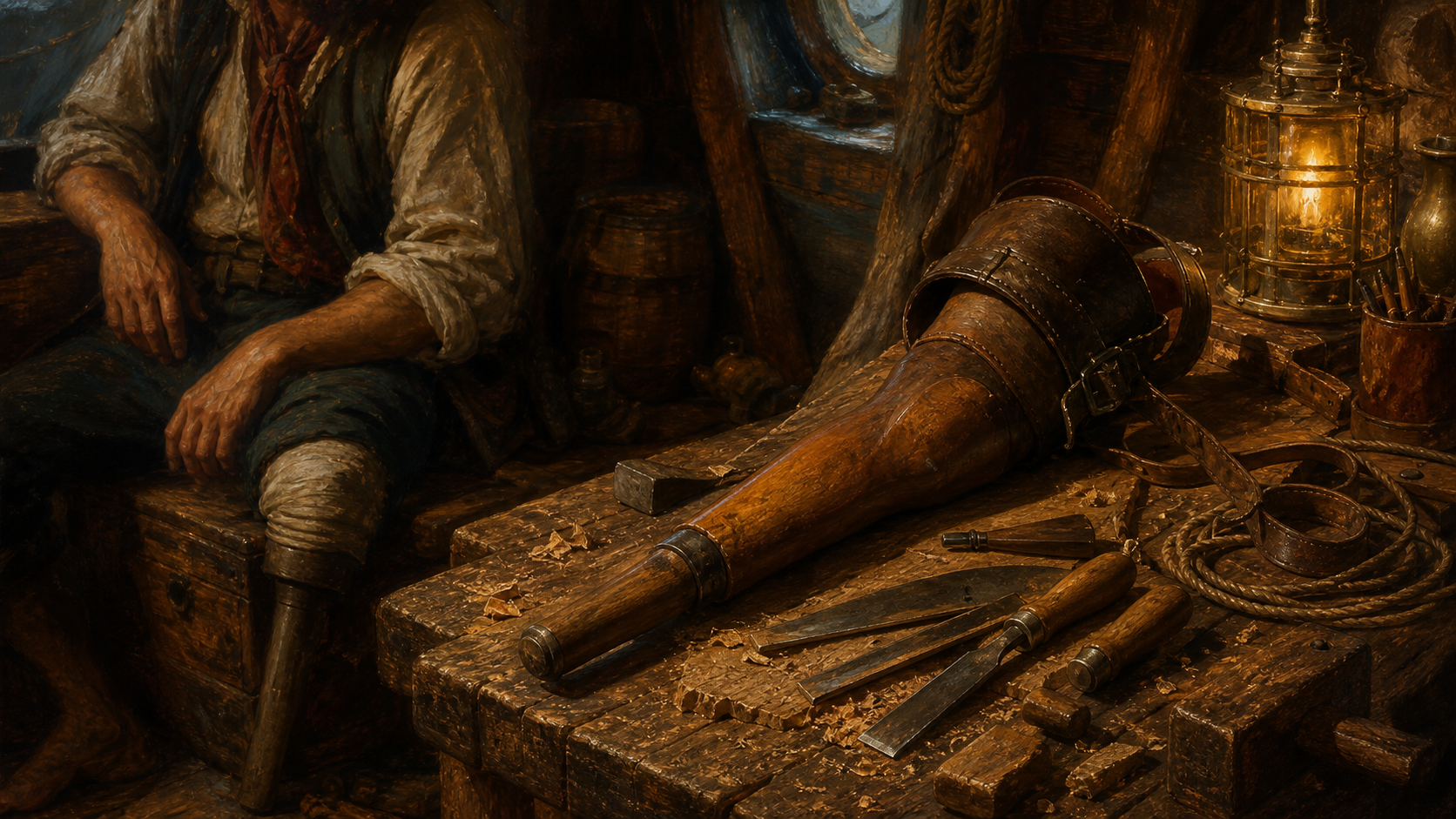
Peg leg pirate imagery comes from real amputation, disability, naval medicine, and fiction, but the classic trope is heavily exaggerated.
The peg leg is one of piracy’s loudest props.
It thumps through cartoons, Halloween aisles, tavern signs, school plays, and every low-budget pirate costume that needs one more obvious clue. The moment a wooden leg enters the room, nobody thinks “maritime workplace injury.”
They think pirate.
That is the strange trick. The peg leg is a joke because the wound behind it has been hidden by costume.
The historical truth is more careful. Sailors could lose limbs. Wooden prosthetics existed. Life at sea could maim people before an enemy ever raised a gun. But pirates as a class did not come issued with peg legs, parrots, eye patches, and a voucher for dramatic hobbling.
The myth is loud.
The reality is a damaged body trying to keep working.
The movie version
The movie version gives the pirate a peg leg because the audience needs fast identification.
A hat says pirate. A cutlass says pirate. A parrot says pirate. A peg leg says pirate so clearly that it barely needs a face above it.
In fiction, the wooden leg often becomes personality. It thumps ominously down a hallway. It hides a weapon. It signals age, toughness, villainy, mystery, or a long career of surviving things that killed less interesting men. It gives the character a sound before he enters the frame.
That is excellent theatre.
It is not a census.
The real version
Limb loss was plausible because maritime life was dangerous.
Ships were moving workplaces full of wet decks, heavy lines, sharp tools, swinging spars, cramped spaces, falling cargo, storms, disease, and exhausted men. Combat added cannon fire, musket balls, blades, splinters, burns, powder accidents, and panic. Infection could turn an injury into a death sentence. Medical care was rough, fast, and often desperate.
A sailor did not need a duel with a heroic soundtrack to lose a leg.
He needed bad weather, bad luck, bad treatment, or one piece of flying wood at the wrong moment.
Pirates faced the same hazards as other seamen, plus the additional risks of illegal violence, pursuit, boarding actions, capture, and execution. A pirate with a missing limb is therefore historically believable. The myth begins when believable becomes standard.
Why compensation mattered
Some pirate articles included compensation for injury. A man who lost a limb might receive a set amount from the common fund before shares were divided. That detail is often presented as charming evidence that pirates were strangely progressive.
It is better understood as grim practicality.
An injured sailor lost earning power. A maimed pirate lost capacity in a world with no modern safety net and very few gentle retirement plans. Compensation helped recruit men, maintain morale, and make the risks seem survivable. It also kept the crew’s bargain visible: if you are damaged while making money for the company, the company owes you something.
That does not make piracy noble.
It makes piracy organized enough to understand that bodies were part of the cost.
The prosthetic problem
Wooden legs and other prosthetics existed in the broader early modern world, but they were not magic solutions. A prosthetic could help someone stand, move, or appear socially functional, depending on design and circumstance. It could also be uncomfortable, crude, expensive, poorly fitted, or useless aboard a demanding vessel.
A ship is not a calm floor.
It pitches, rolls, slips, climbs, and punishes imbalance. A sailor with a serious limb loss might still work in some roles, especially if experienced and supported, but the idea of a peg-legged pirate sprinting across rigging with cartoon ease belongs more to illustration than ordinary seamanship.
Disability did not make someone less human.
It did make life at sea harder.
Why the myth survives
The peg leg survives because it compresses a whole backstory into one object.
It says this pirate has survived violence. It says he is old enough to have a past. It says he belongs to a rougher world. It gives illustrators an unforgettable silhouette and actors a rhythm. It also lets audiences enjoy danger without thinking too long about pain, infection, amputation, poverty, or the economic ruin that could follow bodily injury.
Costume softens the wound.
History should put the wound back.
The better truth
Were there pirates with missing limbs?
Almost certainly.
Were peg legs a universal pirate trait?
No.
The better truth is that the peg leg belongs to the dangerous working world of the sea before it belongs to pirate costume. It points toward injury, compensation, disability, medicine, labor, and survival. The prop is memorable because it carries real human damage, then disguises that damage as fun.
So the peg leg can stay in the costume box.
But it should not stay only there.
Behind the thump is a sailor who got hurt, a crew that had to decide what injury was worth, and a maritime world where one bad moment could change the rest of a life.
That is less cute than the cartoon.
It is also much better history.


