Article
The legend, tested
The best pirate imagery survives because it is readable in half a second. History, unfortunately, takes longer than that.
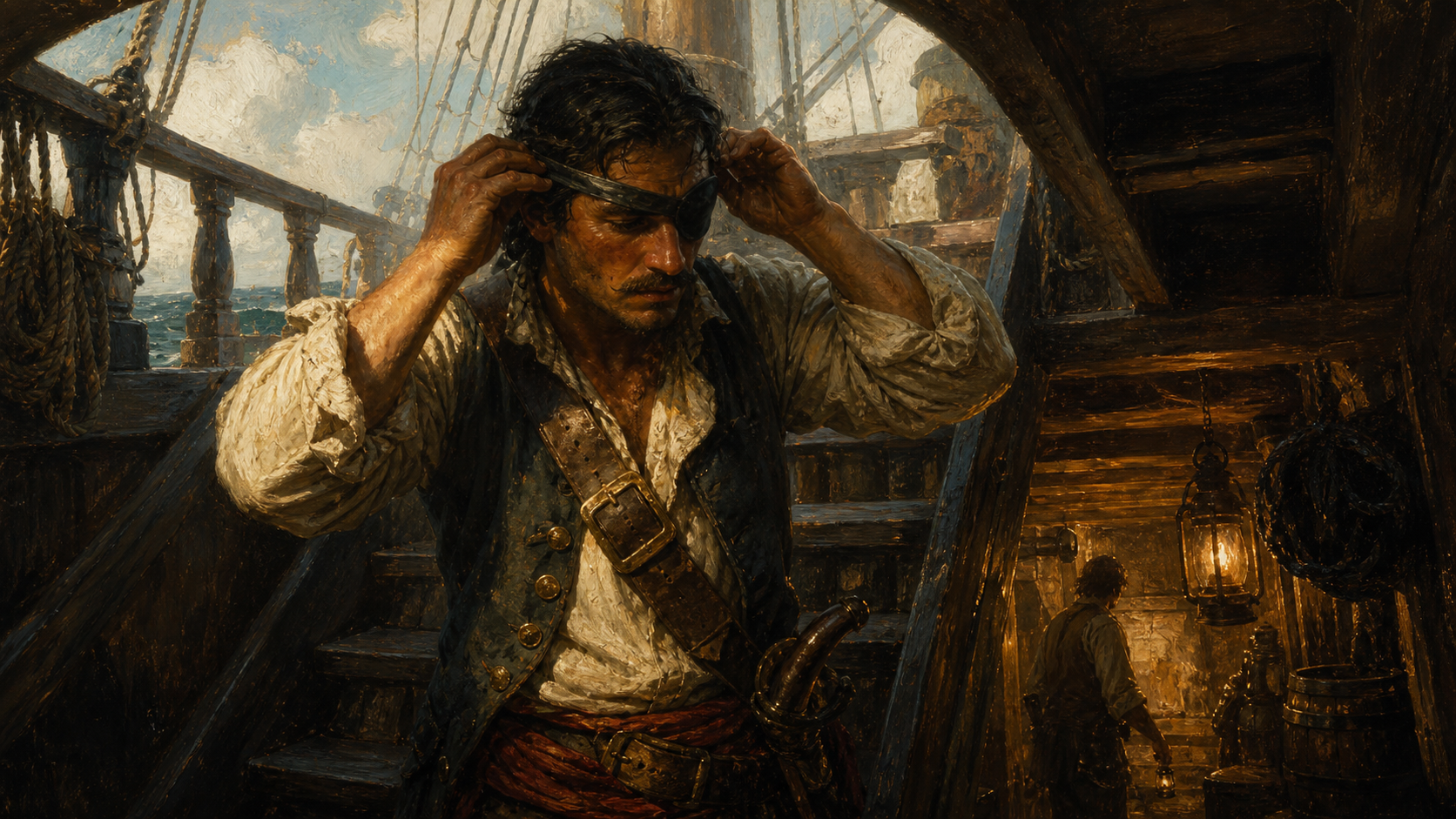
The pirate eye patch is so powerful that it barely needs the rest of the pirate.
Put a black patch over one eye and the audience supplies the ship, sword, treasure, growl, and poor dental plan. It is one of the cleanest symbols in the pirate costume box.
It is also one of the sneakiest myths, because the most popular explanation sounds intelligent.
You have probably heard it: pirates wore eye patches to preserve night vision. Keep one eye covered in daylight, uncover it below deck, and that eye can see better in darkness. Clever. Practical. Exactly the sort of thing a pirate would do.
Maybe.
But “physically plausible” is not the same as “historically documented as standard pirate practice.”
That difference is where the patch starts to peel.
The movie version
The movie pirate wears an eye patch because the image works instantly.
It gives the face asymmetry. It suggests injury, menace, survival, and a past too rough to explain before the next cannon shot. It makes the pirate look dangerous even while standing still. For illustrators and filmmakers, that is gold.
The patch also helps fiction do something very useful: it turns trauma into style.
A missing or damaged eye becomes a clean black shape. Pain becomes silhouette. Disability becomes atmosphere. The audience gets the drama without the infection, fear, poverty, or practical limitation that might have come with the original wound.
Costume is very good at tidying up suffering.
The real version
Some sailors and pirates could have worn eye coverings.
That is not hard to believe. Sea life was dangerous. Eyes could be damaged by splinters, blades, powder, burns, disease, infection, falls, flying rope, tools, and combat. Cannon fire could send fragments of wood across a deck with horrifying speed. A damaged eye might be covered for protection, comfort, appearance, or simply because the injury was unpleasant to expose.
That plain explanation is less clever than the night-vision story.
It is also more firmly connected to the brutal world of maritime labor and violence.
The sea did not need help from costume designers to injure people.
The night-vision claim
The night-vision explanation is attractive because it feels like secret knowledge.
It turns the pirate from a wounded man into a tactical genius. The patch is not a medical covering or a visual cliché. It is a tool. The pirate is not stumbling through darkness. He has planned for it. One eye for daylight, one for the hold. Very efficient. Very satisfying.
The problem is evidence.
The biology makes sense in broad terms. Dark adaptation is real. A covered eye can preserve sensitivity to darkness. But that does not prove pirates routinely used patches that way. A good explanation still needs historical support before it can become a historical habit.
Pirates moved between decks, holds, cabins, shore, night, and day like other seamen. If the practice were widespread and distinctive, one would expect stronger evidence for it as a known routine.
Instead, the claim often appears as a modern just-so story: neat, repeatable, and pleased with itself.
History should be suspicious of explanations that arrive already wearing a bow.
Injury is not less interesting
The injury explanation can feel disappointingly ordinary only if we forget what injury meant.
An eye wound at sea was not a small inconvenience. It could threaten work, status, confidence, survival, and earning power. Infection could be serious. Pain could be constant. A sailor with impaired vision had to keep moving inside a workplace that punished mistakes. A pirate with a visible injury carried the evidence of violence on his face.
That is not less dramatic than the night-vision theory.
It is more human.
The patch becomes a reminder that piracy was a bodily business. People were cut, burned, blinded, crushed, infected, and maimed. Later costume kept the shape and threw away the suffering.
Why the patch won
The eye patch won because it gives pirate imagery a perfect mark of survival.
It says this person has already been through something. It makes the face readable from across a room. It adds menace without requiring gore. It also pairs beautifully with the peg leg, earring, hat, and parrot, because pirate costume is a committee of shortcuts that keeps voting for the same few props.
A patch is visual grammar.
It tells the audience how to read the character.
That is why it spread so well in fiction, illustration, cartoons, games, and Halloween aisles. It is not evidence by itself. It is design that became tradition.
The better truth
Did some pirates wear eye patches?
Probably.
Did pirates routinely wear them to preserve night vision?
That is much harder to show.
The better truth is that eye patches sit between injury, possibility, and theatrical memory. The night-vision story is clever, but cleverness is not documentation. The injury story is plainer, but it pulls the object back into the real maritime world: splinters, smoke, blades, disease, infection, disability, and a body trying to keep working after damage.
So keep the eye patch in the costume.
Just do not let the clever explanation bully the evidence.
A pirate with one covered eye may be hiding a tactic.
More likely, he is hiding a wound.
The second story is not as cute.
That is exactly why it deserves the page.


