Article
The legend, tested
Disability, work, war, and fiction share the same deck.
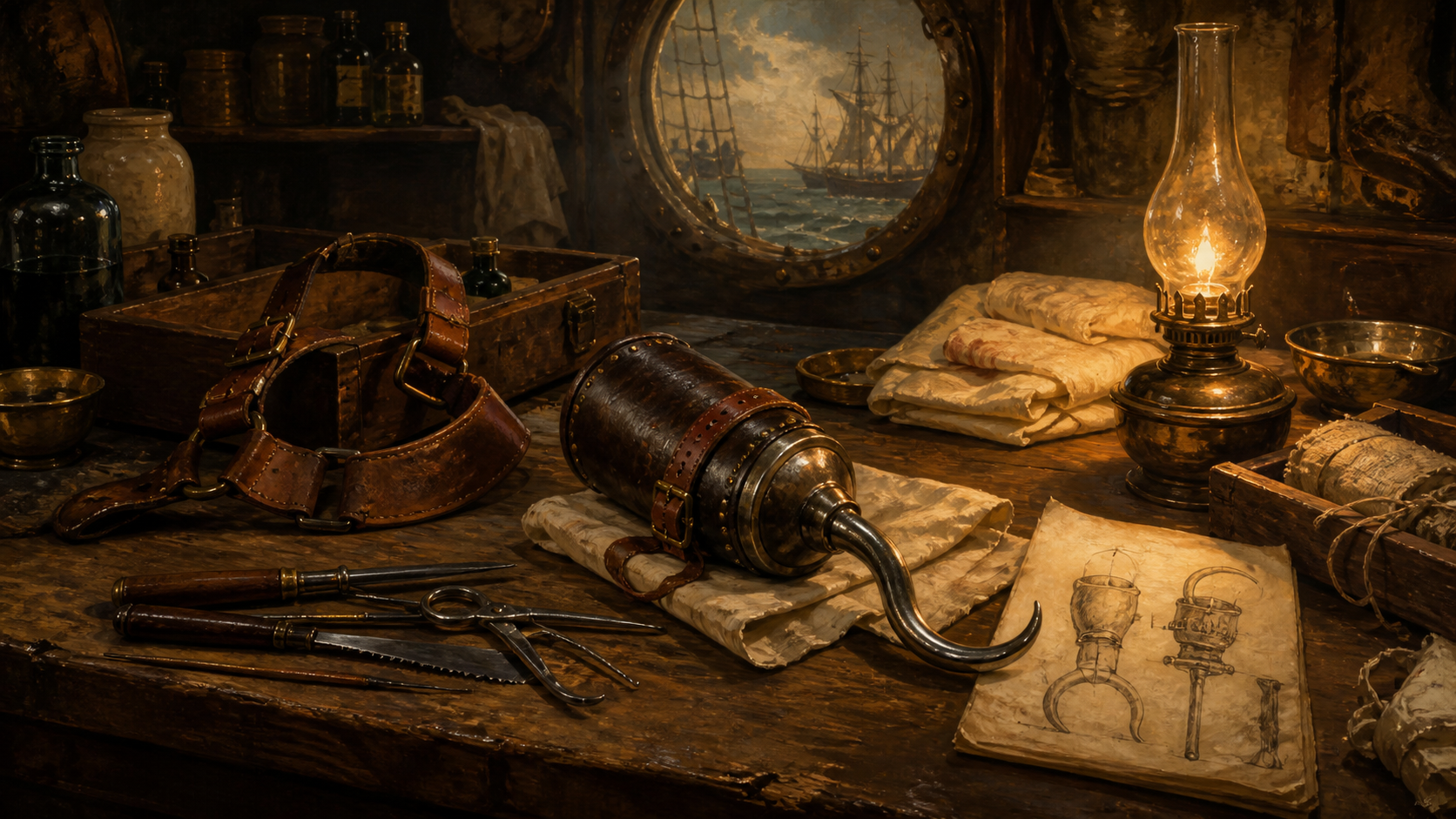
The pirate hook works because it is instantly readable.
One curve of metal tells the audience that this person has survived violence, lost something, and perhaps become dangerous in return. It is a perfect villain shape. No dialogue required.
It is also where history begins to blur.
Sailors did lose hands, arms, legs, eyes, strength, teeth, fingers, and working capacity in a maritime world full of blades, guns, splinters, ropes, pulleys, falls, burns, infection, storms, and hard labor. Prosthetics and adaptive tools existed in the wider world. But the neat pirate hook as standard sea-robber equipment belongs much more to later storytelling than to a documented pirate uniform.
The hook is a good symbol. The injury was the real story.
The Movie Version
A pirate captain lifts one arm. Instead of a hand, there is a hook. It gleams in candlelight. It catches a sleeve, a rope, perhaps a nervous person's collar. The audience understands immediately: dangerous, damaged, theatrical.
Fiction loves visible shorthand. The hook does in one second what a paragraph would otherwise have to explain.
But that shorthand has a cost. It can turn disability into menace and injury into decoration. The missing hand becomes a character trait. The prosthetic becomes a warning label.
Real injured sailors were not props. They were people trying to survive a brutal workplace.
The Real Version
Maritime injury was common because ships were dangerous machines.
A sailor worked with heavy lines under tension, moving spars, wet decks, ladders, cargo, knives, tools, fire, cannon, anchors, pulleys, and men who were tired, hungry, drunk, frightened, or all four at once. Add combat and the situation gets worse quickly.
A cannon did not have to hit a person directly to maim him. Splintered wood could tear flesh. A cutlass could take fingers. A musket ball could shatter bone. Infection could turn a wound into an amputation. A fall could end a career. Burns, crushed limbs, and eye injuries were all plausible in a world without modern surgery, antibiotics, or occupational-safety posters politely ignored in the galley.
Piracy did not make the sea dangerous. It added weapons.
Amputation Was Survival, Not Style
A lost limb in the eighteenth-century maritime world was not a costume note. It was a medical crisis.
Amputation could be the difference between death and survival when a limb was shattered, infected, or gangrenous. The operation itself was dangerous. Pain control was limited. Infection remained a threat. Recovery depended on care, luck, strength, and whether the ship or port had anyone competent nearby.
A sailor who survived could still face the next problem: how to work, earn, move, fight, or live afterward.
That is where prosthetics and adaptive tools enter the story. Peg legs, crutches, artificial limbs, straps, hooks, modified tools, and improvised supports all belong to the broader history of disability and work. Some were crude. Some were skillfully made. Some helped with daily life. Some mainly helped a person stand, walk, or signal status.
The hook may be possible. It was not the point.
Pirate Articles and Injury Compensation
One reason pirate injury matters is that some pirate crews appear to have had compensation systems for wounds. Articles could assign payments for the loss of a limb, eye, or other serious injury. That does not make pirates benevolent. It makes them practical.
A crew asked men to risk their bodies. If the system offered no compensation for losing a hand in the service of the company, morale might become extremely theoretical.
This is one of the stranger truths of pirate history. A violent criminal crew could sometimes offer clearer injury compensation than legal maritime employers. That fact should not romanticize piracy, but it should make readers think harder about why some sailors joined.
Pirate crews were predatory outward. Internally, they needed rules that made the risk worth taking.
The Hook as Villain Shortcut
The problem with the hook is not that no injured pirate could ever have used one. The problem is what the image does.
Fiction often uses visible disability as a shortcut for moral danger. A missing hand becomes cruelty. A scar becomes corruption. A prosthetic becomes menace. The body is asked to prove the soul.
That is lazy storytelling.
Pirate history does not need it. The real violence of piracy is already clear without making disability a costume for evil. A person with a prosthetic might be a criminal, a sailor, a victim, a worker, a survivor, or several of those at once. The metal does not explain the man.
The better article keeps the injury human before it lets the image become theatrical.
Work After Injury
A ship needed labor. Could an injured sailor keep working? Sometimes, depending on the injury, role, skill, and available support.
A man who lost part of a hand might still serve in some capacity. A person with one leg might struggle with deck work but have knowledge valuable enough to remain useful elsewhere. Navigators, pilots, gunners, cooks, carpenters, and experienced seamen all carried skills that were not identical to brute strength.
But survival did not guarantee security. A disabled sailor could face poverty, dependence, dismissal, or reduced status. Maritime life was hard even before injury. After injury, it could become a negotiation with pain, tools, charity, crew loyalty, and whatever legal or illegal system had promised compensation.
That is the real perilous reality: not the hook flashing in candlelight, but the morning after the wound.
Why the Image Survived
The pirate hook survived because it solves a visual problem.
A pirate should be identifiable at a glance. Hat, sash, sword, eye patch, peg leg, hook, parrot. The costume assembles itself from signs that are bold, simple, and easy to draw. The more complicated truth—labor, disease, amputation, disability, compensation, adaptation—is harder to put on a party invitation.
So the hook became part of the pirate kit.
It tells the viewer: this is danger with a handle.
History is less tidy. It asks what caused the wound, who treated it, whether the person survived, how the crew responded, what compensation was owed, and how a damaged body kept moving through a violent sea world.
The Better Truth
Pirate hooks are not impossible. They are just far less important than the myth makes them.
The real subject is injury. Pirates and sailors lived in a world where bodies were damaged by work, weapons, weather, disease, and bad luck. Some survived with amputations or impairments. Some adapted. Some were compensated. Some vanished from the record because the archive likes captains more than injured crewmen.
A hook makes a tidy silhouette.
The truth is rougher: pain, infection, surgery, survival, disability, labor, and the uncomfortable fact that a pirate ship could be both a violent predator and a place where injured men expected compensation from their own.
That is a better story than the hook.
Sharper, too.


