Article
The legend, tested
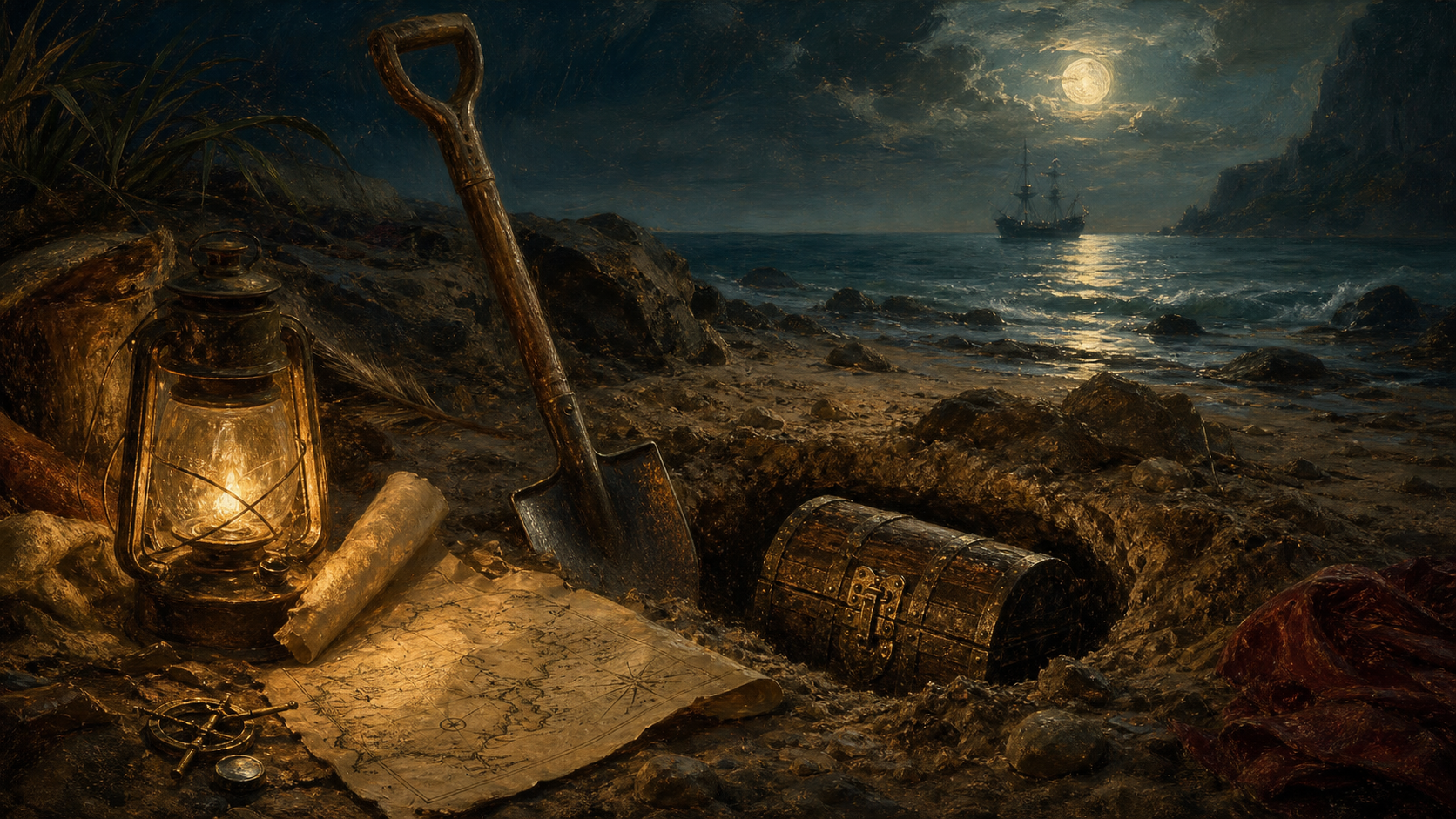
Embark on a quest shrouded in legend and mystery: the hunt for pirate buried treasure. While tales of X-marked spots and hidden booty fuel our imaginations, how often did pirates actually bury their loot? Unearth the tru...
Pirate buried treasure is the myth that refuses to stay buried.
It offers everything a story wants: danger, secrecy, a lonely island, a map with an X, and the possibility that history has been politely waiting for someone with a shovel.
The evidence is less generous. It is also more interesting.
Pirates took valuables. Some loot was hidden, deposited, transferred, fenced, lost, recovered, or swallowed by shipwrecks. A few real caches did exist. But the classic chest under a palm tree, untouched for centuries and marked by a helpful map, is mostly fiction doing what fiction does best: making crime look like a treasure hunt.
Real pirate loot usually had a shorter career. It was divided, spent, traded, gambled, drunk, worn, repaired into ships, used to buy information, or lost to the sea. Pirates were not running a long-term island-based savings program.
Their retirement planning was poor. This may help explain the gallows.
The Movie Version
A pirate captain buries a chest on an island. He draws a map. He marks the location with an X. He perhaps murders the men who helped him, because apparently logistics are easier when all witnesses are dead. Years later, the map resurfaces and adventure begins.
It is perfect storytelling.
The treasure becomes patient. The island becomes a puzzle. The map becomes a promise. The pirate becomes a ghostly accountant of suspense.
The real world was not usually that tidy.
The Real Version
Pirate loot was an economy, not a chest.
A captured ship might carry coin, silver, gold, cloth, sugar, tobacco, indigo, spices, medicine, tools, weapons, food, navigational instruments, clothing, enslaved people, or trade goods. Some cargo looked unimpressive but could be worth serious money. Some glittering objects were less useful than powder, water, sails, or a surgeon's supplies.
Once taken, loot had to be handled. It had to be divided according to shares, kept from spoiling, carried safely, sold discreetly, exchanged through middlemen, or converted into something the crew could use.
That is not a treasure-map fantasy. It is criminal logistics.
A pirate crew expected payment. Burying everyone’s share under a tree would not make a captain popular unless the tree was also issuing receipts and rum.
The Crew Wanted Shares, Not Mysteries
Pirate crews often cared intensely about how plunder was divided. Articles could specify shares for captains, quartermasters, specialists, ordinary crewmen, and compensation for injury. The point was not moral fairness. These were robbers. The point was internal fairness among the robbers.
A crew that risked death expected reward.
That makes the buried treasure myth awkward. If a pirate captain captured a rich prize, the men wanted their portions. They did not want to be told that the money had been hidden somewhere scenic for reasons of narrative convenience.
A captain who secretly buried the crew's wealth would be making a bold career choice, and probably a brief one.
The Rare Real Caches
There were real cases of hidden or deposited pirate goods. Captain Kidd is the obvious example because some of his valuables were placed on Gardiners Island and later recovered. That single hard seed of truth helped grow an entire forest of treasure mythology.
But rare real caches do not prove the whole fantasy.
A person may hide valuables before arrest, during flight, or while waiting for a safer chance to move them. Goods may be temporarily concealed because they are evidence, not because pirates enjoy long-term landscaping. A deposit can be real without supporting every later rumor of secret islands, cursed maps, and skeletons pointing helpfully toward investment opportunities.
The distinction is simple: documented cache, yes. Universal pirate habit, no.
History gives us a few boxes. Fiction gives every beach a shovel problem.
Treasure Maps Were Mostly a Gift From Stories
The treasure map is the myth's best employee.
A map makes the treasure feel recoverable. It turns a lost criminal economy into a solvable game. It gives later readers something to hold, decode, mistrust, steal, and wave under candlelight.
Real pirates had navigational knowledge, charts, pilots, coastal memory, and practical seamanship. But the classic pirate treasure map with a dotted line and an X belongs much more to literary tradition than everyday pirate practice. Robert Louis Stevenson did more for the pirate map than most pirates did.
Why draw a map to hidden wealth if the whole point is that only you know where it is?
A map is good for the reader. It is not always good for the criminal.
Shipwrecks Are the Better Treasure Story
If you want real pirate treasure, wrecks are often more plausible than buried chests.
Ships carried goods. Ships sank. Storms, reefs, battles, bad navigation, overloaded vessels, and rotten luck could send cargo to the bottom. A wreck can preserve objects in ways stories cannot: coins, cannon, tools, fittings, personal items, weapons, and traces of shipboard life.
The Whydah is the great example for Golden Age piracy because it gave archaeology a pirate ship to work with. Its value is not simply treasure. Its value is evidence.
That is the better treasure: not just gold, but proof.
A coin from a wreck tells us less about fantasy and more about route, trade, violence, and the people who died before the legend had time to tidy them.
Why the Myth Survives
The buried treasure myth survives because it changes the moral temperature.
Piracy was robbery, coercion, hostage-taking, violence, and sometimes murder. Buried treasure turns all of that into a game for later people. It lets the reader skip the frightened crew, the stolen cargo, the victimized passengers, the enslaved labor behind some goods, the trials, the hangings, and the smell of a real eighteenth-century ship.
Instead: a map. A beach. A chest. Adventure.
That is a very efficient cleaning process.
It also makes the pirate strangely generous. He steals from the past, hides the wealth, dies conveniently, and leaves the future a puzzle. Crime becomes inheritance.
No wonder the myth refuses to behave.
The Better Truth
Pirate treasure was real. Pirate buried treasure was rare. Pirate treasure maps were mostly cultural magic.
The real loot economy is better than the cliché because it shows piracy as work: violent, risky, logistical, social, and economic. Crews captured goods, divided shares, needed markets, dealt with ports, used supplies, fenced cargo, and depended on networks that made stolen value useful.
The X marks the spot because stories needed somewhere to point.
History usually points somewhere less convenient: a court record, a wreck site, a cargo list, a merchant complaint, a ransom demand, a dead sailor, a divided share, or a port that quietly profited while pretending shock.
The buried chest is beautiful.
The accounting is where the pirates actually lived.


