The story
Jeanne de Clisson Turned Grief Into Black Sails
By Krzysztof Wilczyński
Jeanne de Clisson’s story begins with a real execution and grows into a legend that almost enjoys being too dark.
In 1343, during the chaos around the Breton War of Succession and the larger violence of the Hundred Years’ War, her husband Olivier de Clisson was executed by order of the French king Philip VI after accusations of treason. That much gives the story its hard center: politics, suspicion, public punishment, and a noble family shattered by royal power.
Then the sea enters.
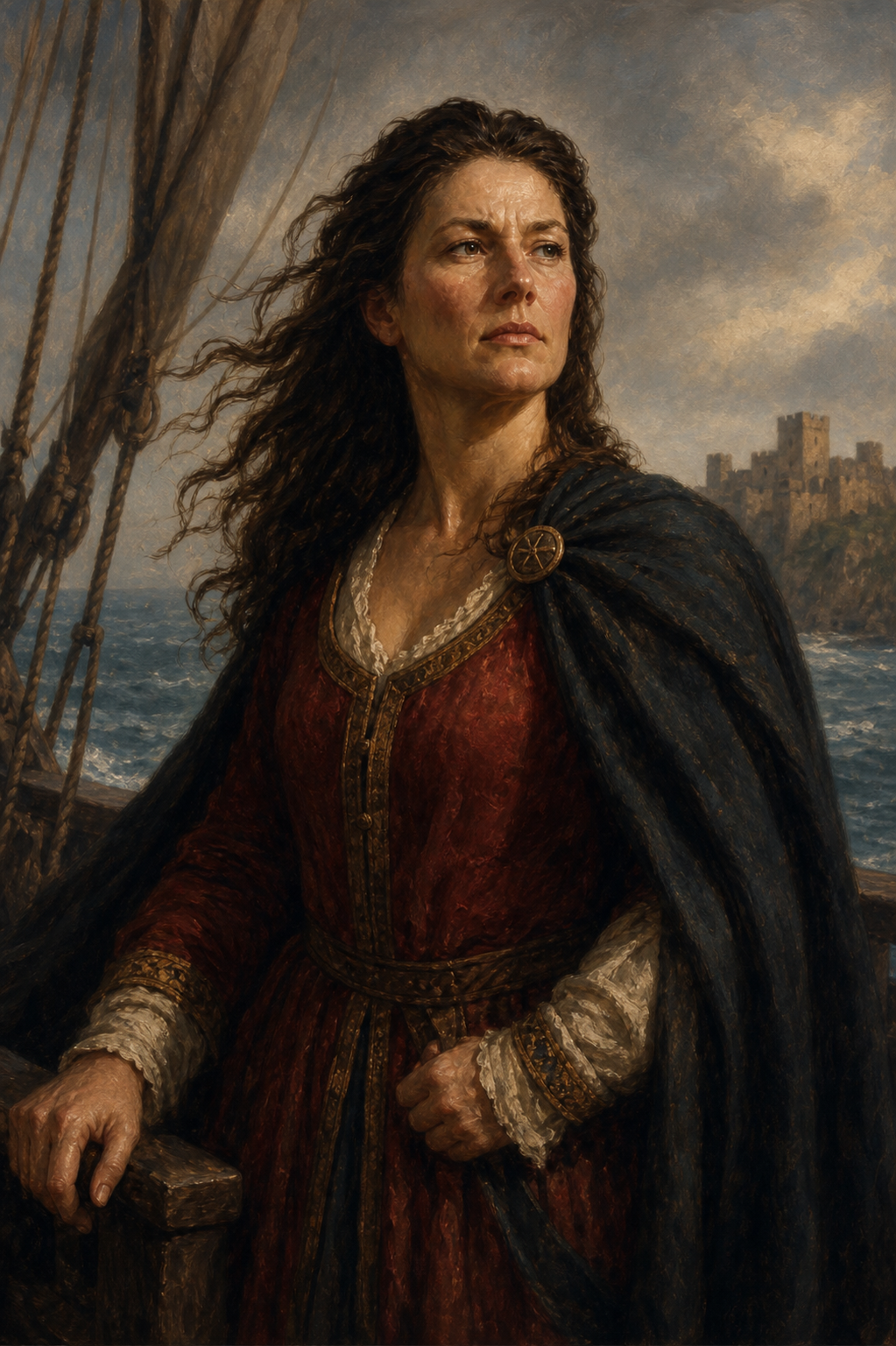
Later tradition says Jeanne sold lands, raised ships, painted them black, and waged a private war against French vessels in revenge. Her fleet becomes the “Black Fleet.” Her ship becomes My Revenge in many retellings. Her legend becomes the Red Lady of Brittany, a woman who left only a few survivors to carry terror back to the king.
It is a magnificent story.
It is also exactly the kind of story that needs a steady hand on the evidence. Medieval revenge, noble politics, maritime violence, and later retelling make a strong drink. Pirate legend has been drunk on weaker stuff.
The Execution That Made the Legend Possible
Olivier de Clisson’s execution is the anchor.
Without it, Jeanne’s story becomes only a theatrical revenge tale in black paint. With it, the story sits inside one of the most unstable political worlds in medieval Europe: Brittany divided by succession conflict, France and England pressing into the struggle, noble families choosing sides, and accusations of treason carrying lethal consequences.
A royal execution was not just a death. It was a message. It told allies, rivals, and nervous nobles where the king believed loyalty ended. It also created enemies who had no reason to accept the king’s version of events.
Jeanne’s later reputation depends on that outrage. She is remembered not as a pirate seeking ordinary plunder, but as a widow who turned political grief into maritime retaliation. Whether every black-sailed detail happened exactly as later tradition says, the emotional mechanism is clear: the state killed her husband, and the legend answered with ships.
That is why the story survives. It does not begin with greed. It begins with injury.
Revenge at Sea
The sea was an ideal place for revenge because it let private violence become mobile.
A castle can be besieged. A court can be watched. A road can be blocked. A ship can appear, strike, and vanish into weather, distance, and rumor. In the fourteenth century, maritime violence could interrupt trade, carry soldiers, move supplies, threaten coasts, and turn political conflict into economic damage.
If Jeanne did take to the sea against French vessels, she was not stepping into pirate adventure as later centuries imagined it. She was entering a medieval world where war, private vengeance, noble allegiance, piracy, and naval pressure could overlap.
That distinction matters. Jeanne de Clisson is often called a pirate because the image fits: black ships, revenge attacks, terror at sea. But her story is not the same as a Golden Age crew chasing prizes in the Caribbean. It belongs to war, nobility, treason, and feudal politics as much as to piracy.
The label pirate helps modern readers find the door. It should not be allowed to lock the room.
The Black Fleet
The Black Fleet is the unforgettable part.
Later versions say Jeanne painted her ships black and used red sails, or black sails, or other variations depending on the retelling. The image is so powerful that it practically writes the poster by itself. A wronged noblewoman on a black ship hunting French vessels: history rarely offers better lighting.
That is exactly why the detail should be handled carefully.
The darker and cleaner the image, the more likely it has been polished by repetition. That does not mean it is false. It means the page should separate the strong core from the dramatic costume around it. The execution of Olivier de Clisson is the firm engine. Jeanne’s association with maritime revenge is the lasting tradition. The exact appearance, naming, and operations of the fleet need fact-checking before they are treated as settled detail.
But even as legend, the black fleet tells us something important. It shows how Jeanne was remembered: not as a passive widow, not as a woman erased by her husband’s death, but as someone whose grief became visible, organized, and terrifying.
The color black did what flags often do in pirate memory. It made violence readable from a distance.
The Red Lady and the Witnesses
The harshest versions of the story say Jeanne’s crew killed most of the captured French sailors and left only a few alive to report what had happened.
That detail is brutal, and it should not be treated as entertainment. If true in any form, it describes terror as communication. The survivors are not mercy in the modern sense. They are messengers. They carry fear back to the enemy.
This is where the legend becomes most revealing. Jeanne’s revenge is remembered not merely as killing, but as staged memory. The point was not only to destroy a ship. It was to make the French crown hear the name attached to the destruction.
That kind of violence belongs to the same dark logic that appears across pirate history. Fear can be operational. A reputation can travel faster than a vessel. Terror can make the next target imagine the ending before the attack begins.
But there is a moral cost to enjoying the story too easily. Revenge legends often make violence feel clean because the first wound was unjust. The execution of Olivier de Clisson may explain Jeanne’s fury. It does not make every later victim disappear into the scenery.
A good profile lets the grief burn without pretending the fire did not spread.
Woman, Widow, Pirate, Symbol
Jeanne de Clisson survives partly because she makes a powerful shape in memory: the noblewoman betrayed by the king, the widow who refuses silence, the woman who turns from courtly life to maritime vengeance.
That shape is irresistible. It is also dangerous.
Powerful women in pirate history are often turned into symbols faster than men. They become “the pirate queen,” “the avenger,” “the red lady,” “the woman who did what men feared to do.” The titles are useful hooks, but they can flatten the person into a single emotion.
Jeanne’s story should stay political. Her husband’s death was not a private domestic tragedy floating outside history. It belonged to conflict between France, Brittany, England, loyalty, accusation, and noble power. Her revenge, if carried out as tradition says, was not only personal fury. It was violence within a larger war-shaped world.
That makes her more interesting than the slogan.
She was not simply angry. She was angry in a world where ships, noble status, wealth, and political fracture could turn anger into action.
The Ending After the Storm
Later tradition says Jeanne eventually left piracy and settled into another life, including marriage to Sir Walter Bentley, an English military figure connected to the conflict in Brittany. As with much of her story, details should be checked carefully and presented with the right level of certainty.
But the broad shape matters: unlike many pirate legends, Jeanne’s story does not necessarily end at the gallows, in a wreck, or with a heroic last stand. It drifts from revenge into settlement, remarriage, and the quieter rearrangements of noble politics.
That is less cinematic than the black sails. It is also historically useful. People do not live only in their most dramatic year. The legend remembers Jeanne as a storm. History has to ask what came before the storm, what it damaged, and what remained after.
The best ending is not “she disappeared into legend.” The best ending is stranger: a woman whose remembered violence grew from a documented political wound, then became larger than the evidence could comfortably hold.
Why Jeanne de Clisson Still Matters
Jeanne de Clisson matters because she sits at the edge of pirate history, medieval war, revenge legend, and political memory.
She is not a standard pirate captain, and forcing her into that mold makes the story smaller. She belongs to a world where noble power, royal suspicion, war at sea, and private vengeance could combine into something pirate-shaped. That edge-case status is useful. It teaches readers that piracy is not one neat costume worn across all centuries.
Her story also shows how beautiful a dark lie can become when it grows from a real wound. The execution is documented enough to hold weight. The black ships and red revenge need careful handling. The legend survives because people want the universe to answer injustice with an image strong enough to frighten a king.
For a later Irish maritime woman whose power rested on ships, kinship, and negotiation, read Grace O’Malley. For another woman whose sea power made a rival state nervous, continue to Sayyida al-Hurra. For the broader route, return to Famous Pirates.
Jeanne de Clisson’s story should not be polished into certainty just because it looks spectacular in black.
The best version keeps the blade and the doubt together: a husband executed, a widow transformed by politics and grief, a sea legend dark enough to survive for centuries, and a reminder that revenge stories are most dangerous when they are almost too satisfying to question.


