The story
Sayyida al-Hurra Made Spain Nervous From the Mediterranean
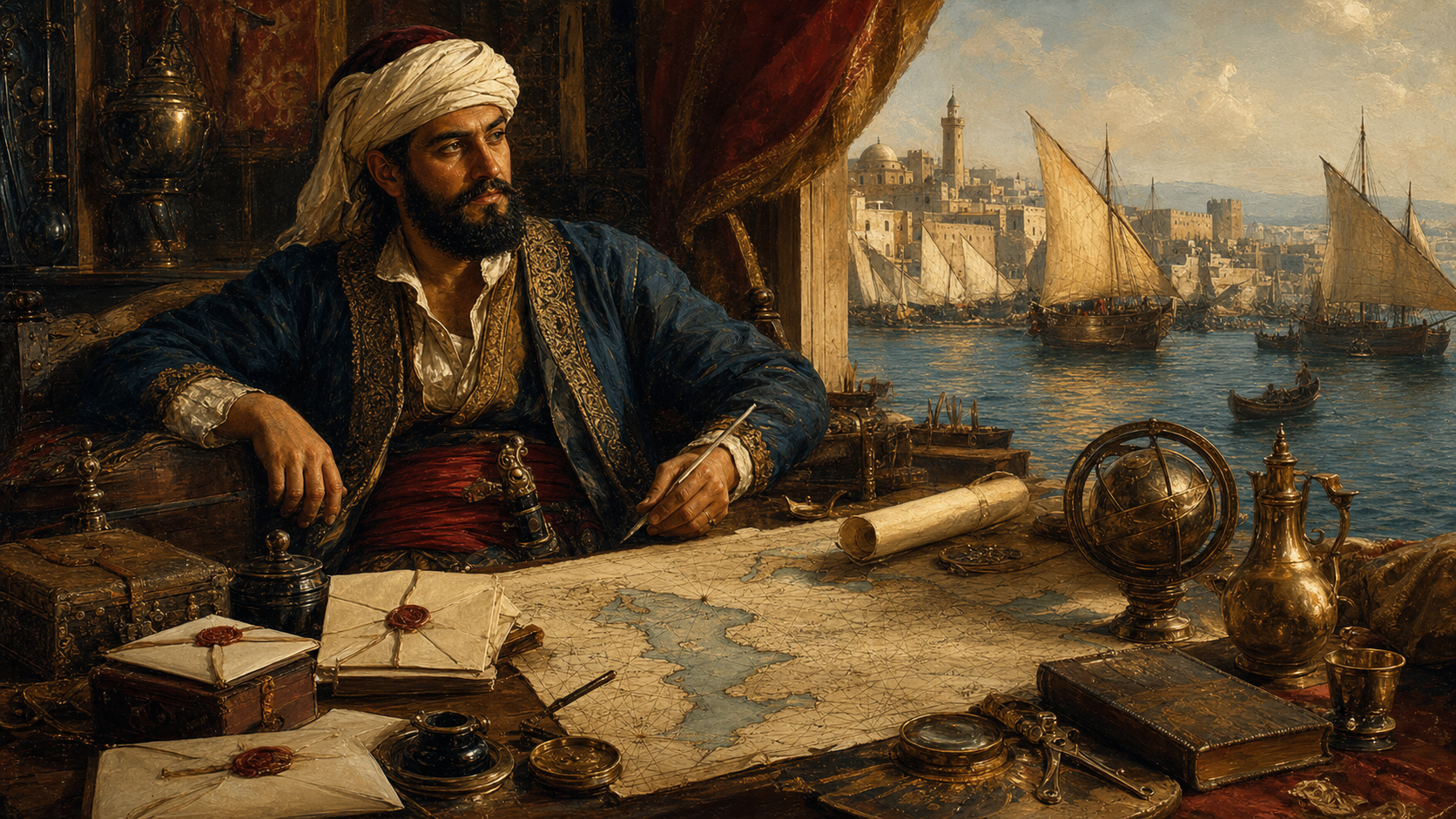
Sayyida al-Hurra's story begins in the shockwave after 1492. Granada fell, Muslim rule in Iberia ended, and exile moved families, wealth, grief, skill, and anger across the western Mediterranean. The sea between Spain and North Africa was not a clean border. It was a route, a battlefield, a marketplace, and a memory of loss. Sayyida al-Hurra belonged to that world.
Calling her a pirate is useful only if the word is handled carefully. She was not a tavern rogue with a flag and a pet legend. She was a ruler associated with Tetouan, a North African city shaped by Andalusi refugees and by pressure from Iberian expansion. Her power at sea made Spain nervous because it was not random crime drifting offshore. It was maritime pressure attached to politics, religion, commerce, revenge, and statecraft.
Granada, Exile, And Tetouan
The fall of Granada mattered because it changed the emotional and political map of the western Mediterranean. For exiled Muslims and Jews, Spain was not simply a neighboring kingdom. It was the place from which families had been expelled, converted, threatened, or uprooted. That history gave raiding and ransom a sharper edge. Maritime violence could carry money, captives, and political messages at the same time.
Tetouan became one of the places where that displaced world took new shape. Rebuilt and strengthened by Andalusi refugees, the city looked toward the sea with more than commercial interest. From the North African coast, ships could threaten Iberian shipping, take captives, support allies, and remind Spain that conquest on land did not end conflict at the shoreline. Sayyida al-Hurra's authority belonged to this coastal pressure system.
That is why the title can be lively without making the body silly. Spain had reason to worry because a strong leader in Tetouan could make the nearby sea expensive, dangerous, and politically embarrassing. Coastal security, trade, captives, and prestige all mattered. A raid was not only a raid. It could become a ransom negotiation, a diplomatic problem, a religious wound, or a public sign that power across the water had not been subdued.
A Ruler, Not A Costume
Sayyida al-Hurra is often presented through labels: pirate queen, corsair queen, ruler of Tetouan, Muslim heroine, Spanish nightmare. Some of those labels point toward real parts of the story, but none of them is enough by itself. The title al-Hurra is usually understood as a marker of free or noble status. It gives the story dignity, not decoration. She was remembered as a woman with authority in a world where women in power are too often made either miraculous or unbelievable.
The more useful profile treats her as a political actor. She operated in a Mediterranean where Christian and Muslim powers both used sea violence when it served them. Corsairs could be condemned as pirates by enemies and treated as useful partners by allies. Captives could become bargaining positions. Prizes could finance ports and rulers. Diplomacy and raiding were not opposites; they often belonged to the same argument conducted by different means.
That does not make captivity gentle or raiding noble. It makes the system more durable. A captive taken at sea could draw in families, religious institutions, merchants, officials, and governments. Ransom turned human danger into political pressure. Sayyida al-Hurra's maritime power should be read inside that harsh machinery, not softened into pageant language. She mattered because she could help make the western Mediterranean less secure for Spain and Portugal.
Corsair War And Political Pressure
In the sixteenth-century Mediterranean, the boundary between pirate, corsair, privateer, and state actor was often contested. The label depended heavily on who was speaking. To Spain, North African corsair activity could look like piracy, terrorism, or religious war. To allies and coastal communities on the other side, the same activity could look like defense, retaliation, income, or legitimate pressure against an enemy. The people captured at sea did not experience these labels as a seminar. They experienced danger.
Sayyida al-Hurra's reputation is tied to that contested world. Her sea power did not float apart from land politics. It connected Tetouan to wider struggles over Iberian expansion, North African authority, Ottoman influence, Moroccan politics, and control of maritime routes. That is a far more interesting story than a simple pirate-queen poster. It explains why Spain might fear her and why later memory kept hold of her name.
Compared with a figure such as Francis Drake, she also shows how moral labels travel badly across enemy lines. Drake could be celebrated in England and cursed in Spain. North African corsairs could be feared by Iberian powers and valued by their own communities. The pattern is not identical, but the lesson is similar: at sea, law often arrived wearing national colors.
Power, Gender, And Memory
Sayyida al-Hurra's gender has helped preserve her fame, but it can also flatten her. A woman commanding power in this setting is remarkable; treating that as her only importance is lazy. She mattered because she was positioned inside real networks of rule, refugee memory, maritime violence, ransom, and diplomacy. The surprise is not that a woman somehow entered a man's story. The stronger point is that the story of the sea was not as male-only as later shorthand made it seem.
There are also limits to what can be said confidently. Surviving accounts are uneven, filtered by later writers, and sometimes eager to turn powerful women into symbols. A calm profile can admit that without making the story weak. The secure frame is strong enough: Tetouan, Andalusi displacement, Iberian anxiety, corsair pressure, and the political use of the sea. Where later tradition becomes more ornate, the reader deserves a clear signal that the record is thinner.
Her eventual displacement from power belongs to regional politics rather than a tidy pirate ending. There is no neat gallows scene or captured treasure ship to close the curtain. That can feel less theatrical, but it is historically better. Sayyida al-Hurra's life points toward marriage alliances, Moroccan rule, local power, and the instability that came with authority in a contested port city. The sea made her formidable. Politics still had teeth on land.
Why She Still Matters
Sayyida al-Hurra matters because she widens the reader's idea of piracy without turning the word into mush. Her story shows how raiding, ransom, diplomacy, exile, revenge, and state power could occupy the same coastline. She was not outside history, waving from a romantic margin. She was inside the politics of her world, using the sea as one instrument of pressure.
For the wider gallery, return to Famous Pirates. For the broader background of sea power, law, empire, and violence, follow the history of piracy. Sayyida al-Hurra belongs between those routes because her story makes the category problem visible: pirate to whom, ruler to whom, corsair under whose protection, and enemy by whose law?
The exciting part of Sayyida al-Hurra is not that she can be squeezed into a familiar pirate costume. It is that she makes the costume look too small. Spain had reason to be nervous because her world connected memory, ships, captives, money, coastal rule, and revenge. That is enough drama. The body does not need to shout. The history already has a blade in it.


