The story
Sir Francis Drake
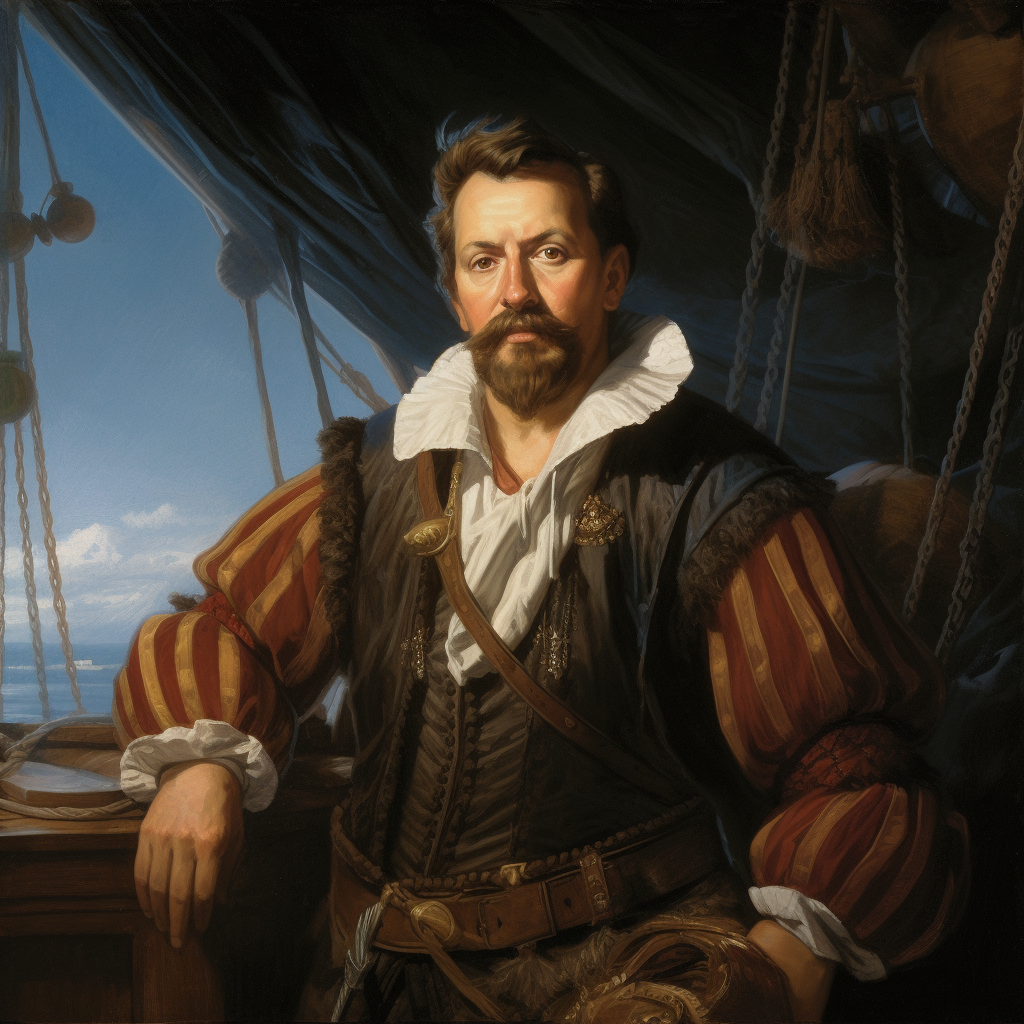
Francis Drake is a pirate if the story is told from the Spanish side of the deck. To Elizabethan England he was a privateer, explorer, naval commander, and national weapon. To Spain he was El Draque, the dragon: a state-backed raider who hit ships and ports under a legal cover England found extremely useful. That double identity is the point. Drake did not sail like an outlaw with no government behind him, but a royal commission did not make his violence gentle to the people he attacked.
Privateering was paperwork with cannon smoke attached. It allowed a crown to turn private ships into pressure against an enemy while preserving just enough legal language to argue about respectability later. Drake's career belongs inside that argument. He was daring, skilled, and politically valuable. He was also a predator in Spanish waters. The label changes with the flag above the report.
The Atlantic That Made Drake
Drake was born around 1540 and learned the sea during the hardening rivalry between England and Spain. His early career was tied to John Hawkins and English slaving ventures in the 1560s, a fact that belongs near the front of the story. The Elizabethan Atlantic was not a clean adventure playground. Ships carried trade goods, weapons, enslaved people, disease, religion, ambition, and revenge in the same troubled world.
The disaster at San Juan de Ulua in 1568, where Spanish forces attacked Hawkins's fleet, helped feed Drake's hostility toward Spanish power. His later raids were not random mischief. They belonged to a Protestant-Catholic, English-Spanish, commercial-imperial struggle in which silver, ports, captives, and reputation mattered. Drake became famous by learning how to move through that system and strike where Spain believed distance still protected it.
That early Atlantic experience also explains why Drake could be so effective. He understood ships, crews, trade routes, fear, and timing. He knew that an empire depended on routines: cargo gathered, silver moved, ports expected certain ships, officials trusted distance, and local defenses often lagged behind the threat. A smaller English force could not simply overpower Spain's empire, but it could embarrass the machinery, interrupt the flow, and make security look uncertain.
In the early 1570s he raided Spanish interests in the Caribbean and along the Spanish Main. He learned that treasure did not only travel on ships. It moved through mule trains, storehouses, ports, and predictable imperial routines. That is where Drake becomes more than a quick sea thief. He targeted systems. Spanish silver had a chain of movement from mines to ports to fleets, and English privateering learned to hit the chain before it became a guarded convoy.
The Golden Hind And The Great Insult
Drake's circumnavigation from 1577 to 1580 made him the first Englishman to sail around the world. It was exploration, privateering, politics, and plunder folded into one hazardous voyage. The expedition included storms, desertion, command crisis, the execution of Thomas Doughty, passage through the Strait of Magellan, and a run up the Pacific coast where Spanish shipping was not expecting an English raider.
The capture of the treasure ship commonly known as the Cacafuego became one of the voyage's great prizes. Drake returned in the Golden Hind with wealth and prestige enough to make diplomatic discomfort manageable. Elizabeth I knighted him aboard the ship in 1581. Spain saw piracy. England saw profit, reach, and a useful insult delivered across an ocean.
The execution of Doughty keeps the voyage from becoming only treasure and triumph. The politics of that episode remain contested, but it reveals the pressure inside long-distance command. A ship circling the world was a cramped society under fear, hunger, ambition, and uncertainty. Authority had to be performed and enforced. Drake's success came with discipline that could turn lethal inside his own expedition.
The Pacific run mattered because Spain had not built that coast around the expectation of English attack. Drake exploited a mental map as much as a nautical one. He appeared where he was not supposed to appear, and that made the violence feel larger than the tonnage involved. The prize was treasure, but it was also proof that Spain's oceanic walls had doors.
Drake's landing on the western coast of North America, often discussed under the name New Albion, adds another useful caution. The exact location has attracted debate, and the page does not need to pretend that every coastline argument is settled. What matters for the profile is the imperial gesture: naming, claiming, mapping, and turning a voyage into a story of English reach. The map itself became part of the prize.
Privateer To One Side, Pirate To Another
Drake's usefulness to Elizabeth came from the awkward space between official war and deniable violence. He could damage Spain, enrich investors, strengthen court favor, and embarrass Philip II without requiring England to fight Spain on Spain's preferred terms. That flexibility is why privateering mattered. It was not lawless in English eyes, but it was hardly comforting to Spanish merchants watching cargo, ships, and lives become leverage.
The Spanish view deserves space because it was not mere whining from the losing side. Drake attacked Spanish routes, ports, silver flows, and imperial confidence. He made distance unreliable. He could appear where Spain expected routine. To the people he raided, the English legal theory behind his commission did not return goods or undo fear. The word pirate named an injury, not just a diplomatic complaint.
That is why Drake is more useful than a simple outlaw profile. He shows how legality and morality can pull apart. A document could make a raid acceptable to one crown and criminal to another. Investors could profit while diplomats frowned. A queen could enjoy the treasure and manage the scandal. The sea did not become honest because someone brought paperwork; it became more arguable.
Privateering also gave England a practical tool while its formal naval power was still developing. Ships, investors, experienced captains, and royal permission could combine into a kind of outsourced pressure. The arrangement spread risk and reward across court, merchants, crews, and crown. That made Drake useful before England could reliably dominate by fleet alone.
For Spanish communities, the distinction could feel like mockery. A license written in London did not soften a raid in the Caribbean or along the Pacific coast. It only explained why the attacker expected applause at home. That gap between legal authorization and lived injury is the heart of Drake's pirate problem.
For comparison, Henry Morgan also lived in the uncomfortable borderland between state-backed violence and piracy. The wider setting appears across the history of piracy, where law, trade, naval pressure, and reputation often argue with one another. Drake belongs in that company because he makes the categories visible.
Armada, Legend, And National Memory
Drake's later career moved from privateering celebrity to national defense. His 1587 raid on Cadiz, remembered as singeing the King of Spain's beard, disrupted Spanish preparations. In 1588 he served as vice admiral during the Spanish Armada campaign. He was important, but the Armada's failure came from many causes: English tactics, Spanish difficulties, weather, command decisions, fireships, and luck. A single-hero version is easier to remember and less useful.
The famous story that Drake calmly finished a game of bowls before fighting the Armada is best treated as patriotic legend. It captures the image England wanted: cool, confident, unhurried, and slightly theatrical. Whether the scene happened in that neat form matters less than what the story reveals. Drake had become a national pose. He was no longer just a captain; he was a way England imagined itself under pressure.
National memory kept Drake bright because he gave England the kind of story it wanted in an age of danger: a smaller kingdom needling a richer empire, a sea captain turning distance into opportunity, a dragon name thrown back as a badge of fearlessness. Spanish memory had fewer reasons to admire the performance. Both reactions belong in the article. Drake's fame was built out of admiration and injury at the same time.
That usefulness lasted because Drake could stand for several stories at once: Protestant defiance, maritime skill, imperial ambition, profitable raiding, and the idea that England could survive by being faster and sharper at sea. Heroes are often built from convenient compression.
His death in 1596 during a failed Caribbean expedition gives the profile a colder ending. He probably died of dysentery and was buried at sea near Portobelo. The final campaign did not match the bright raids that made his name. That matters because legends edit careers. They keep the successful insult, the treasure ship, the knighting, the Armada image, and the dragon nickname. Failure and sickness usually get less poster space.
Why Drake Still Matters
Drake matters because he refuses a simple verdict. If a crown backs the voyage, is the raider a privateer? If the victims call him pirate, are they wrong? If profits support national power, does legality become moral cover? Drake does not answer those questions neatly. He makes them impossible to avoid.
The title can stay exciting because the body earns it. Privateer, Raider, Dragon is not a costume rack; it is the argument. Privateer names the English legal frame. Raider names what he did. Dragon names the fear and anger he left in Spanish memory. Together they describe a man whose reputation depends on perspective, paperwork, and violence.
For the wider gallery, return to Famous Pirates. Drake belongs there not because he was an ordinary outlaw, but because he shows how close official violence could stand to piracy when states found the arrangement profitable. England made him a hero because his raids served English power. Spain named the injury more plainly. The reader needs both views, because the subject becomes flatter the moment one side is allowed to do all the talking.
The best version of Drake keeps the thrill and the discomfort together. He was a brilliant seaman, a ruthless commander, a slaving-era Atlantic actor, a privateer enriched by plunder, a national defender, and a pirate in the eyes of the people he hurt. That is not a contradiction to smooth away. It is the reason his profile still has teeth.


