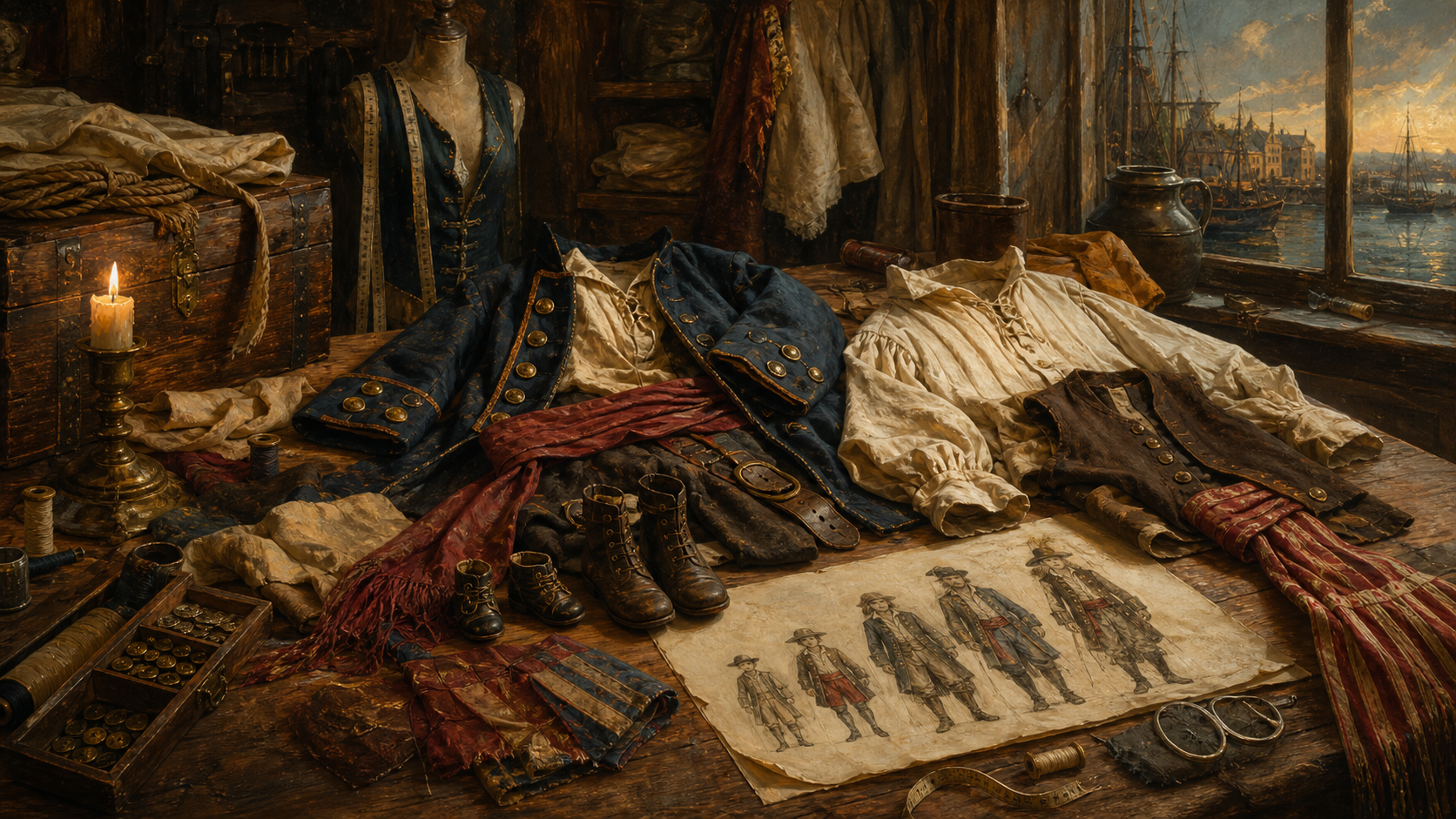
A pirate costume has one job before all others: make the wearer feel a little more dangerous than Tuesday normally allows.
That is why the costume survives. It is not really about accuracy. It is about permission. A child gets to become the captain of the backyard. An adult gets to escape business casual without having to explain a midlife crisis. A family gets a theme that works for Halloween, school events, birthday parties, theater, fairs, photos, and any gathering improved by a hat with unreasonable confidence.
Still, a little history helps. The best pirate costume does not have to be museum-perfect. It should simply avoid looking like every pirate in history shopped from the same bag of stripes.
The Basic Pirate Shape
Most pirate costumes work because they create a recognizable silhouette: loose shirt, waist sash or belt, vest or coat, head covering, boots or boot covers, and one or two accessories that say “sea robber” before anyone has to explain the outfit.
That silhouette is partly historical and partly theater. Real pirates were sailors, and sailors needed clothes that could survive salt, sweat, rope, tar, weather, cramped decks, and hard work. They wore practical garments, stolen garments, repaired garments, and whatever fit well enough to keep moving. Some successful pirates wore fine coats, bright fabrics, jewelry, and plundered clothing when they could get it. But nobody was issued a universal pirate uniform.
The costume version compresses all of that into one readable picture. That is fine. Costumes are translation, not confession.
The trick is to choose the right translation for the person wearing it.
Pirate Costumes for Children
For children, comfort beats historical ambition every time.
A child’s pirate costume should be easy to move in, easy to adjust, and safe enough for running, sitting, eating, shouting, and forgetting where the sword went. Soft shirts, elastic waists, lightweight vests, simple sashes, foam swords, cloth bandanas, and easy boots or shoe covers usually matter more than elaborate coats.
The best children’s costumes also leave room for imagination. A hat and sash can do more work than a stiff full-body outfit that becomes itchy after ten minutes. If the child is going to wear the costume to school, a party, or a long event, avoid anything too hot, too tight, too sharp, too long, or too dependent on adult repair.
Historically inspired details can still help: a plain shirt, a practical vest, a waist sash, a soft headscarf, and a simple pouch often look better than plastic overload. Add a treasure map, toy spyglass, or small flag, and the costume becomes a story rather than a pile of pieces.
The child does not need to look like Blackbeard. The child needs to feel like the ship has chosen them.
Pirate Costumes for Teens
Teen costumes usually need a different balance: less cartoon, more style.
This is where layered pieces work well. A dark vest over a loose shirt, a sash in a strong color, fitted trousers or leggings, boots, a belt, and a coat or scarf can create a more polished pirate look without becoming stiff. Teens often care whether the costume looks intentional rather than childish, so choose pieces that could almost pass as dramatic clothing before the accessories push them fully into pirate territory.
A good teen costume also works for group themes. One person can be the captain, another the quartermaster, another the mapmaker, another the tavern rogue, another the naval officer who has made questionable life choices. This gives everyone a role without forcing matching outfits.
Avoid the trap of making every pirate costume depend on fake dirt and fake scars. Weathered can look good. Random smudging often just looks like the laundry lost a fight.
Pirate Costumes for Adults
Adult pirate costumes can go several directions.
The classic version uses a white or cream shirt, dark trousers, waist sash, vest, boots, and hat. It is easy to recognize, easy to customize, and forgiving if assembled from ordinary clothing. A scarf, belt, pouch, earring, coat, or prop can push it further.
The captain version adds authority: longer coat, better boots, wider belt, heavier hat, stronger color contrast, perhaps a decorative sword or pistol prop where allowed. The danger here is over-accessorizing. A pirate captain should look like someone who gives orders, not someone who lost a bet in an antique shop.
The sailor version is often better historically: practical shirt, short jacket or vest, head wrap, simple trousers, belt, and worn-looking shoes. It looks less like a costume poster and more like someone who might actually climb rigging without needing a dressing room.
The tavern version is looser and more social: linen-style shirt, vest, sash, boots, dramatic scarf, mug, cards, map, or coin pouch. It is good for parties because it says “pirate” without requiring a full shipboard command structure.
Pirate Costumes for Families
Pirates are excellent for family costumes because the theme naturally creates a crew.
One person can be captain. One can be quartermaster. One can be a mapmaker. One can be a cabin kid. One can be a ghost of a shipwreck, a treasure guard, a tavern keeper, or the deeply suspicious parrot. The outfits do not need to match. In fact, they usually look better when they share a palette but not a uniform.
Pick two or three shared colors: navy, rust, cream, black, red, tan, or brass. Then vary the pieces by age and personality. Children can have softer, simpler versions. Adults can carry the more structured coats and accessories. A shared flag or treasure chest ties the group together.
The best family costume has a story. Are you the crew of a cursed map? A pirate family on shore leave? A defeated naval party pretending everything is fine? A shipwrecked crew that has clearly lost the captain’s hat in a disagreement?
Costume themes work better when they suggest what happened five minutes before the photo.
Historically Inspired Without Becoming Miserable
Accuracy does not have to be joyless.
For a more historically inspired pirate costume, start with sailor logic. Choose clothes that look movable, layered, and weather-ready. Avoid making every piece pristine. Use natural-looking fabrics where possible. Linen, cotton, canvas-like textures, wool-like coats, leather belts, rope details, brass-colored buckles, and muted sea colors usually look stronger than shiny plastic.
Remember that pirates wore what they had, what they stole, what they repaired, and what made them look dangerous when necessary. A fine coat could be plunder. A scarf could be practical. A sash could hold tools. A hat could signal status. A plain shirt could be the most realistic thing in the room.
Historically inspired does not mean boring. It means the costume feels like it has a job.
The Movie Pirate Look
The movie pirate look is not a crime. It is simply not a document.
Huge hats, dramatic coats, long boots, eye patches, hooks, parrots, gold earrings, striped shirts, skull jewelry, and theatrical makeup all belong to the popular pirate vocabulary. Use them if they serve the occasion. Just know what they are doing: they are helping other people recognize the story quickly.
That is not a weakness. A costume has to speak across a room.
The problem comes only when the movie version is treated as universal history. Pirates did not all dress like the same poster. They came from many seas, centuries, cultures, and legal categories. A Barbary corsair, a Caribbean buccaneer, a South China Sea pirate, a privateer in Elizabethan service, and a Golden Age Atlantic sailor should not all look identical.
The costume can simplify. The mind should not.
Accessories That Actually Work
Good pirate accessories create character without turning the outfit into clutter.
A map suggests purpose. A pouch suggests loot. A spyglass suggests command or watchfulness. A sash adds color. A belt gives structure. A hat changes posture. A scarf softens the silhouette. A flag gives the whole group a crew identity. A foam sword may be necessary for children, but many adult costumes look better when the weapon is not the entire point.
Jewelry can work if restrained. So can a fake coin, a compass, a notebook, or a rolled chart. The best accessory should answer a question: Who is this pirate? Captain, navigator, mutineer, smuggler, scholar, runaway, tavern singer, ship’s cook, ghost, or person who is absolutely going to betray everyone by sunset?
A prop is better when it creates a role.
What To Avoid
Avoid unsafe weapons, uncomfortable shoes, heavy coats in hot rooms, dragging fabric, masks that block vision, and accessories that need constant adjustment.
Avoid turning children’s costumes into miniature adult seduction costumes. Let young pirates be adventurous, funny, defiant, clever, brave, ridiculous, or dramatic. They do not need grown-up styling to carry the theme.
Avoid fake historical certainty. Nobody at the party needs a lecture, but the costume page does not have to repeat myths as facts. Eye patches were not standard night-vision technology. Parrots were possible, not mandatory. The plank was mostly theatrical. The accent owes more to performance than shipboard reality.
A better pirate costume can enjoy all of these things while knowing they are part of the legend.
The Best Costume Is the One With a Story
The strongest pirate costume is not the most expensive. It is the one that makes the wearer stand differently.
A child with a map may become a captain. An adult with a worn coat and a dry expression may become a privateer who insists everything was legal. A teenager with a red sash and a battered notebook may become the cartographer no one should have trusted. A family with one shared flag becomes a crew before anyone says a word.
That is the real point of pirate costume. It lets people borrow a little rebellion for the day.
Dress the part. Keep the evidence in one pocket and the fun in the other. The sea has room for both.


