Pirate costumes for women have been badly treated by the costume aisle.
Too often the choice is between a plastic captain, a tavern fantasy, and something that appears to have lost most of its fabric during a boarding action. That may be fine for some parties. It is not the whole sea.
A stronger women's pirate costume starts with a better question:
Who is she supposed to be?
A captain who expects obedience? A privateer with paperwork and a dangerous smile? A deckhand who can actually move? A tavern rogue with stories nobody should believe? A sea queen? A smuggler? A woman stepping out of the historical record and into the louder room of legend?
Once the role is clear, the costume stops being a pile of accessories and starts becoming a character.
The hat may still help.
It should not be doing all the work.
Start with movement
The first rule is practical: the outfit has to move.
Pirates lived in a world of ships, docks, taverns, stairs, mud, rope, heat, weather, and bad decisions. A costume does not need to be historically perfect to respect that reality, but it should not make walking across a room feel like crossing the Atlantic in chains.
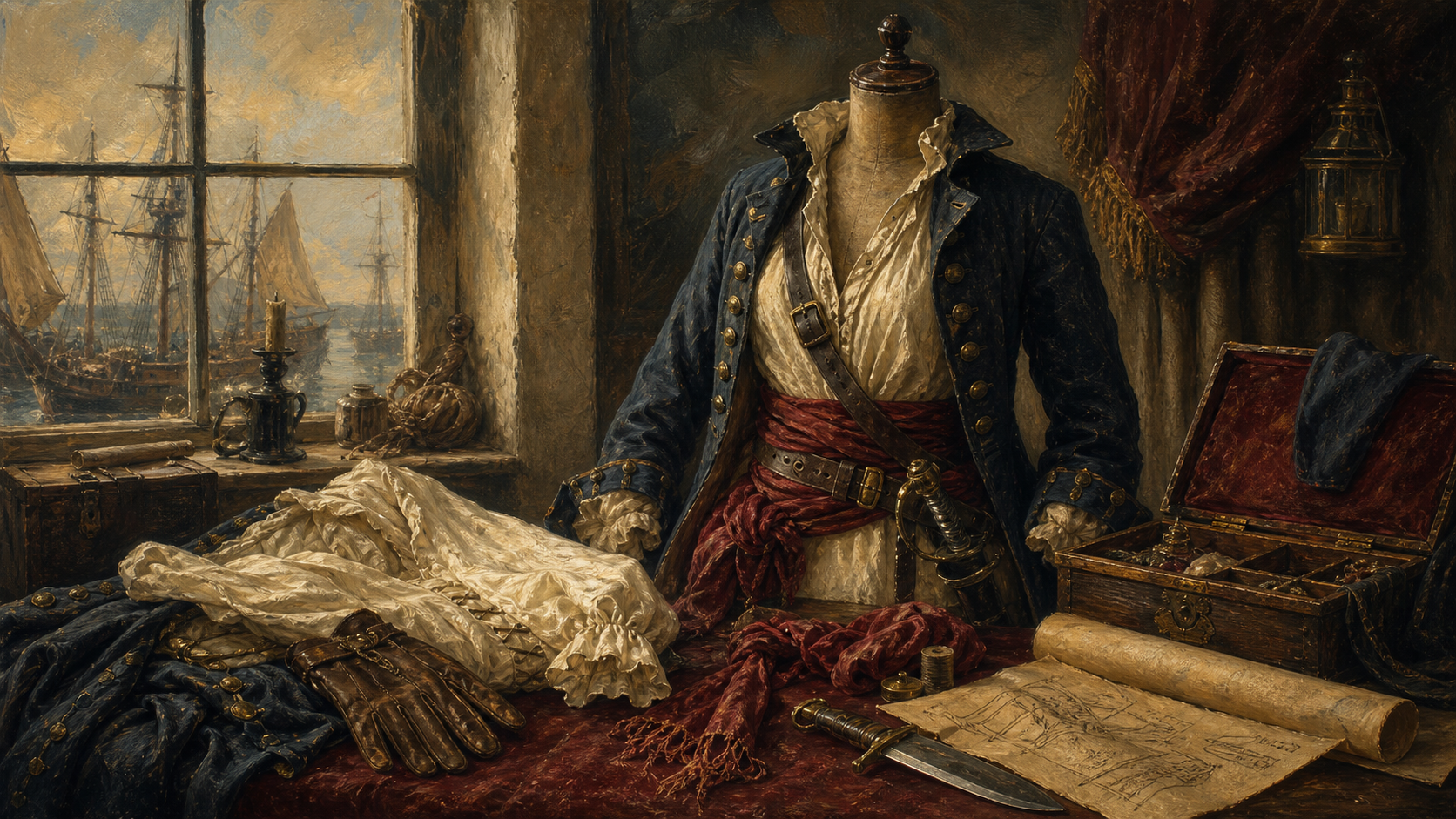
A good base can be simple: loose blouse or shirt, vest or waistcoat, trousers, leggings, skirt over leggings, sash, belt, and boots or dark shoes. That is enough to build from.
Trousers immediately read as active and shipboard. A skirt can work beautifully, especially for a privateer, tavern rogue, or storybook captain, but length matters. If it drags, snags, trips, or needs constant management, it is not drama. It is a liability with lace.
A vest gives shape without the heat of a full coat. A short jacket adds authority. A long coat can look fantastic, but it should pass the sit-walk-heat test. If it only works while standing in a mirror, it is a portrait, not a costume.
Choose the role before the accessories
The captain wants structure.
Think coat, sash, belt, confident hat, and one strong prop. The captain does not need every possible object tied to her body. One good hat, one good belt, and one good coat can do more than a sword, pistol, compass, pouch, skull necklace, eye patch, parrot, and three pounds of decorative chain.
The deckhand wants ease.
Loose shirt, vest, rolled sleeves, darker trousers, scarf or head wrap, belt, and practical shoes. This is the best choice for movement, outdoor events, festivals, and people who would rather enjoy the party than spend the evening adjusting a coat designed by someone who has never met weather.
The privateer wants polish.
A cleaner blouse, fitted waistcoat, long coat or military-inspired jacket, boots, restrained jewelry, and perhaps a document case or map. The privateer insists the raid was legal. The audience may decide how much to believe her.
The tavern rogue wants attitude.
Layer textures: blouse, vest, sash, coin belt, scarf, dramatic earrings, and something that looks acquired rather than purchased. This is where mismatched pieces can look intentional. The outfit should suggest a person who entered by the back door and already knows where the good bottle is kept.
Historical flavor without costume jail
A pirate costume does not need to become a dissertation with sleeves.
But a little historical flavor helps. Real maritime clothing was shaped by work, weather, class, money, and whatever could be stolen, bought, repaired, or made to last. The most useful inspiration is not “sexy pirate.” It is layers, fabric, movement, and purpose.
Avoid making the outfit entirely dependent on bare skin. Bare shoulders, corsets, and dramatic cuts can be part of a costume, but they should be choices, not the entire concept. A woman pirate costume can be confident without reducing the wearer to decoration.
The real women associated with piracy — Anne Bonny, Mary Read, Zheng Yi Sao, Grace O'Malley, Sayyida al-Hurra, and others — came from very different worlds. They were not all the same type of figure, and none of them can be flattened into one costume template. Use them as sparks, not costumes to photocopy badly.
Anne Bonny and Mary Read point toward disguise, trial, gender expectations, and legend-heavy memory. Zheng Yi Sao points toward command at scale. Grace O'Malley belongs to Irish coastal power and politics. Sayyida al-Hurra belongs to Mediterranean corsair pressure and rule.
That range is freeing. A women's pirate costume does not have to be one thing.
The sash does more than you think
A sash is one of the easiest upgrades.
It defines the waist, adds color, carries the eye, and helps tie unrelated pieces together. Red is classic, but rust, navy, cream, faded green, burgundy, black, or gold can all work depending on the mood.
The belt sits over or under the sash depending on the look. A belt gives structure and somewhere to hang a pouch, bottle, compass, or prop dagger. But do not overload it. Too many dangling items turn a pirate into a moving hardware display.
A headscarf can be more comfortable than a large hat and often feels more practical. A tricorn or captain hat adds instant recognition, but comfort matters. If the hat is too heavy, too hot, or constantly falling off, it will spend the evening under someone's chair.
The best accessory is the one you can forget you are wearing until someone compliments it.
Boots, shoes, and the problem of floors
Boots look excellent. Boots also need mercy.
If the event involves standing, walking, dancing, grass, cobblestones, stairs, or children, choose footwear that will not betray you. Tall boots, ankle boots, dark flats, and practical costume boot covers can all work. Extreme heels may look dramatic for five minutes and then become the villain of the evening.
Most people will notice the silhouette before they notice the exact shoe. A strong sash, vest, and headpiece can carry the pirate read even with sensible footwear.
Pirates had many enemies. Your shoes do not need to join them.
Props should tell one story
Props are where costumes either sharpen or collapse.
A sword says fighter. A map says navigator or treasure hunter. A pistol says threat. A tankard says tavern. A ledger or scroll says privateer, smuggler, or someone who knows the law just well enough to avoid it. Jewelry can suggest plunder, status, or performance.
Choose one main story.
If the outfit says captain, carry a map or sword. If it says tavern rogue, carry a tankard or pouch. If it says privateer, carry papers. If it says sea queen, use jewelry, coat, and posture rather than a dozen props.
The goal is not to look like the costume drawer exploded. The goal is to look like a person who came from somewhere and is probably going somewhere worse.
Quick formulas that work
For a practical pirate: loose blouse, vest, trousers, sash, belt, boots, headscarf.
For a captain: blouse, fitted vest, long coat, sash, belt, hat, one strong prop.
For a tavern rogue: blouse, layered skirt or trousers, vest, scarf, coin belt, earrings, tankard.
For a privateer: cleaner shirt, waistcoat, dark trousers or skirt, structured coat, boots, map case or letter.
For a storybook sea queen: dramatic coat or capelet, deep colors, sash, jewelry, boots, and enough restraint to keep the outfit powerful rather than cluttered.
The better costume
A good women's pirate costume does not ask, “How do I look like a pirate?”
It asks, “What kind of pirate story am I entering?”
That is where the outfit gets interesting. Clothing becomes character. Props become clues. Comfort becomes confidence. Historical flavor gives the costume weight without trapping it in museum glass.
The best version is practical enough to wear, dramatic enough to remember, and specific enough that the wearer feels like more than a costume label.
The sea has room for more than one kind of trouble.


