Pirate culture
Custom, symbol, and story
The Jolly Roger was not cute branding; it was a threat system designed to make a ship surrender before the shooting started.
The Jolly Roger has had an unfairly cheerful afterlife.
It decorates lunch boxes, birthday parties, Halloween aisles, beach bars, cartoons, toy chests, and the occasional office where someone wants to suggest rebellion but still attend the 2:30 meeting. A skull over crossed bones now says “pirate fun” more often than it says “you may be murdered for your cargo.”
That is a remarkable public-relations recovery.
The original point was less adorable.
A pirate flag was a threat system. It was raised when the target was close enough to understand the message and frightened enough to act on it. It told a merchant crew that surrender might preserve their lives, while resistance could make the next few minutes very educational in the worst possible way.
The Jolly Roger was not decoration.
It was negotiation with a skull on it.
The movie version
In movies, the pirate ship sails around proudly displaying the skull and crossbones at all times.
Everyone knows who is coming. The music swells. The flag snaps. The captain looks villainous in excellent lighting. The audience has no doubts, because the flag has done the work of a title card.
It is perfect cinema.
It is not very good piracy.
A pirate ship that announced itself from miles away gave potential victims more time to flee, prepare, hide valuables, reach harbor, signal for help, or curse with useful specificity. Pirates often preferred deception until the moment deception stopped being useful. False colors, innocent posture, or ordinary sailing behavior could bring a pirate vessel close enough that the target had fewer choices.
Then the flag mattered.
Not as branding.
As pressure.
The real version
Pirate flags were part of the attack.
They communicated intent across distance, noise, wind, and fear. A merchant captain did not get a calm explanatory pamphlet. He saw a fast vessel closing in, weapons ready, men on deck, and finally the flag that made the situation plain.
The message was simple: surrender.
A black flag could suggest that quarter might be given if the target submitted. A red flag, in some contexts, could signal harsher intent or no mercy. Meanings varied by time, place, and account, so it is worth being careful. But the broad logic is clear enough. Flags helped pirates turn reputation into compliance.
That was the whole point.
A pirate crew wanted goods, ships, supplies, money, papers, and information. A target that surrendered preserved value. A target that fought risked damaging the cargo, killing useful people, and injuring the pirate crew. Fear was cheaper than battle.
The flag made fear visible.
There was not one official pirate flag
The modern mind wants one Jolly Roger.
History gives us many.
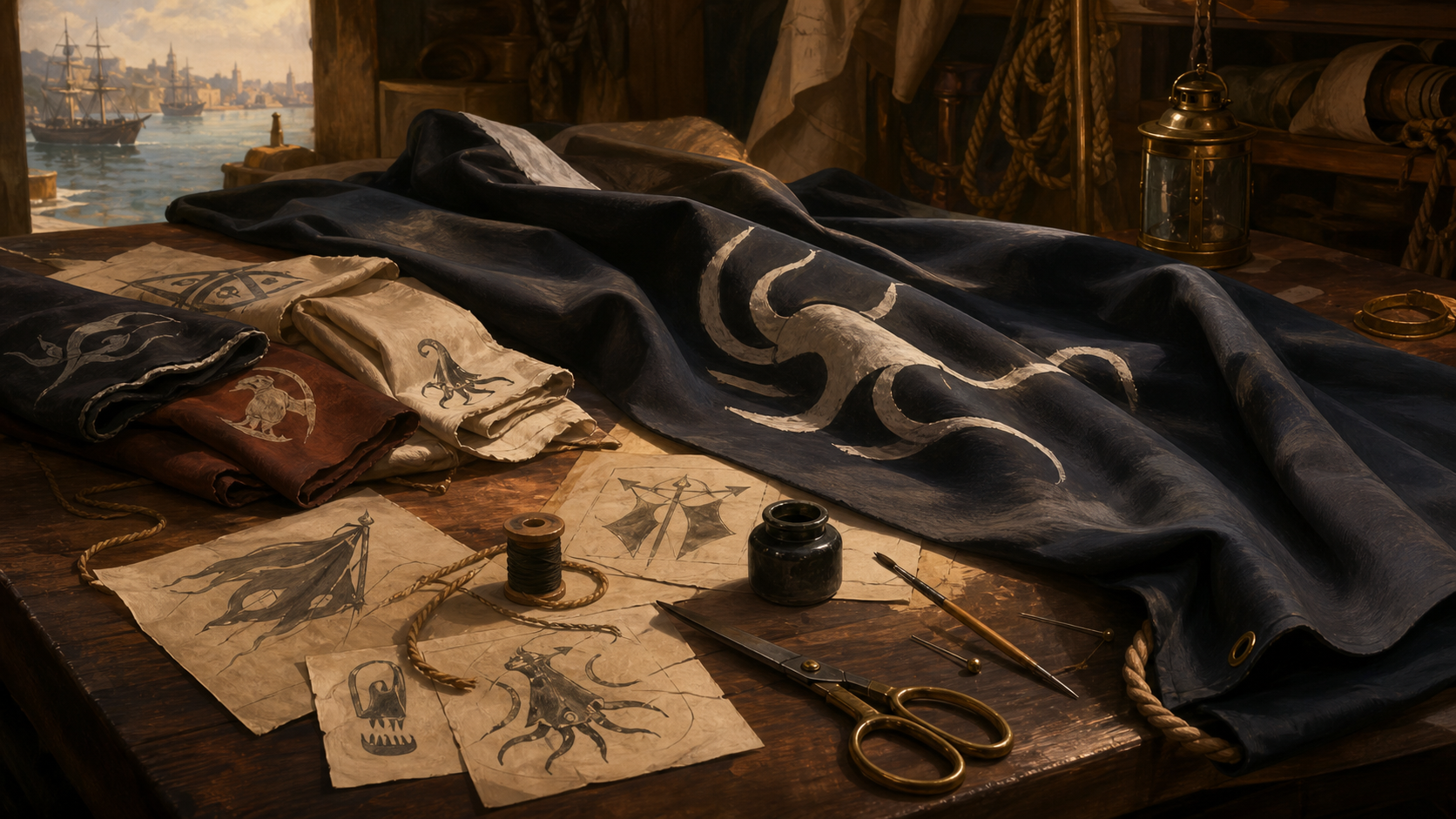
Pirate flags could feature skulls, skeletons, hourglasses, bleeding hearts, weapons, full figures, crossed bones, crossed cutlasses, or other cheerful reminders that mortality had joined the conversation. Some designs are better documented than others. Some have been repeated because they are visually irresistible. Some attributions should be handled with caution because later pirate culture loves tidy symbols more than evidence always allows.
John Rackham, Calico Jack, is strongly associated with the skull and crossed cutlasses design in modern memory. Blackbeard is associated in popular tradition with a horned skeleton spearing a heart, though flag attributions can be messy. Bartholomew Roberts is linked to dramatic flags that made his enemies and his own reputation part of the same performance.
The important point is not that every design can be nailed down with museum-label certainty.
The important point is that pirates understood symbols.
A flag could compress a threat, a reputation, and a promise of violence into one visible object.
The name is murkier than the image
The phrase “Jolly Roger” has a debated origin.
Several explanations have been proposed, including links to red flags, French wording, English slang, or other nautical and criminal associations. The confident version is often more satisfying than the evidence allows. That is normal for pirate history. The subject attracts explanations that arrive wearing boots before checking whether the floor is solid.
The safest treatment is simple: by the early eighteenth century, “Jolly Roger” was associated with pirate flags in English usage, but the exact origin of the term remains uncertain.
That uncertainty does not weaken the article.
It protects it from pretending that a good story and a proven origin are the same thing.
Why skulls worked
A skull is efficient.
It crosses language, literacy, and social rank. You do not need to read English, French, Spanish, Dutch, or any other language to understand that a skull is not an invitation to tea. Bones, hourglasses, bleeding hearts, and weapons all carried related messages: death, time running out, violence, punishment, and the cost of resistance.
Pirates did not invent the human fear of death.
They put it on cloth.
This matters because a flag was not only a sign of identity. It was a weapon aimed at decision-making. A merchant captain had to decide whether to resist. His crew had to decide whether to obey. Passengers had to decide whether to panic quietly or loudly. The pirate flag entered that room before the pirates did.
A good flag saved time.
Time saved lives for the pirates and sometimes for the victims.
It also saved profit.
The flag did not make pirates harmless
There is a tempting soft version of this argument: pirates used flags to avoid violence, therefore they were almost civilized.
No.
A threat that prevents a fight is still a threat. A victim who surrenders because resistance looks fatal is still being coerced. The fact that pirates preferred profitable surrender over chaotic slaughter does not make them gentle. It makes them practical.
The Jolly Roger worked because everyone knew violence was available.
Without that possibility, the flag was costume.
With it, the flag became a decision forced upon the target: submit now, or discover whether the story about this crew is true.
That is why the modern cuteness of the skull can mislead. The flag was not mischievous decoration. It was the visible edge of armed robbery.
The flag also advertised reputation
Pirates lived partly by reputation.
A captain known for cruelty might get quicker surrender. A captain known for keeping terms might make submission easier. A famous flag could make a ship seem larger than its guns. A story told in one harbor could weaken resistance in another.
This is why pirate imagery became powerful. It did not just identify. It traveled.
The flag was a portable rumor.
And rumors were useful at sea. News moved by ships, captains, prisoners, merchants, officials, and frightened sailors. A pirate crew that could make its name frightening could collect some of the benefits before firing a shot.
That does not mean every flag story is true.
It means flag stories mattered because people acted on them.
Why the myth survived
The Jolly Roger survived because it is one of history’s cleanest symbols.
It is graphic, bold, instantly readable, and easy to detach from its original violence. Once removed from actual piracy, it becomes flexible. It can mean rebellion, danger, mischief, Halloween, childhood adventure, heavy metal, sports teams, tourist bars, or a birthday cake that suggests grand theft maritime.
That afterlife is not surprising.
Symbols escape.
But the historical Jolly Roger should be brought back to its deck now and then. It was not raised for whimsy. It was raised to make another crew imagine death and choose surrender.
The better truth
The Jolly Roger was not cute.
It was not one universal pirate logo flown constantly across the seven seas. It was a threat, a tactic, a timing device, and a piece of psychological warfare. Pirates used flags to turn fear into compliance and reputation into profit.
The skull became adorable later.
At the rail, it meant the negotiation had become very short.


