Pirate culture
Custom, symbol, and story
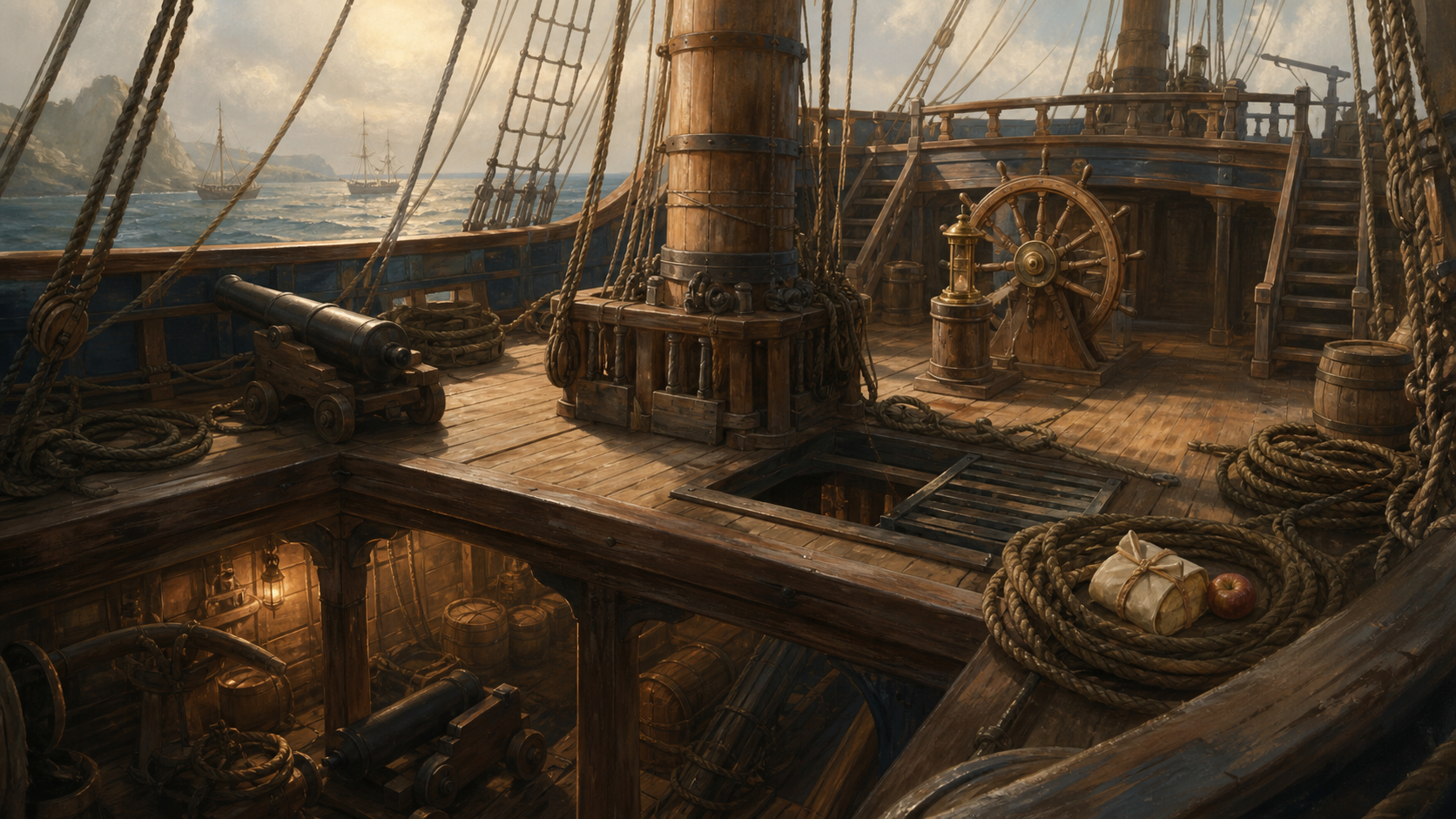
Learn the parts of a pirate ship, from rigging and deck layout to guns, hold space, crew areas, repairs, and why pirates liked fast vessels.
A pirate ship was not a floating skull logo.
It was wood, rope, canvas, iron, sweat, storage problems, and compromise.
The best pirate vessel was not always the biggest or prettiest. It was the one that could catch prey, escape stronger enemies, carry enough men to board, survive repairs, and operate in the messy geography where merchant routes, shoals, islands, inlets, and ports met.
Popular culture gives pirates towering ships with endless decks, spotless cannon lines, and dramatic wheel poses.
The record is more practical.
Pirates used what they could capture and adapt: sloops, brigantines, schooners, merchantmen, and the occasional large prize refitted for intimidation. A pirate ship was less a fixed type than a purpose. If it could chase, threaten, board, carry, hide, and flee, it could become a pirate ship.
The black flag got the attention.
The hull did the work.
The hull decided where the pirate could go
A ship’s hull was not only its body. It was its set of possibilities.
A shallow-draft vessel could slip through inlets, shoals, creeks, islands, and coastal waters where larger naval ships might struggle. That made small, fast vessels extremely useful for pirates who needed to appear, strike, and disappear before heavier authority arrived.
A larger ship could carry more men, more guns, more cargo, and more fear. But size came with costs. A big vessel needed more supplies, deeper water, more maintenance, and a crew capable of handling it. It could intimidate merchants, but it could also become harder to hide and harder to manage.
That is why pirate ship choice was always a bargain.
Speed mattered. Firepower mattered. Draft mattered. Storage mattered. Crew size mattered. The coastline mattered. The target mattered.
There was no perfect pirate ship.
There was only the ship that served the next risk better than the last one.
Sails were engines, escape plans, and survival
Canvas was power.
A pirate ship’s rig determined how it moved, how quickly it could change direction, how much crew it needed, and how well it could chase or flee. A fast ship could choose its fights more often than a slow one. Speed let pirates overtake merchant vessels, avoid naval patrols, and turn distance into safety.
Sails also required labor. They had to be set, trimmed, reefed, repaired, and managed in changing weather. Rope had to be handled. Masts, yards, blocks, and rigging all needed care. The romantic view sees sails swelling against the sunset. The working view sees men climbing, hauling, cursing, and trying not to die because a line snapped at the wrong moment.
A pirate crew needed sailors, not just fighters.
The most dramatic boarding party in the world is useless if nobody can sail the ship close enough to board.
Guns created fear, not just damage
Cannon mattered, but not always in the way movies suggest.
Pirates often preferred surrender to destruction. A merchant vessel full of cargo was more useful intact. A target crew that surrendered quickly saved time, ammunition, damage, and pirate casualties. Guns helped persuade people that resistance was a poor investment.
A broadside could damage rigging, hull, crew, and morale. Smaller guns could sweep decks or intimidate. Swivel guns and small arms added close-range danger. But guns were heavy, hungry things. They required powder, shot, maintenance, trained hands, and space. Too much armament could slow a vessel or strain its structure.
Firepower was therefore not merely a count of cannon. It was part of a system: reputation, approach, numbers, flag, shouting, speed, and the target’s fear.
A pirate ship did not need to win every battle by force.
It needed to make enough victims believe force would be worse than surrender.
Decks were workplaces, not stages
The deck is where the movie pirate looks best.
The real deck was a workplace under pressure.
Men stood watch, handled lines, loaded guns, repaired damage, cleaned, cooked, argued, slept when they could, and prepared for sudden violence. The same space might hold cargo, weapons, prisoners, wounded men, spare gear, food barrels, water casks, livestock, boats, and every smell a crowded wooden world could invent.
Boarding turned the deck into a battlefield. Gunsmoke, splinters, blood, shouted orders, wet planks, falling rigging, and panic made neat sword duels unlikely. The deck was not arranged for drama. It was arranged by necessity, and necessity is a poor choreographer.
This is one reason experienced crews mattered so much. A ship was full of hazards before the enemy arrived.
Combat simply added more.
Storage decided how long freedom lasted
A pirate ship could not live on attitude.
It needed water, food, powder, shot, tools, spare canvas, rope, medicine, trade goods, plunder, and space for whatever had been taken from prizes. Storage limited range. It shaped where a pirate could sail and how soon the crew needed shore.
Water was especially unforgiving. Food could spoil. Powder could get damp. Cargo could become awkward. Prisoners took space. A captured prize might supply the crew, but it might also create new problems: what to keep, what to sell, what to burn, what to release, and what to do with the people aboard.
The hold was therefore not just a dark place under the deck.
It was the ship’s stomach, wallet, and headache.
A pirate who could not manage supplies was only temporarily free.
Boats, anchors, and small tools mattered
The famous ship gets the name. The small boat often does the work.
Pirates needed boats for landing, boarding, scouting, sounding depths, moving goods, reaching shore, and escaping awkward situations. Anchors mattered because a ship had to stop safely. Lines, blocks, hooks, axes, pumps, carpentry tools, cooking gear, lanterns, needles, charts, compasses, and repair supplies all made piracy possible in ways that never fit neatly on a flag.
This is where the romance of the ship becomes useful rather than false.
A pirate vessel really was a world. It carried tools, labor, weapons, lawless ambition, private rules, hunger, fear, and hope in one wooden frame. It could be beautiful from a distance and unbearable up close.
The closer one gets to the actual ship, the less it looks like a symbol and the more it looks like work.
The crew was part of the anatomy
No ship worked without people.
A pirate vessel needed sailors who knew rigging, pilots who knew coasts, gunners who could handle weapons, carpenters who could keep the hull alive, cooks who could feed men from miserable supplies, quartermasters who could manage shares and discipline, and captains who could choose targets without getting everyone killed.
The crew was not cargo. It was part of the machine.
This is why pirate articles, shares, and discipline matter when talking about ships. A vessel full of men who did not trust the bargain was unstable. A ship that could not be repaired, navigated, or controlled was a coffin with sails.
The ship’s anatomy included wood and canvas.
It also included fear, skill, greed, and trust.
The better truth
A pirate ship was not one thing.
It was a captured opportunity reshaped by need. It might be small and fast, large and frightening, shallow enough for inlets, heavy enough for intimidation, or temporary enough to be abandoned when the next prize offered something better.
The famous silhouette matters because it draws us in. But the working ship is more interesting: hull, draft, rig, deck, guns, storage, boats, tools, and crew all arguing with one another under weather.
The black flag may have made the ship memorable.
The anatomy made it dangerous.


