Pirate culture
Custom, symbol, and story
Blackbeard commanded Queen Anne's Revenge for six months. The ship made his name last considerably longer.
In the popular imagination, Blackbeard and Queen Anne's Revenge belong together like thunder and lightning.
The man supplies the smoke. The ship supplies the shadow.
The surprising part is how brief the partnership was. Blackbeard commanded Queen Anne's Revenge for only a short stretch of his career, roughly from late 1717 into 1718. That was enough. Some ships need decades to become famous. This one needed a captain who understood fear, a coastline that could be frightened, and a name large enough to keep echoing after the hull was gone.
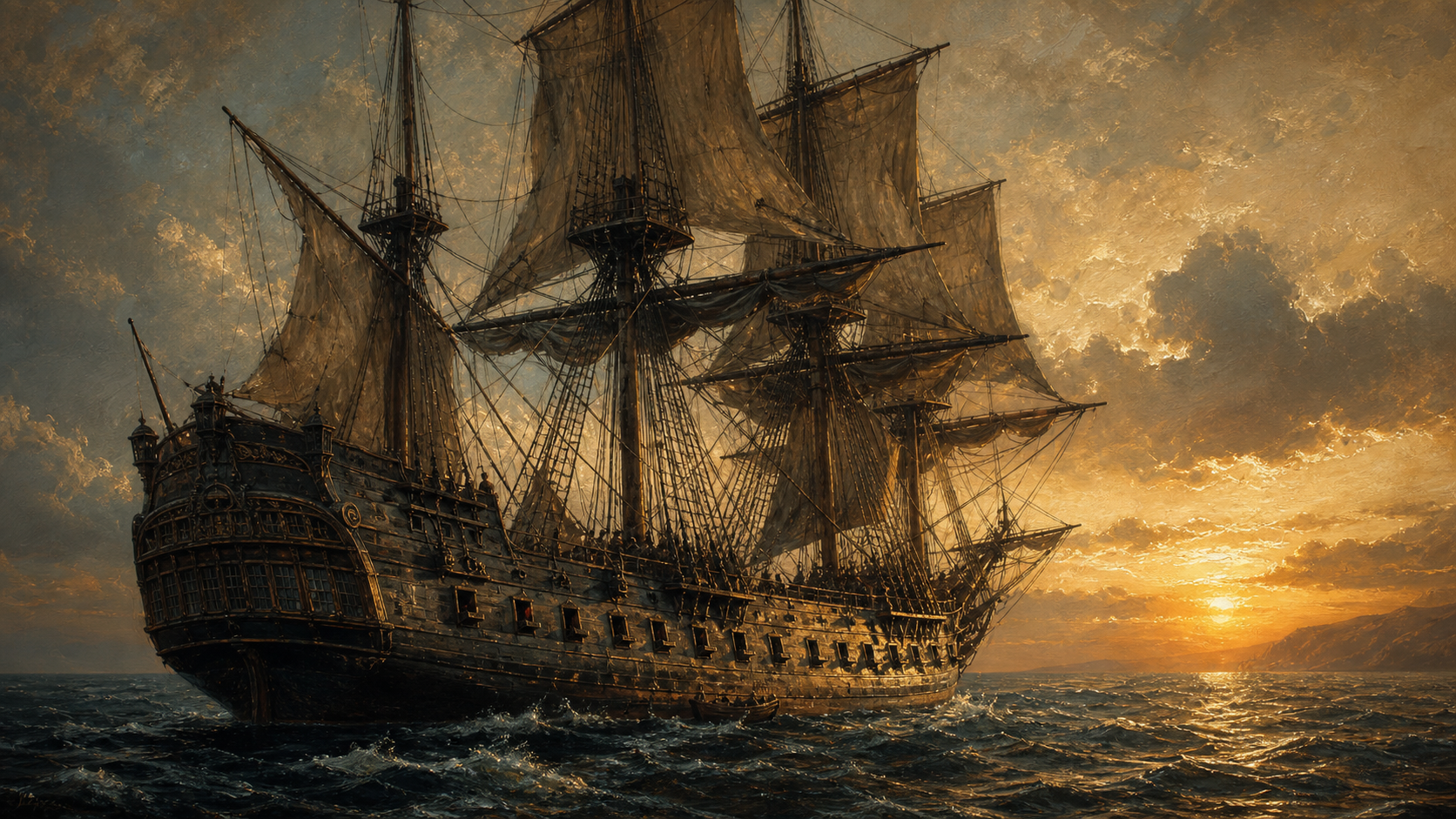
A pirate ship was not only transport. It was a tool. It carried guns, men, food, reputation, captives, stolen goods, and the ability to appear where ordinary merchants hoped trouble would not. Queen Anne's Revenge made Blackbeard's threat visible from a distance.
That visibility changed everything.
Before Blackbeard: La Concorde
Before she became Queen Anne's Revenge, the ship was La Concorde, a French vessel tied to the Atlantic slave trade.
That origin matters. Pirate romance often treats ships as props waiting for a dramatic flag. La Concorde was not born into a clean adventure. She belonged to a world of forced labor, disease, imperial commerce, profit, and human suffering. Blackbeard's capture of the vessel did not erase that history. It layered one form of violence over another.
Blackbeard captured La Concorde near the eastern Caribbean in 1717. He refitted her, armed her heavily, and turned her into the flagship most closely associated with his name. The transformation was practical as well as theatrical. A larger, better-armed vessel could intimidate targets that might ignore a smaller pirate craft. It could support a broader force, carry more men, and make colonial officials pay attention.
The old ship's past should stay visible because it keeps the story honest.
The vessel that helped make Blackbeard famous came from the same brutal Atlantic economy that pirates exploited, interrupted, and depended on.
Why the ship mattered
Most pirate vessels were not floating castles. Speed, shallow draft, maneuverability, and surprise could matter more than size. A smaller sloop could chase, flee, enter awkward water, and appear along coasts where heavier ships were less useful.
Queen Anne's Revenge was different because she gave Blackbeard scale.
Scale mattered psychologically. A ship carrying many guns and men could make a merchant captain choose surrender before a costly fight. Pirates preferred that. A battle could kill sailors, damage cargo, tear rigging, and reduce profit. Fear was cheaper.
This is the key to Blackbeard's reputation. He was not frightening only because he looked terrifying. He understood that fear could work before violence began. A large armed flagship gave that fear a body. It let reputation arrive with cannon ports.
A small pirate craft could threaten.
Queen Anne's Revenge could announce.
Charleston and the use of pressure
Blackbeard's blockade of Charleston in 1718 showed what the ship and squadron could do.
He did not need to conquer the city. He seized ships outside the harbor, took hostages, and forced negotiations. The famous demand was not a mountain of jewels. It was medicine. That detail is useful because it drags the story out of treasure fantasy and back into the working body of a pirate crew.
Pirates needed supplies. They got sick. They were wounded. They operated in a world where infection, fever, injury, and scarcity could matter as much as cannon fire.
Charleston was embarrassing because it turned a wealthy colonial port into a hostage problem. Ships could not simply move as usual. Officials had to calculate risk. Merchants had to feel vulnerability. Blackbeard made the harbor's dependence on safe passage visible, then used that dependence to get what he wanted.
Queen Anne's Revenge did not make him invincible.
It made him difficult to ignore.
The grounding near Beaufort Inlet
The end of Queen Anne's Revenge in Blackbeard's hands came near Beaufort Inlet, North Carolina, where the ship was grounded in 1718.
The motive and circumstances have attracted argument. Was it accident? Was it deliberate? Was Blackbeard reducing his crew and consolidating plunder? The evidence does not let every confident version stand equally tall. The safe article should say what is firm and leave the sharper claims where the evidence allows them.
What matters for the reader is that the great flagship did not carry Blackbeard into years of domination. It served him briefly, helped create a powerful reputation, and then left his active story.
That brevity is not a weakness. It is the lesson.
Pirate power could flare quickly. A captured ship could become a symbol almost overnight. The same ship could then be lost, abandoned, wrecked, or transformed into archaeology while the legend sailed on without it.
Blackbeard did not need Queen Anne's Revenge for long.
He needed her long enough.
Archaeology pulled the ship back from legend
The wreck believed to be Queen Anne's Revenge was discovered off North Carolina in the 1990s, giving the story a rare material anchor.
That matters because many pirate stories survive through hostile reports, trial records, sensational print, and later retelling. Here, seabed evidence enters the conversation. Cannons, fittings, ballast, medical items, and other recovered materials do not tell a full biography. They do something humbler and stronger: they remind us that the legend sat on wood, iron, water, labor, and real Atlantic geography.
Archaeology does not make every Blackbeard story true. It does not prove every theatrical detail about smoking beards, impossible ferocity, or supernatural afterlife.
It does prove that this was not only a poster.
There was a ship. It had weight. It carried people. It belonged to a violent economy before Blackbeard captured it and to a violent story after he did.
Why the name lasted
Queen Anne's Revenge is a perfect pirate ship name because it sounds like a threat with paperwork behind it.
Queen Anne had died only a few years earlier. The name points back toward war, privateering, politics, and the unsettled world that helped produce the Golden Age of piracy. Whether Blackbeard intended an exact political statement or a broader gesture of menace, the result worked. The name made the ship feel larger than a captured merchant vessel. It sounded historical before history had finished with it.
That is one reason the ship survives so strongly in memory. It carries several stories at once: the French slave ship, the pirate refit, Blackbeard's theatrical terror, Charleston's humiliation, the North Carolina grounding, and the modern recovery of wreck material from the seabed.
A lesser story would only say Blackbeard had a big ship.
The better story says the ship made his short career feel enormous because it joined violence, branding, logistics, and material evidence in one hull.
The ship behind the silhouette
Queen Anne's Revenge should not be remembered as a magic pirate fortress.
She was a captured ship, repurposed for predation, born from the Atlantic slave trade, used for intimidation, lost after a short career, and later pulled back into history through archaeology. That is stranger and stronger than the simple legend.
The ship matters because she shows how pirate reputation worked. A name could frighten. A flag could threaten. A large vessel could make fear visible. A brief possession could become a permanent cultural object if the timing was right and the captain was memorable enough.
Blackbeard's beard got the poster.
Queen Anne's Revenge gave the poster a horizon.


