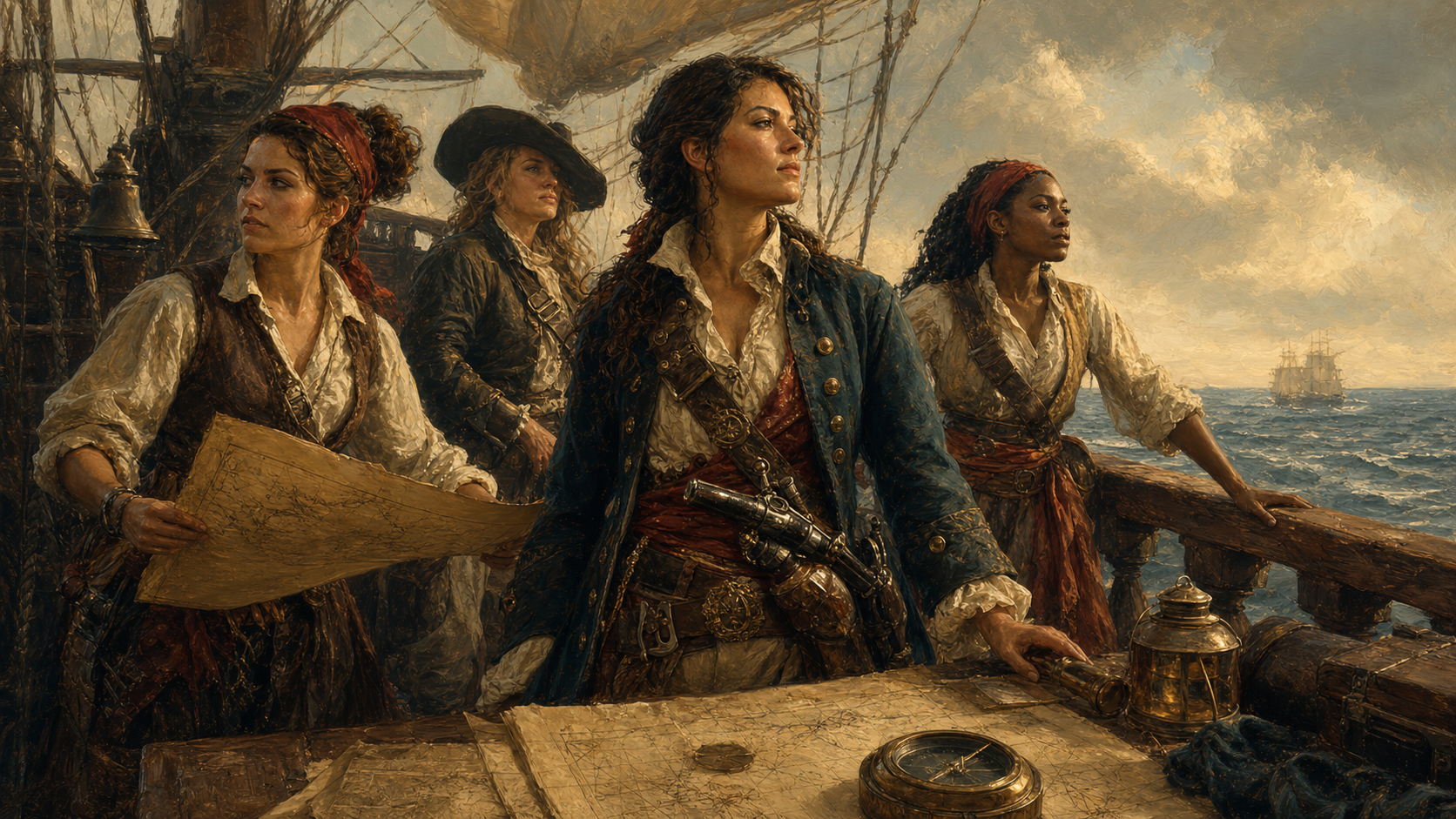
Fact article
Fact trail
Women at sea were rare, but the record is stronger and stranger than the tiny roles pirate movies usually give them.
Pirate films often know exactly what to do with a woman at sea: give her a costume, a dagger, a flirtatious entrance, and then make the plot hurry back to the men. History is less obedient. Women were not common in piracy, and pretending otherwise would only replace one false story with another. But when women do appear in the record, they are usually more interesting than the tiny roles later entertainment gives them. They stand in court, command fleets, negotiate with rulers, inherit maritime power, exploit political disorder, and sometimes disappear into gaps that fiction has been happily filling ever since.
The evidence is uneven, so the careful version is also the stronger one. Anne Bonny and Mary Read are tied to trial records and to Captain Charles Johnson's A General History of the Pyrates, a vivid source that must be handled with care. Zheng Yi Sao is attached to a much larger South China Sea world of confederations, negotiation, and state response. Grace O'Malley and Sayyida al-Hurra belong to maritime politics as much as pirate legend. The point is not to flatten all of them into one costume. The point is to let each woman keep the world that made her possible.
Bonny and Read were not decoration
On November 28, 1720, Anne Bonny and Mary Read were convicted of piracy in Jamaica after sailing with John Rackham's crew. Several men from the crew went quickly toward execution. Bonny and Read delayed the rope by pleading pregnancy, a legal claim sometimes called pleading the belly. Mary Read died in prison in 1721. Anne Bonny's later fate is uncertain, and that uncertainty has made her especially vulnerable to neat fictional endings. A missing ending is not an invitation to pretend we know more than we do. It is part of the story.
The trial matters because it gives Bonny and Read firmer ground than tavern myth alone. Johnson's later account adds color, cross-dressing, sharp dialogue, and memorable scenes, but it does not all carry the same evidentiary weight. The documented core is already powerful enough: two women were tried as pirates in a colonial court, their gender affected the legal aftermath, and their reputations grew in a culture that loved scandal almost as much as punishment. For the surrounding myth problem, the pirate legends and myths section is the better place to keep tugging at the thread.
Zheng Yi Sao shows what shrinking really loses
Zheng Yi Sao is often introduced as a surprise, as though the interesting fact is simply that a woman held power. That is the smallest possible version of her. After the death of Zheng Yi, she remained central to a major pirate confederation in the South China Sea. The forces associated with that confederation were large enough to challenge Qing authority, disrupt commerce, and require negotiation rather than simple theatrical pursuit. The scale matters. This was not a single defiant woman on a postcard. It was maritime organization, violence, discipline, profit, and state pressure moving at once.
Her 1810 settlement with Qing authorities is especially important because it changes the usual ending. Many pirate stories end with the state restoring order through death. Zheng Yi Sao's story ends, at least in broad outline, with negotiated survival. The record and later retellings do not need to make her gentle to make her impressive. She operated in a hard world and appears to have understood power clearly enough to leave piracy with terms. That is a more adult story than the usual screen habit of turning women pirates into exceptions who exist mainly to surprise men who should have read more.
Grace O'Malley and Sayyida al-Hurra were political actors
Grace O'Malley, or Grainne Mhaol, does not fit neatly into a Caribbean pirate frame because she belonged to sixteenth-century Irish maritime politics. She controlled ships, defended family and regional power, raided, negotiated, and eventually met Elizabeth I in 1593. That meeting is often polished into legend, but the political fact beneath it is better: Tudor authority had to deal with her. Calling her only a pirate queen is catchy, but too small. She was a Gaelic power broker whose ships made her difficult to ignore.
Sayyida al-Hurra belongs to yet another setting. As ruler of Tetouan in the sixteenth century, she operated in the Mediterranean world shaped by the aftermath of Granada, Iberian expansion, corsair activity, ransom, diplomacy, and religious conflict. The label pirate can be misleading if it strips away sovereignty and politics; the label ruler can also become too tidy if it hides maritime raiding and retaliation. The more useful phrasing is plain: she exercised coastal power in a violent sea where commerce, captivity, and revenge were braided together. That does not fit neatly on a poster, which is probably why posters keep disappointing us.
The shrinking happens in the retelling
Women pirates get shrunk in several predictable ways. They become romantic exceptions, proof that a story is modern, or a single shocking anecdote. Their work disappears: command, finance, kinship networks, legal strategy, intelligence, negotiation, and the management of men who were not always inclined to be managed. Their settings disappear too. Jamaica in 1720 was not the South China Sea in 1810. Sixteenth-century Ireland was not sixteenth-century Tetouan. A good article should not pretend these are the same world with different hats.
The better history is more restrained and more interesting. Women were rare in most pirate crews because maritime labor, naval violence, law, and custom made their presence difficult and dangerous. That rarity matters. But rarity is not the same as absence, and it is certainly not the same as decoration. When the sources give us women in piracy or adjacent maritime power, they often appear at moments of pressure: trial, succession, imperial conflict, family survival, commercial disruption, or negotiation with a state that would prefer not to admit it had to bargain.
This is why the title's complaint is not really about movies alone. It is about any retelling that trades complexity for a wink. Bonny and Read do not need invented certainty to matter. Zheng Yi Sao does not need to be softened into a heroine. Grace O'Malley does not need to become a costume-party queen. Sayyida al-Hurra does not need to be filed under simple piracy when the Mediterranean politics are the point. The record is uneven, but it is not empty, and the gaps should make us more careful rather than more careless.
For readers who want the people behind the shorthand, the famous pirates profiles are the natural next stop. For readers chasing the broader machinery of myth, start again at pirate facts and legends. The useful takeaway is calm enough: women pirates were not everywhere, but the women who did enter the record were not small. Later stories made them small because smaller is easier to package. History, inconveniently, kept the larger shape.
<!-- Codex notes: - Import as draft only. Do not publish automatically. - Preserve attribution decision exactly as specified in frontmatter. - Review internal links against current Umbraco paths before publishing. - Source queue bucket: Blank-author, needs attribution decision - Audit note: Review for small clarity, evidence, and ending improvements without stretching the topic. -->


