The story
The Irish Pirate Queen Who Faced Elizabeth I and Did Not Blink
Grace O'Malley is easiest to flatten into a poster: an Irish pirate queen, a Tudor queen, one fearless meeting, everybody staring dramatically across the room. The real story is better because it is less tidy. Grainne Mhaol, known in English as Grace O'Malley, came from the maritime west of Ireland, where ships, kinship, cattle, tribute, raiding, trading, and English expansion all pressed against one another. By the time she met Elizabeth I in 1593, she was not arriving as a curiosity. She was a coastal power broker with family interests to defend and enough local force behind her that Tudor officials had learned to take her seriously.
The word pirate is useful only if it does not do all the thinking for us. O'Malley's world was not the later Caribbean world of Blackbeard and the Jolly Roger. It was sixteenth-century Connacht, a region where Gaelic lordship, seaborne movement, local war, and English administration collided. Ships gave her family reach. Harbors and islands gave them leverage. Raiding could be criminal in one set of records and political pressure in another. The evidence is clearest when it shows English officials trying to fit her into categories that served English rule, while she kept operating according to the harder logic of her own region.
The west coast made her powerful
O'Malley was born into the O'Malley lordship of Umhall, a family network shaped by the sea rather than by neat inland boundaries. In that world, command did not come only from owning land. It came from boats, crews, marriage alliances, tolls, protection, and the ability to move goods and fighters through difficult coastal geography. Clew Bay and the surrounding coast were not scenery. They were infrastructure. Anyone trying to extend Tudor power into the west had to reckon with people whose authority came from places English paperwork did not fully control.
That geography also explains why calling her simply rebellious misses the point. English expansion in Ireland was not an abstract policy to the people living under it. It meant officials, rival claimants, military pressure, altered inheritance, and attempts to turn local power into something London could recognize and manage. O'Malley used the tools available to her: ships, family connection, negotiation, and, when necessary, violence. That does not make her gentle. It makes her historically legible.
The meeting with Elizabeth was not a fairy tale
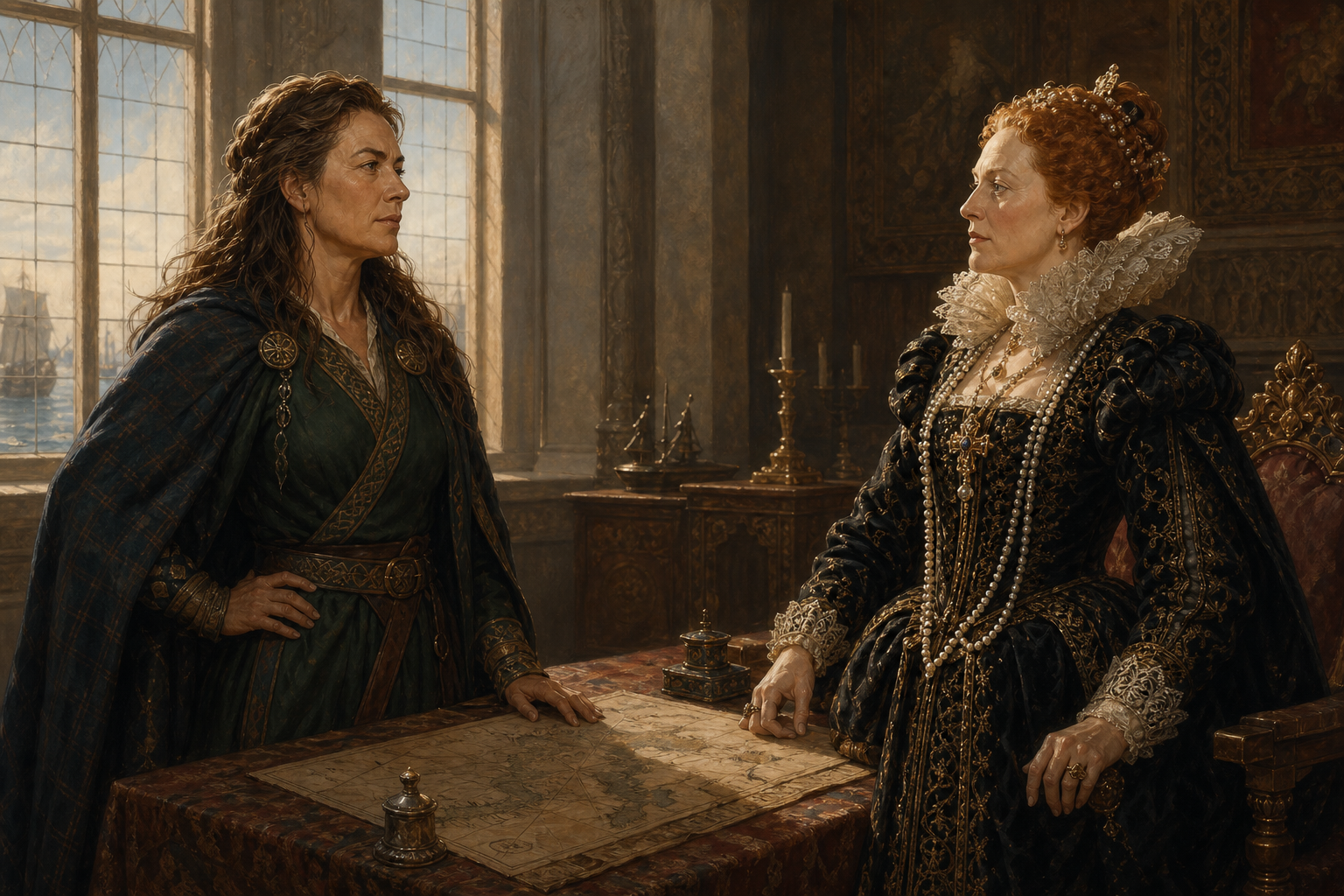
The 1593 meeting with Elizabeth I is the scene everyone remembers because it looks almost too perfectly arranged: two formidable women, two political worlds, one royal court. The documented fact of the meeting is strong, but later storytelling has polished the edges. Stories about language, manners, handkerchiefs, and defiant etiquette may preserve bits of memory, or they may be later decoration. The safer and stronger reading is that O'Malley came with practical demands involving her family, her position, and the pressure of English officials in Ireland.
Elizabeth's side had practical concerns too. Tudor government wanted obedience, order, information, and leverage. O'Malley wanted room to maneuver and relief from threats to her household and authority. The meeting was not a romantic summit of queens admiring one another's nerve. It was negotiation under pressure. O'Malley did not need to blink because she was not there for theater. She was there because the court was one more arena in a long fight over power on the Irish coast.
Why the title still fits
The title calls her an Irish pirate queen because that phrase carries the hook readers know. The body has to earn it by admitting the phrase is imperfect. Queen can overstate her formal title if read too literally. Pirate can flatten a Gaelic maritime leader into a later outlaw stereotype. Irish is essential but not sufficient, because her identity sat inside local lordship, family strategy, and English conquest. Put together carefully, though, the phrase points toward the right subject: a woman whose maritime power made her difficult for a queen's government to ignore.
Her story also sits usefully beside other famous pirates because it shows how broad the category can become when politics enters the water. Some pirates were thieves with crews. Some were privateers with paperwork. Some were raiders whose legitimacy depended on which court was reading the report. O'Malley belongs near the edge of that map, where maritime force and regional authority become hard to separate.
What legend adds, and what it risks
Legend has helped keep O'Malley vivid, but it can also make her smaller. A heroine who simply refuses to bow is easier to sell than a leader navigating inheritance, ship power, local rivalry, imprisonment, petitions, and Tudor expansion. The record gives us enough to respect her without pretending every later flourish is proven. She operated for decades in a world where women could hold influence, but rarely without contest. Her authority was built, defended, challenged, and renegotiated.
The surviving picture is also shaped by hostile and administrative sources. Tudor officials wrote about Irish leaders through the needs of conquest, taxation, pacification, and complaint. Gaelic memory preserved different kinds of importance. Modern biography has to work between those pressures, checking the dramatic stories without draining the life out of them. That is why a calm account is not a duller account. It lets the politics remain visible. It also leaves room for the uncomfortable fact that O'Malley could be both a symbol of resistance and a hard regional operator protecting her own power.
That is why she matters beyond the famous meeting. O'Malley forces the reader to see piracy, lordship, and empire in the same frame. Her life belongs to the history of piracy, but also to the history of Ireland, Tudor state-building, maritime trade, family survival, and the uneasy ways local power resisted being tidied away by a larger state. The court scene is memorable because it concentrates all of that tension into one room.
The best ending is not that Grace O'Malley was fearless in a decorative sense. It is that she understood where power was being negotiated and went there. She had ships behind her, grievances to press, family interests to defend, and a coast that had taught her authority was not granted only by people with crowns. That makes the meeting with Elizabeth more than a wonderful anecdote. It makes it evidence of a life spent refusing to let other people's categories decide the size of her world.


