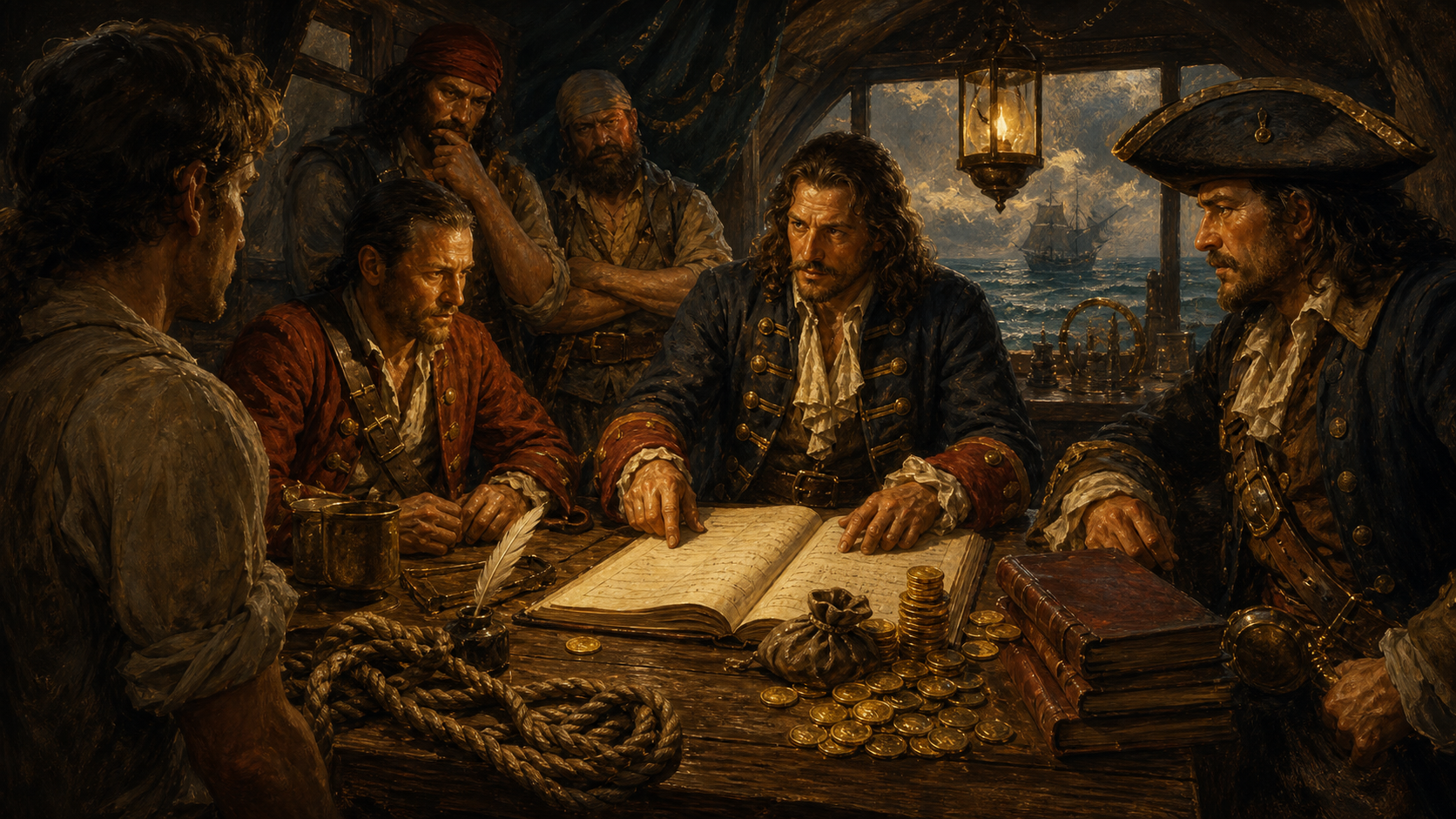
The story
William Fly Reached the Gallows and Still Had Notes
The authorities wanted William Fly to die as a warning.
That part went according to plan. He was hanged in Boston in 1726 for mutiny and piracy, in front of a world that liked its lessons public and its condemned men useful. The law had a script. The minister had a script. The crowd had come to see a pirate made small beneath the rope.
Fly did not cooperate as neatly as they wanted.
He reportedly used the moment to criticize brutal ship captains and warn that harsh treatment at sea helped make pirates. That does not make him innocent. It makes him more interesting than a simple villain waiting to be filed under "hanged and done."
A pirate can be guilty and still point toward a real problem.
That is the uncomfortable power of William Fly.
Mutiny before piracy
Fly's case began not with buried treasure, but with shipboard violence.
He and others mutinied aboard a vessel commanded by Captain John Green. The captain was killed. The ship was seized. The men crossed the line from grievance and shipboard violence into piracy, and colonial law knew what to do with that line once it had bodies and witnesses in hand.
This was not a romantic rebellion.
Mutiny at sea was terrifying because a ship was a closed world. There was no easy exit, no neutral street corner, no constable just beyond the tavern door. Authority, resentment, discipline, hunger, fear, and weapons all shared the same wooden space. When that order broke, it could break violently.
Pirate stories often begin after the black flag rises. Fly's story is useful because it asks what happened before. What did men endure aboard lawful ships? What did captains demand? How much beating, humiliation, hunger, withheld pay, or arbitrary discipline could be dressed as order before someone called the violence by a different name?
None of that excuses murder.
It explains why the gallows did not end the argument.
Boston wanted an example
By 1726, New England officials had no interest in treating piracy as a charming inconvenience.
Pirates threatened trade, order, property, and the authority of the state. A captured pirate was therefore more than a defendant. He was raw material for public instruction. Trial, confession, sermon, execution, and print could turn one man's death into a message aimed at sailors still weighing their chances.
Boston had the machinery for that message.
Cotton Mather, the famous Puritan minister, was involved in shaping the execution as moral theater. To Mather and others like him, a pirate at the gallows could prove the wages of sin, the justice of punishment, and the need for repentance before death closed the account.
Fly resisted the role.
Accounts present him as defiant rather than properly broken. He is said to have corrected the hangman over the noose and to have spoken against cruel ship captains. The details need careful handling because execution narratives were printed with purpose. But the scene has survived because it cuts against the expected shape.
The condemned man did not merely confess.
He edited the sermon.
The noose and the labor problem
Fly's alleged warning to captains matters because it points to a real maritime wound.
Eighteenth-century sailors could face brutal discipline, poor food, cramped quarters, low wages, delayed payment, danger, disease, and captains whose legal authority could become personal cruelty once the ship left shore. Merchant service was lawful. Lawful did not always mean humane.
Piracy offered some sailors a dark alternative.
Pirate crews could divide plunder by shares, elect or remove leaders in some circumstances, compensate injuries, and limit certain forms of arbitrary command. That internal order has sometimes made pirates look more democratic than the societies chasing them. The truth is harder. A pirate ship could be less abusive to its own members while still surviving by robbing and frightening everyone outside it.
Fly's case sits in that contradiction.
He did not become a noble reformer because he denounced harsh captains. He remained a man condemned for violent crime. But the conditions he pointed toward were not imaginary. The legal sea could be cruel enough that the illegal sea became tempting.
That is not a defense.
It is a diagnosis.
A bad pirate can still reveal a true thing
The temptation with Fly is to force him into one of two clean boxes.
In one box, he is only a murderer and pirate whose final words deserve no attention. In the other, he becomes a rebel labor critic with a rope around his neck. Both boxes are too tidy.
Fly was guilty of serious violence. The men he and his companions killed or endangered do not become footnotes because his final speech had bite. At the same time, his execution exposed the anger of seamen living under hard discipline in a maritime economy that needed their labor and often treated them as replaceable.
That is the profile's center.
Not greatness. Not glamour. Pressure.
A captain's authority at sea could be lawful and abusive. A sailor's retaliation could be understandable and criminal. A minister could try to turn a pirate into a warning, and the pirate could turn the warning back toward the merchant captains standing safely on shore.
That is why the story still has teeth.
The printed ending
Pirate executions did not end at the scaffold.
They moved into print. Sermons, broadsides, notices, trial summaries, and moral accounts carried the lesson beyond the crowd. A pirate's body lasted a short time. The printed warning could travel farther.
This is where Fly's afterlife becomes especially sharp. If Mather and the authorities wanted him to demonstrate the evil of piracy, Fly's reported defiance complicated the message. The lesson still condemned mutiny and robbery, but it also preserved an accusation against brutal command.
The gallows were supposed to close the case.
Instead, they left a margin note.
That note should not be exaggerated into a manifesto. It should be read as a small, hard piece of evidence from a violent labor world: a condemned sailor insisting, at the end, that cruelty from lawful captains helped feed unlawful rebellion.
Why William Fly still matters
William Fly was not one of piracy's great captains. He did not command a vast fleet, seize a legendary treasure ship, blockade a famous city, or retire with impossible wealth. His career was brief, violent, and ended beneath a rope.
That is precisely why he matters.
Fly pulls pirate history away from flags and treasure and back toward the workplace of the sea. He shows how mutiny, piracy, labor abuse, public execution, and moral print culture could meet in one uncomfortable case. He reminds readers that piracy was not only a problem of wicked men choosing wickedness from a clear sky. It also grew in a maritime world where legal authority could be harsh enough to make illegal alternatives imaginable.
The better truth is not that Fly was right because he was hanged.
The better truth is that hanging him did not make his accusation disappear.
Boston got its example. Cotton Mather got his warning. The law got its body.
William Fly got the last irritation: a pirate at the gallows, still correcting the men who thought the lesson belonged only to them.


