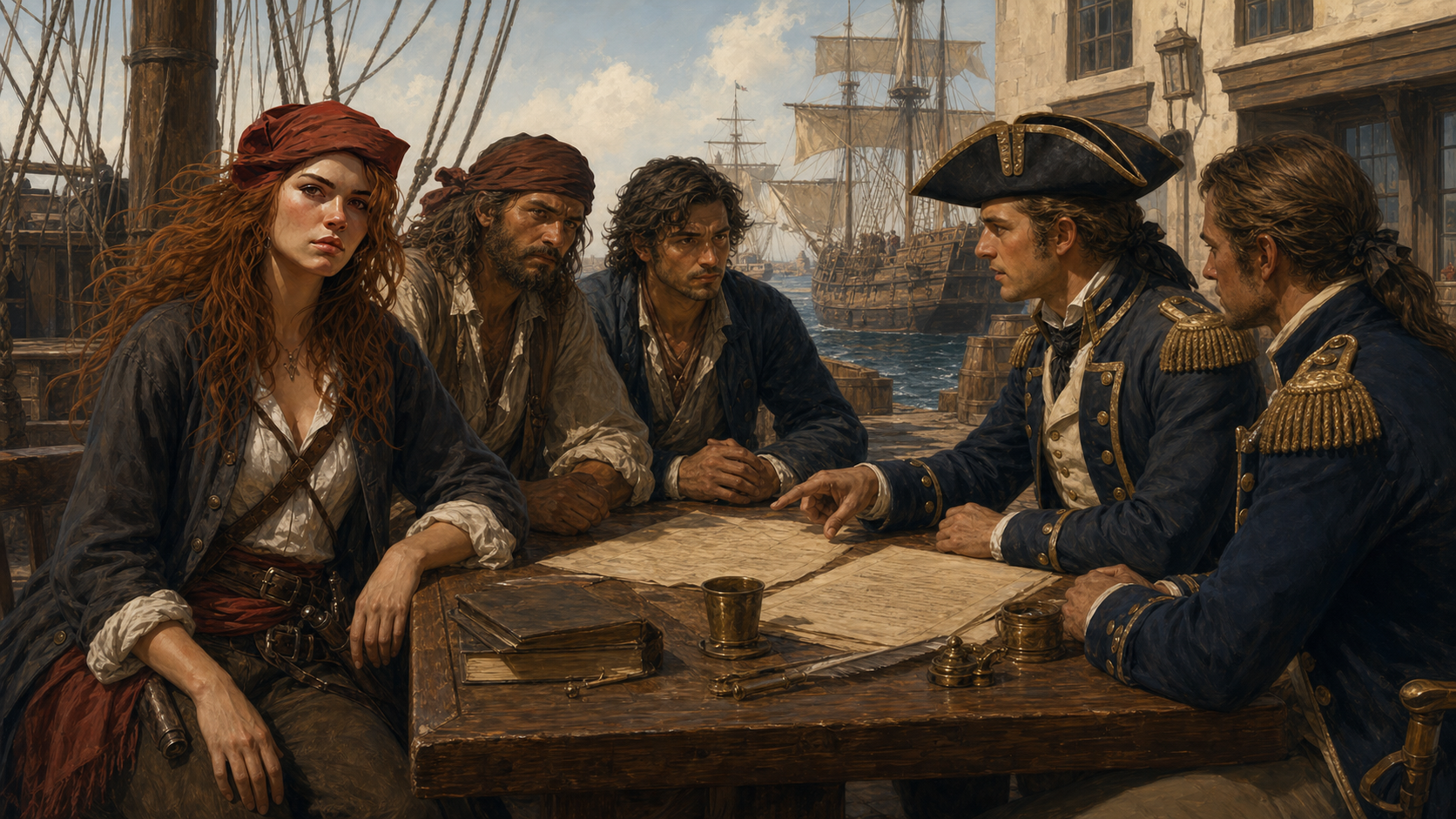
The cartoon pirate captain rules by volume.
He barks. The crew obeys. A pistol appears. Someone backs away from the rail. Order is restored by facial hair and threats.
Real pirate command could be stranger than that.
Some pirate crews wrote articles before they went hunting. They elected captains, chose quartermasters, defined shares, set rules for gambling and weapons, arranged compensation for wounds, and placed limits on behavior aboard ship. Before they robbed anyone else, they tried to solve the problem of governing themselves.
This does not make them heroes.
It makes them organized criminals with an unusually practical workplace constitution.
Why a vote made sense
A pirate ship was a cramped wooden argument full of weapons.
Men slept near each other, worked near each other, drank near each other, handled guns near each other, and depended on shared survival in weather, battle, hunger, and pursuit. If one captain controlled every decision, every punishment, and every division of loot by personal whim, he could become more dangerous to the crew than the enemy.
Voting helped solve that problem.
Many pirates came from merchant or naval backgrounds where discipline could be harsh and pay uncertain. Naval service could mean brutal hierarchy. Merchant service could mean miserable work for poor reward. Piracy offered a different bargain: more risk, more violence, but also a stronger claim to shares and, in some crews, a louder voice in who gave orders.
The vote was not philosophical purity.
It was self-defense against bad command.
The articles were the deal
Pirate articles were agreements. They set expectations before trouble arrived.
Surviving examples vary, so they should not be treated as one universal pirate constitution. But the pattern is clear enough to matter. Articles could define how plunder would be divided, what a captain or quartermaster received, what compensation a wounded man might claim, when lights went out, how weapons were handled, what happened to thieves, and how disputes were settled.
That sounds almost civilized until one remembers what the system was for.
The articles made robbery more durable. They helped keep the crew from destroying itself before it found a prize. They limited certain kinds of internal abuse so that external violence could continue more efficiently.
Pirate democracy was not kindness.
It was maintenance.
The captain was powerful, but not unlimited
Pirate captains could be terrifying, especially in chase or battle. When speed, violence, and a clear order mattered, the captain's authority could expand quickly.
But outside immediate action, some crews placed real checks on him. He could be elected. He could be removed. He could be challenged if he failed to find prizes, endangered the ship foolishly, cheated the shares, or lost the confidence of the men.
That is a very different picture from the movie tyrant who rules forever because the costume department said so.
The captain had to keep proving that he was useful. He needed nerve, seamanship, judgment, and reputation. He also needed the crew to believe that following him was better than replacing him.
A pirate captain did not stand above politics.
He stood inside it, usually with armed voters.
The quartermaster mattered
The quartermaster is one of the best signs that pirate authority was more complicated than simple captain worship.
On many pirate ships, the quartermaster represented the crew's interests. He could help divide plunder, supervise discipline, manage provisions, settle disputes, and limit the captain's power outside battle. If the captain was the point of the spear, the quartermaster was often the hand checking whether the grip still held.
This role makes sense in a world where men did not trust command automatically.
The crew wanted someone near power who was not merely the captain's echo. That arrangement could reduce cheating, stabilize expectations, and turn private resentment into a recognized office.
It also tells us something important: pirates were not allergic to authority.
They were allergic to authority that did not pay, did not protect, or did not listen.
Shares were politics
Loot division was not just accounting. It was legitimacy.
A pirate crew survived by danger. Men risked death, wounds, hanging, disease, shipwreck, and betrayal. Shares gave that risk a structure. Ordinary crewmen might receive one share, officers more, and specialists or wounded men particular compensation depending on the articles.
The details mattered because money was the proof that the bargain was real.
A captain who cheated the division threatened the entire shipboard order. A man who stole from the company did the same. That is why pirate rules could be harsh about theft within the crew. Robbery from outsiders was the business. Robbery from the common stock was treason against the business.
The morality is ugly.
The logic is sharp.
Wound compensation was not softness
Some pirate articles included compensation for injuries: loss of a limb, eye, finger, or other disabling wound. These payments can sound almost modern, as if pirates had accidentally invented a benefits package while loading pistols.
The reality was colder.
A wounded sailor could lose his ability to work. A man who risked his body needed some promise that the crew would not simply throw him into poverty if he survived the fight. Injury compensation helped recruit men, maintain trust, and make dangerous action more acceptable.
It was also a reminder that piracy was physical labor with catastrophic risks.
The romantic pirate loses a leg and gains personality.
The real sailor lost income, mobility, status, and sometimes any reasonable future.
Internal fairness did not make piracy innocent
This is the part the internet often gets wrong.
It is tempting to turn pirate democracy into a rebel fairy tale: free men, equal votes, shared treasure, no bosses, better hats. There is some truth in the contrast with harsh maritime labor systems. Pirate crews could offer more voice and clearer shares than many legal ships.
But internal fairness is not moral innocence.
A crew that treated its own members with rough equality could still terrorize captives, steal cargo, burn vessels, threaten towns, and force ordinary sailors into danger. The democratic bargain existed inside the ship. The people outside the ship did not vote to be robbed.
Pirate democracy makes pirates more interesting.
It does not make them good.
Why the myth matters
The tyrant-captain myth survives because it is simple. A single villain is easier to understand than a shipboard constitution built for armed theft.
But the real structure is better. It shows sailors reacting to the brutal labor world they knew. It shows men building rules because total disorder was bad for business. It shows command as something negotiated, not merely shouted. It shows why pirates could be both more egalitarian inside the crew and more dangerous to everyone outside it.
Some pirates voted before they robbed you.
That is not a redemption arc.
It is a warning that organization and violence have never been opposites.


