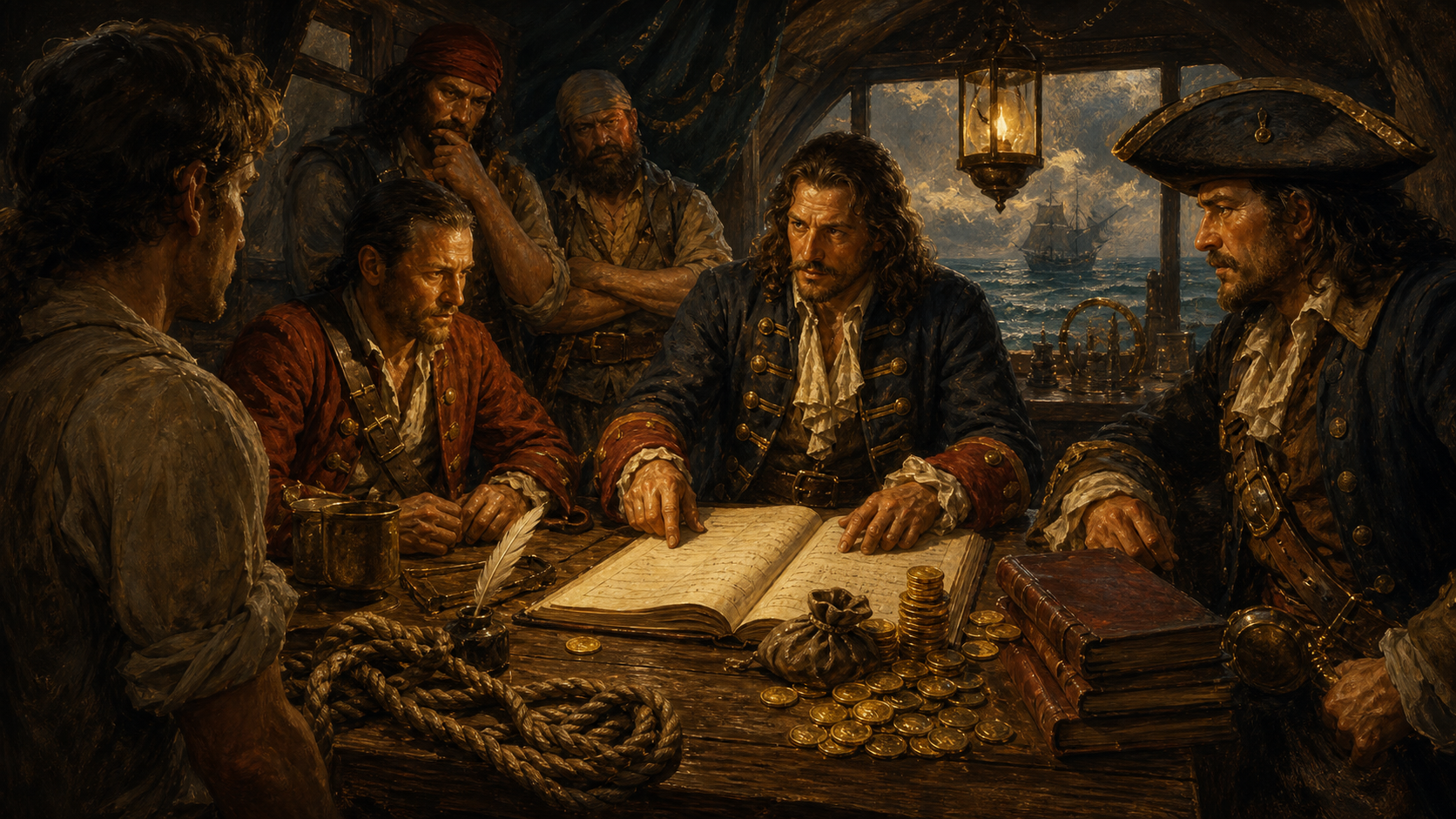
Walking the plank is almost too useful to storytellers.
It gives the victim one narrow board, one blue drop, and one tidy moment when the crowd can gasp. It is clean, theatrical, and easy to draw.
History, being history, usually preferred something less elegant.
The better documented punishments around piracy were messier, slower, more public, and often more bureaucratic. They did not need a plank. They had courts, ropes, chains, prisons, hunger, marooning, mutilation, and the full talent of states for making examples.
Pirates could be cruel. Governments could be cruel with paperwork.
That is where the real horror begins.
1. Hanging at the dock
The official punishment for convicted pirates was often execution.
In England, pirates could be tried under Admiralty law and hanged as enemies of maritime order. Execution Dock on the Thames became part of that public theater. The location mattered. Pirates were not being punished as ordinary criminals in a back alley. They were warnings to sailors, merchants, shipowners, insurers, and anyone tempted by a faster road to wages.
A hanging worked as policy.
It told crews that the state could reach beyond land, drag sea crimes back to court, and turn the condemned body into a lesson. Pirates frightened ships into surrender. Governments frightened sailors away from piracy.
The plank was drama.
The gallows were administration.
2. Gibbeting after death
Execution was not always the end of the message.
Some bodies were displayed in chains after death, especially when officials wanted the warning to last longer than the crowd. Captain Kidd's body was famously gibbeted near the Thames after his 1701 execution. Whatever one thinks of Kidd's tangled case, the display was brutally clear.
Here is what piracy earns.
Gibbeting turned the shoreline into a noticeboard. Every passing sailor could read it without letters. The extra horror is that the dead body still had work to do.
A pirate could die once.
The warning could keep hanging.
3. Marooning
Marooning sits much closer to pirate practice than walking the plank.
The basic idea was simple and terrible: leave a person on an island, sandbar, or remote shore with little hope of rescue. Sometimes the victim might receive a small amount of food, water, powder, shot, or a weapon. Sometimes even that mercy was thin enough to insult the word.
Marooning was punishment, exile, and slow execution by geography.
It also carried psychological force. A person was not simply killed. He was removed from the human world and left with heat, thirst, hunger, insects, fear, weather, and the horizon. The cruelty was not only death. It was waiting to find out whether death had remembered the appointment.
4. Flogging
Flogging was not unique to pirates. It belonged to the wider maritime world of discipline, punishment, and command.
That is exactly why it matters.
Life at sea was already harsh under legal authorities. Naval and merchant discipline could be brutal, and pirate crews often defined themselves partly against the abuse common sailors suffered in lawful service. But pirate ships could still punish their own men, and violence aboard a cramped vessel could become intensely personal.
A flogging punished the body in front of others.
It reminded everyone that order on a ship was not an abstract idea. It was skin, rope, pain, and witnesses.
5. Keelhauling and near-drowning punishments
Keelhauling is often associated more with naval discipline in some maritime traditions than with everyday pirate practice, and it should be handled carefully.
But the reason it appears in sea punishment stories is obvious. Dragging a person under or along a ship's hull could tear flesh, break bones, drown the victim, or leave him alive just long enough to understand that survival was not mercy.
Even when a specific anecdote is uncertain, the fear is historically legible. Ships made punishments possible that land did not. Rope, hull, water, barnacles, and crew labor could turn the vessel itself into the instrument.
The sea was not just the setting.
Sometimes it was recruited.
6. Imprisonment before trial
Pirate stories often rush from capture to gallows because that is where the poster is.
Prison was the slower part.
Captured pirates could be held in miserable conditions while authorities gathered evidence, transported prisoners, arranged trials, or decided who was useful as a witness. Disease, filth, crowding, fear, and uncertainty could make imprisonment a punishment before the law finished naming it.
For some prisoners, the worst part was not knowing whether the next official visitor brought mercy, testimony, transport, or death.
The rope got the audience.
The cell got the waiting.
7. Turning informant under threat
Not every punishment needed to leave marks.
Captured pirates could face pressure to testify against crewmates, identify leaders, describe routes, name buyers, or help authorities break wider networks. That kind of pressure placed a person in a brutal moral trap. Speak and live, perhaps. Stay silent and hang, perhaps. Speak and be hated by every survivor who remembers.
Piracy depended on trust among men who already knew betrayal was useful.
The law exploited that.
A court could turn one pirate into a weapon against the rest, and the punishment became social as much as legal: fear, shame, exposure, and the knowledge that survival might come at the price of another man's neck.
8. Mutilation and violent shipboard revenge
Pirates used intimidation to get information, punish resistance, or frighten victims into surrender. Some accounts of pirate cruelty are lurid and should be checked carefully, but the broader pattern is not soft. Beatings, torture, cutting, burning, and threats appear in pirate stories because violence could be used to extract knowledge: where valuables were hidden, who owned what, whether more goods were aboard, or which captives were worth ransom.
The plank gives one clean threat.
Real violence often came in pieces.
That is not more romantic. It is more frightening, because it shows cruelty working as a tool rather than a dramatic flourish.
9. Public trial as humiliation
Trial could be punishment before sentence.
A pirate trial did not merely determine guilt. It made the accused legible to the public. Names were read, crimes described, witnesses heard, confessions used, and identities fixed in a legal story. The court transformed sea violence into a record the state could control.
That mattered because pirates had their own reputations.
The trial answered pirate fame with official narration. It said: you are not a free captain, a rebel, a terror, or a legend. You are a prisoner, a defendant, a convicted felon, and soon a warning.
The punishment was not only death.
It was being rewritten by the people who caught you.
10. Becoming a legend for the wrong reason
This is the strangest punishment.
Some pirates were punished by being remembered badly forever.
A body could hang, decay, and vanish, but the printed story remained. Trial accounts, pamphlets, moral warnings, official reports, and later histories turned pirates into examples. Some became monsters. Some became fools. Some became warnings about greed, rebellion, cruelty, or bad luck. A few became glamorous despite everyone's best efforts.
That afterlife could be useful to the state or to later entertainment.
Either way, the person disappeared under the story.
Pirates tried to control fear while alive. After death, other people controlled the meaning.
The better truth
Walking the plank survives because it is simple.
The real punishment world was not simple. Pirates punished. States punished. Crews punished. Courts punished. The sea itself punished anyone who made the wrong decision at the wrong hour.
That is why the plank is almost comforting. It gives violence a shape small enough to imagine.
History was bigger, slower, and less courteous.
The board was mostly a beautiful lie.
The rope was not.


