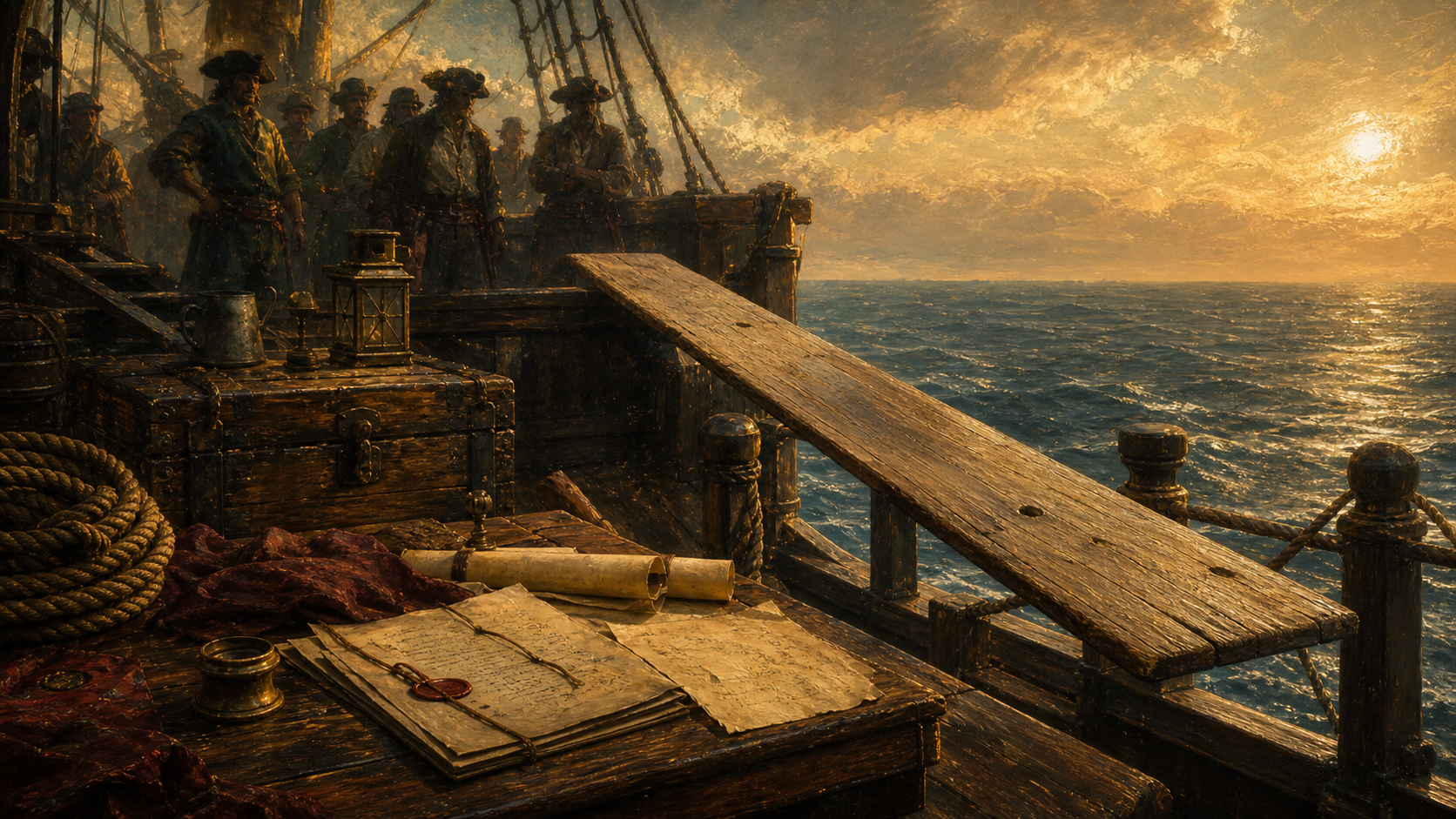
Walking the plank is almost too perfect.
A victim. A narrow board. The sea waiting below. Pirates jeering from the deck. Sharks, if the illustrator has no respect for restraint.
It is clean, theatrical, and instantly understandable. That is exactly why it survived.
The trouble is that walking the plank was not a standard pirate punishment. It belongs much more to later pirate fiction, stage melodrama, illustration, and film than to the routine record of Golden Age piracy. That does not mean pirates were merciful. It means the movies gave us the tidy punishment and history kept the uglier ones.
Real pirates did not need a plank to be terrifying. The sea was already right there.
The Movie Version
A pirate captain wants to make an example. The crew drags a captive to the rail. A board appears, apparently from the ship's theatrical supplies. The victim walks slowly toward death while the audience enjoys the countdown.
It works because it turns murder into ceremony.
The plank gives everyone a role. The captain becomes judge. The crew becomes chorus. The captive gets a dreadful little stage. The sea becomes executioner. No wonder fiction loved it. It is a scene that can be understood from the back row of a theater.
History was rarely so considerate.
The Real Version
Pirates punished, threatened, tortured, abandoned, beat, shot, cut, marooned, and humiliated people. They did not need to invent a neat board ritual to prove they were dangerous.
The plank is difficult to find as a common, documented pirate practice. The more reliable record points to punishments that were practical, brutal, and tied to shipboard needs: discipline, revenge, fear, information, crew control, and public warning.
A pirate crew lived inside a dangerous wooden machine full of weapons, drink, resentment, hunger, greed, and hard labor. Discipline mattered. Not because pirates were orderly gentlemen with exciting scarves, but because disorder could kill the whole company before the Navy had to bother.
A punishment had to send a message. Sometimes the message was for the enemy. Sometimes it was for the crew. Sometimes it was for a captured captain who knew where valuables were hidden. Sometimes it was for anyone thinking of betrayal.
The plank was theater. Real punishment was management with blood on it.
Marooning Was Worse Than the Plank
Marooning is one of the punishments that actually belongs in pirate history.
A person could be left on an island, sandbar, or remote coast with little food, little water, and perhaps a weapon or powder. The details varied, but the basic message was simple: you are now the problem of the sun, thirst, insects, hunger, exposure, and whatever your imagination does after the ship leaves.
A quick death at sea is frightening. A slow uncertainty on land may be worse.
Marooning had practical advantages for pirates. It removed a troublemaker without necessarily turning the deck into a murder scene. It could be framed as punishment rather than immediate execution. It also gave the crew a story to tell the next person considering theft, mutiny, desertion, or betrayal.
The sea did not have to swallow you. Sometimes the shore did.
Torture Was About Information
Pirate violence was often practical in the coldest possible sense.
Captives might be beaten or tortured to reveal hidden money, cargo, valuables, routes, or the location of goods. This was not dramatic villainy for its own sake, though the records can sound lurid enough. It was violence used as extraction: of information, obedience, fear, and advantage.
That is more disturbing than the plank because it is less theatrical and more useful. A pirate did not always want a dead captive. A living captive who knew where the silver was hidden could be more valuable.
The movies gave us a board. The records give us pressure, pain, and questions asked with weapons nearby.
Flogging and Beating Kept Crews in Line
Pirate crews often rejected the harsh discipline of merchant and naval service, but that does not mean pirate ships were floating therapy circles.
A crew might have articles governing shares, conduct, gambling, weapons, lights, theft, quarrels, and compensation for injury. These rules could feel surprisingly structured. They were also enforced in a world where everyone was armed and nobody could call human resources.
Punishments could include beating, whipping, confinement, loss of shares, expulsion, or worse. A pirate ship needed enough internal order to keep robbing other ships. Disorder wasted profit. Quarrels could become murder. Theft from the common stock could destroy trust. Cowardice in battle could endanger everyone.
Pirate discipline was not gentle democracy. It was survival law among armed criminals.
The State Had Its Own Punishments
The worst pirate punishments were not always inflicted by pirates.
Captured pirates could face trial, execution, and public display. Hanging was meant to kill the body and instruct the crowd. Displaying the corpse or head extended the lesson. Execution Dock and other public punishment sites turned pirate deaths into state messaging.
Pirates used terror to make ships surrender. Governments used terror to make sailors reconsider piracy.
That grim symmetry matters. The state did not merely remove pirates. It staged their removal. A hanging body told merchants, sailors, tavern crowds, and would-be raiders that the law could still reach the sea, even if it arrived late and in a bad mood.
A plank was private theater. A gallows was public policy.
Why the Plank Survived Anyway
The plank survives because it gives pirate cruelty a shape that is easy to sell.
It is less complicated than marooning. Less ugly than torture. Less bureaucratic than trial records. Less morally uncomfortable than naval execution. It turns violence into a scene with a beginning, middle, and splash.
That is why fiction keeps returning to it. The plank is not really about historical evidence. It is about narrative efficiency.
One board says pirate. One step says doom. One splash says scene over.
The Better Truth
Pirates probably did not need walking the plank as a regular punishment because the real tools of fear were already available: abandonment, beating, torture, guns, knives, ropes, loss of shares, public execution, and the general knowledge that a wooden ship far from shore is a terrible place to run out of mercy.
The plank is memorable because it is clean.
The truth is more useful because it is not. Pirate punishment reveals how sea crime actually worked: discipline inside the crew, intimidation toward victims, extraction from captives, and public terror from the authorities who hunted them.
Movies gave us the beautiful lie.
History, as usual, had worse manners.


