Fact article
Fact trail
Lost money, recovered clues, and the lure of stories that keep sending people back to the map.
Pirate treasure has always been better at escaping evidence than escaping imagination.
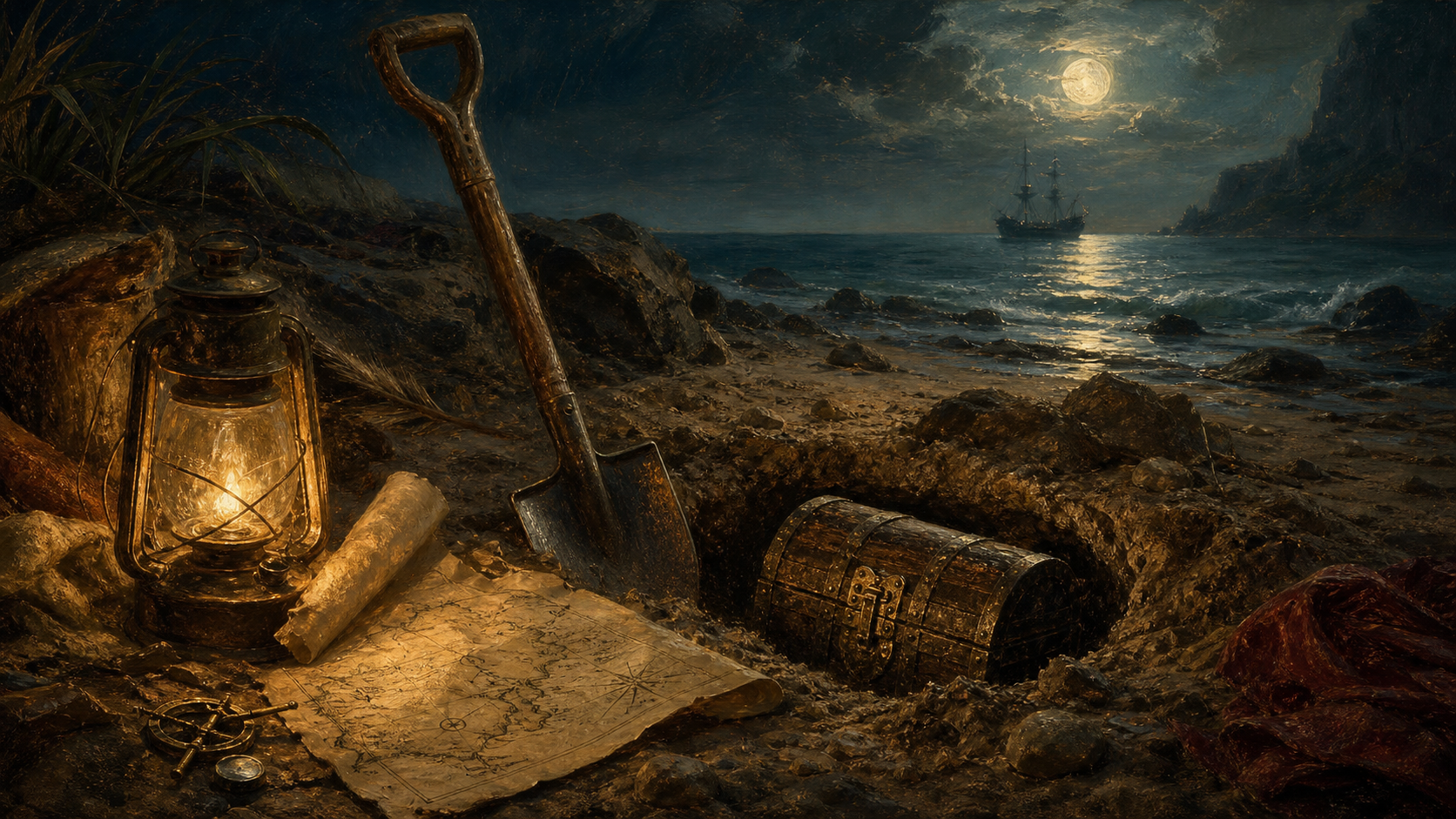
The classic version is simple: a chest, an island, a map, an X, and a pirate who thoughtfully dies before collecting his savings. It is a beautiful system, mostly designed by fiction. Real pirate loot was usually divided, spent, sold, hidden briefly, seized, consumed, wrecked, or transformed into ordinary goods with very unromantic bookkeeping.
And yet certain pirate treasures refuse to stay buried.
Some are real caches. Some are wrecks. Some are missing fortunes. Some are legends with one hard seed of truth. Some are probably nonsense wearing excellent boots. All of them show why treasure remains the most stubborn pirate myth of all.
1. Captain Kidd’s Gardiners Island Cache
William Kidd is the rare pirate-adjacent figure who gives treasure hunters something real to point at.
Before his arrest, Kidd placed valuables on Gardiners Island. The cache was recovered and became part of the legal and political story surrounding his trial. That matters because it gives the buried-treasure myth a genuine foothold.
The problem is what happened afterward. One real cache became permission for centuries of speculation. Kidd’s name attached itself to hidden fortunes, secret maps, and beaches that suddenly looked suspicious if viewed with enough desire.
What is real: Kidd did hide valuables on Gardiners Island.
What grew later: the idea that endless Kidd treasure remains scattered wherever a shovel can be sold.
The real cache belongs to evidence. The larger treasure fever belongs to culture.
2. Henry Every’s Missing Fortune
Henry Every captured one of the most politically explosive prizes in pirate history when his crew attacked the Mughal ship Ganj-i-Sawai in 1695.
The loot was enormous by pirate standards, but the real shock was diplomatic. The attack threatened English trade in India and enraged Mughal authorities. Then Every disappeared, which is exactly the wrong thing to do if one wants the treasure story to die politely.
What happened to his share? Did he keep it? Lose it? Spend it? Hide it? Was he cheated? Did he live quietly under another name? The record does not give a satisfying answer.
What is real: the raid and its consequences.
What remains slippery: the final path of Every’s wealth.
A missing pirate with a famous fortune is not a story. It is a machine for manufacturing endings.
3. The Whydah’s Recovered Treasure
The Whydah is different because the sea eventually gave some of the story back.
Captured by Samuel Bellamy in 1717, the Whydah wrecked off Cape Cod in a storm, killing Bellamy and most aboard. Later recovery work brought up artifacts connected to one of the best-known Golden Age pirate wrecks. Coins, weapons, ship fittings, and other material made the story tangible in a way many pirate legends are not.
But the treasure is not clean romance. The Whydah had been a slave ship before Bellamy captured it. Its wealth was tied to the Atlantic economy of forced labor, empire, trade, and violence.
What is real: a pirate wreck with recovered material evidence.
What needs caution: treating the recovered wealth like innocent storybook gold.
The Whydah did not just preserve treasure. It preserved discomfort.
4. La Buse’s Cryptogram
Olivier Levasseur, known as La Buse, has one of the great treasure-story endings.
According to tradition, before his execution he threw a cryptic message to the crowd and challenged someone to find his treasure. The supposed cryptogram has inspired treasure hunters for generations. It is almost too perfect: a condemned pirate, a final clue, a hidden fortune, and a puzzle that keeps refusing to solve itself in a commercially inconvenient way.
This is treasure legend at full sail.
What is real enough to matter: Levasseur’s reputation and the durable treasure tradition around him.
What remains uncertain: whether the famous clue leads to anything recoverable.
The story survives because it has the shape of proof and the behavior of bait.
5. The Lost Riches of the Ganj-i-Sawai
Every’s raid deserves a second place on this list because the ship itself was such a powerful treasure object.
The Ganj-i-Sawai carried wealth, passengers, and political meaning. It belonged to a world far larger than a pirate crew. The stolen goods became part of a crisis, but the full accounting of pirate plunder in such cases is rarely as tidy as later readers want.
Loot moves. It is divided, traded, hidden, gambled, spent, stolen again, melted, disguised, or lost. That is why pirate treasure often becomes less traceable the moment it becomes useful.
What is real: a hugely consequential seizure.
What refuses to settle: the complete trail of the plunder after division and escape.
A chest sits still. Real loot misbehaves.
6. The Queen Anne’s Revenge Wreck
Blackbeard’s flagship is not a buried treasure chest, but it is a treasure of another kind: a material anchor for a man often swallowed by legend.
The vessel believed to be Queen Anne’s Revenge was discovered off North Carolina. Artifacts associated with the wreck have helped pull Blackbeard’s story toward archaeology and away from pure smoke. Cannons, fittings, and seabed evidence do not give us Blackbeard’s private thoughts, but they give the legend weight.
The ship also reminds us that pirate treasure is not always gold. Sometimes the treasure is evidence.
What is real: a wreck strongly associated with Blackbeard’s flagship and a body of recovered material.
What needs care: turning every artifact into a dramatic confession.
The wreck does not solve Blackbeard. It makes him harder to dismiss as only a poster.
7. Oak Island’s Pirate Treasure Rumors
Oak Island is the sort of place where treasure rumor learned to build a permanent residence.
Pirates have been dragged into the island’s mystery because pirate treasure makes every hole more exciting. Stories have connected the site to hidden wealth, secret engineering, and famous names. The trouble is that desire often outruns evidence, and Oak Island has been chased by theories for a very long time.
It remains culturally important not because it proves pirates buried a fortune there, but because it shows how treasure legends work. A strange site, an uncertain origin, repeated digging, famous names, and the promise that the next clue may finally explain everything — that is the recipe.
What is real: a long treasure-hunting tradition.
What is not proven: a clean pirate-treasure explanation.
Oak Island is less a pirate chest than a lesson in how treasure stories can swallow fortunes while chasing one.
8. Port Royal’s Sunken World
Port Royal was not simply a pirate treasure site. It was a real city with a real history, tied to privateering, trade, vice, violence, empire, slavery, and maritime commerce.
The 1692 earthquake and disaster that destroyed much of Port Royal created a submerged archaeological landscape. That makes the site valuable in a way more serious than a chest rumor. It preserves pieces of a seventeenth-century Caribbean port world connected to piracy and privateering, but not reducible to either.
What is real: a major disaster and an important submerged historical site.
What needs caution: treating the sunken city as a pirate treasure box.
Sometimes the treasure is not what was hidden. It is what disaster accidentally preserved.
9. Madagascar’s Pirate Afterlife
Madagascar has attracted pirate dreams for centuries.
European imagination turned parts of the island into a stage for pirate refuges, lost colonies, hidden communities, and offshore fortunes. Some pirates really did operate in the Indian Ocean and use remote bases. But Madagascar’s pirate afterlife often mixes fact, rumor, colonial fantasy, and the seductive idea of a place beyond ordinary law.
That makes its treasure stories complicated. They reveal European hunger for distant pirate worlds as much as they reveal recoverable loot.
What is real: Indian Ocean piracy and the use of remote maritime spaces.
What needs care: every claim that turns Madagascar into a convenient treasure drawer.
A remote island can hide many things. It can also hide the fact that the story is doing most of the work.
10. The Treasure Pirates Actually Wanted
The most stubborn pirate treasure is the one people keep ignoring.
Pirates often wanted cargo: cloth, sugar, tobacco, spices, medicine, tools, weapons, food, silver, gold, coins, enslaved people, and anything else that could be sold, used, or divided. A practical cargo could matter more than a romantic chest. Medicine could be worth demanding. Spare parts could keep a ship alive. Food could be survival. A small fortune in trade goods could look boring to a movie audience and beautiful to a crew.
What is real: pirate loot was often practical, movable, and quickly divided.
What myth prefers: coins in a chest under a tree.
The real treasure economy is less tidy and more revealing. It shows piracy as work, violence, logistics, markets, hunger, and greed — not just glitter.
Why Treasure Refuses To Die
Treasure stories survive because they solve a problem for the imagination.
They turn crime into a puzzle. They turn stolen goods into adventure. They turn violence into a map. They turn historical uncertainty into a place where anyone with a shovel can feel one clue away from destiny.
Most pirate treasure was never buried. Much of it was spent, divided, sold, seized, wrecked, or transformed into other things. But the exceptions, rumors, wrecks, and missing endings keep the myth alive.
The X marks the spot because stories need somewhere to point. History is less generous. It gives us caches, wrecks, ledgers, victims, rumors, archaeology, and gaps.
Sometimes that is better than a chest. A chest ends when it opens. A good pirate mystery keeps asking what kind of world wanted the treasure in the first place.


