Fact article
Fact trail
Buried treasure, fatal flags, hooks, parrots, staged accents, and all the stories that became too useful to die quietly.
Pirate movies have done terrible things to history.
They have also done wonderful things to the imagination.
Without them, many people would not recognize the Jolly Roger. Children would have fewer reasons to menace sofas with plastic swords. Parrots would have fewer career opportunities. The world would be poorer in several ridiculous ways.
The problem is that movies made their pirate world so vivid that it often replaced the real one.
The cinematic pirate is built from moonlit decks, buried chests, tavern maps, one-legged captains, skull flags, sword fights, parrots, and men with suspiciously consistent accents. It is dramatic, memorable, and often beautiful.
It is also a terrible guide to history.
The real story was more political, more economic, more violent, more global, and much messier than the costume version suggests.
So let us enjoy the lies, then rob them politely.
1. Pirates made prisoners walk the plank
The movie version: A prisoner stands on a board above the sea while pirates laugh and sharks organize themselves for dramatic timing.
The real version: Walking the plank was not a standard pirate punishment.
Pirates could be brutal. They marooned people, beat people, tortured people, threatened people, killed people, and used fear as a tool. They did not need a neat board to make the sea dangerous. If someone had to die, there were faster, uglier, and more practical methods available.
The plank survives because it is perfect theater. It gives the villain a stage, the victim a slow countdown, and the audience one clean image.
History was usually less tidy.
The better truth: pirates did not need theatrical punishments. The real ones were worse.
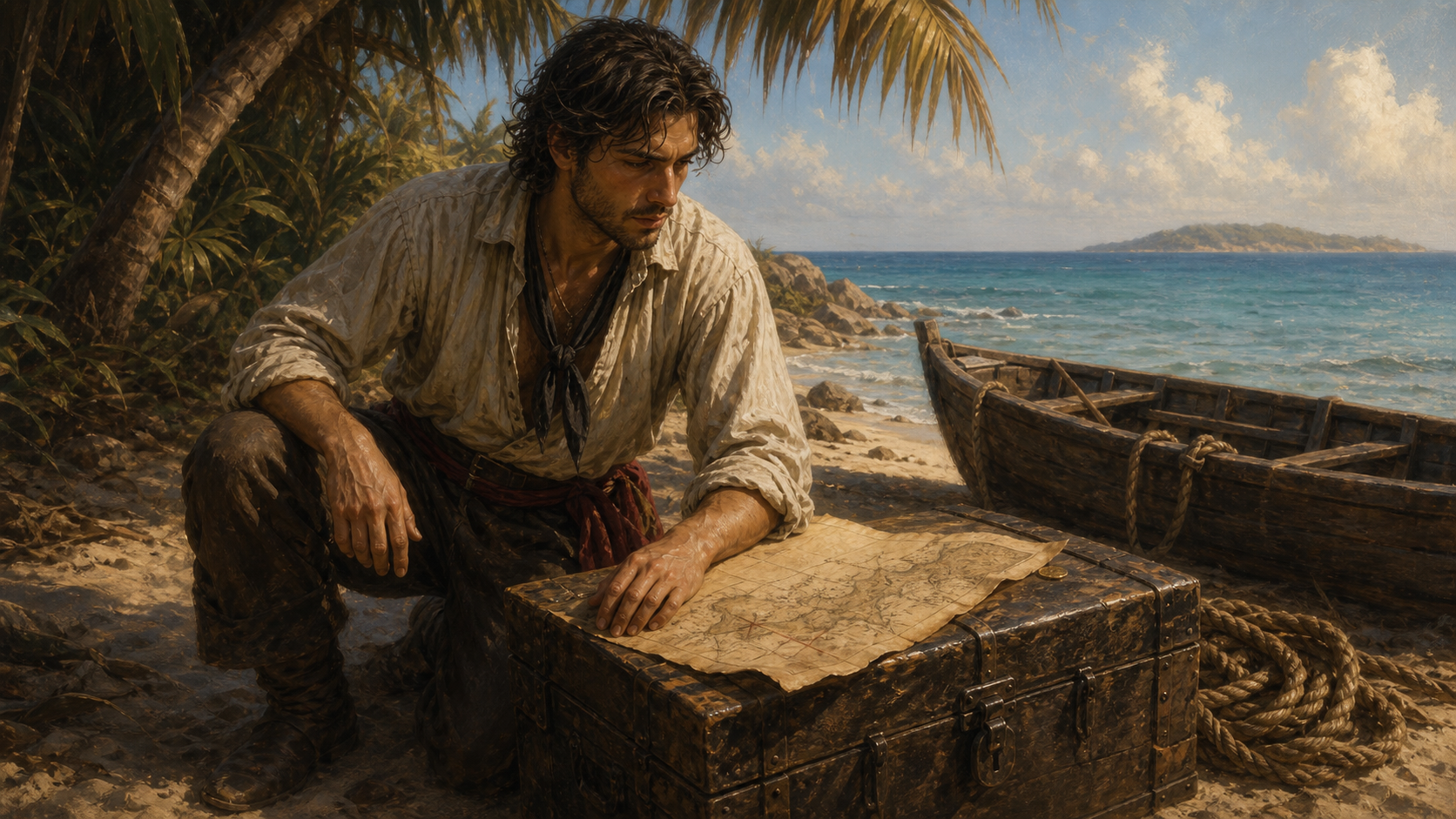
2. Every pirate had a treasure map
The movie version: A map appears. There is an X. Someone finds a shovel. Childhood begins.
The real version: Treasure maps are mostly fiction's gift to piracy.
Pirates generally did not capture wealth, bury it, draw a helpful diagram, and then hope nobody misplaced the palm tree. A pirate crew expected shares. Loot was meant to be divided, sold, spent, traded, or used. A captain who announced that everyone should bury the money for later would have been introducing himself to mutiny.
Captain Kidd's real hidden goods helped feed the legend, but the rare case became the rule in imagination.
The better truth: pirate maps mostly belong to stories. The X marks the spot because fiction needed somewhere to point.
3. Pirates buried treasure all the time
The movie version: Every island is basically a bank with coconuts.
The real version: Buried treasure was not normal pirate finance.
Treasure was often not even treasure in the glittering sense. Pirate loot could be sugar, cloth, tobacco, medicine, tools, weapons, food, silver, enslaved people, or cargo that could be sold. A prize full of useful goods might matter more than a box of coins.
Burial makes theft romantic. It turns cargo into mystery and robbery into adventure. That is why the image survives.
The better truth: pirates usually wanted portable value, not a long-term relationship with a shovel.
4. Pirates all said “Arrr”
The movie version: Every pirate sounds like the same gravelly actor after being left overnight in a rum barrel.
The real version: The famous pirate voice owes far more to performance history than to a universal pirate accent.
Pirates came from many places: England, Ireland, Wales, Scotland, France, the Netherlands, Spain, Portugal, Africa, the Caribbean, the Americas, and beyond. The sea was multilingual and multiethnic. A Caribbean pirate crew did not sound like one man doing dinner theater.
The rolling “Arrr” became sticky because it was fun, theatrical, and easy to imitate.
The better truth: the pirate accent is a cultural costume. Wear it for fun. Do not mistake it for a transcript.
5. Pirates kept parrots on their shoulders
The movie version: A pirate has a parrot. The parrot has opinions. The parrot may be the smartest officer aboard.
The real version: Parrots were possible, not standard issue.
Sailors and pirates could encounter parrots, trade them, transport them, or keep exotic animals. That part is plausible. But the shoulder-parrot as mandatory pirate equipment belongs mostly to iconography.
The bird works visually. It adds color, humor, and personality. It turns a violent criminal into someone oddly charming.
A real ship was cramped, dirty, dangerous, and short on fresh comforts. Keeping a tropical bird alive was not the central concern of men trying to avoid disease, storms, hunger, naval patrols, and hanging.
The better truth: parrots make excellent pirate symbols and questionable historical uniforms.
6. Pirates dressed like costume-shop aristocrats
The movie version: Every pirate owns boots, a hat, a sash, a coat, jewelry, flowing linen, and lighting that flatters cheekbones.
The real version: Pirate clothing was work clothing, stolen clothing, repaired clothing, and sometimes show-off clothing.
Sailors needed garments that survived heat, salt, tar, wet decks, climbing, loading, rowing, fighting, and sleeping badly. Pirates might wear fine stolen clothing when they could, and some clearly cared about display. But the everyday wardrobe was more practical and much sweatier than the costume version.
The better truth: pirates wore what worked, what lasted, what they stole, and what made them look dangerous when looking dangerous helped.
7. Pirate captains were absolute tyrants
The movie version: The captain commands. The crew obeys. Disagreement ends near the rail.
The real version: Many pirate crews limited captain power.
Some crews elected captains, chose quartermasters, wrote articles, divided shares by agreement, and compensated injuries. This was not modern democracy, and it did not make piracy moral. It did make shipboard authority more negotiated than the movie tyrant suggests.
A captain had to produce prizes, manage risk, and keep confidence. He could be removed if the bargain failed.
The better truth: some pirate ships were violent little workplace republics. Not noble republics. Armed ones.
8. The Jolly Roger flew all the time
The movie version: Pirate ships sail everywhere under skull flags because brand consistency matters.
The real version: Pirate flags were tools, not constant decoration.
A pirate ship often benefited from deception. False colors could help it approach a target before revealing danger. The black flag, when used, was psychological warfare: surrender and maybe live; resist and risk worse.
There was no single universal pirate flag. Designs varied. Skulls, bones, skeletons, weapons, hearts, hourglasses, and full figures all appear in pirate flag tradition.
The better truth: the Jolly Roger was not a logo. It was a threat delivered at the right moment.
9. Pirates mostly fought elegant sword duels
The movie version: Piracy is fencing with better hats.
The real version: Boarding actions were chaotic, smoky, loud, and often very ugly.
Pirates used pistols, muskets, cutlasses, axes, knives, pikes, clubs, grenades, cannon, intimidation, and numbers. A fair duel was not the goal. Surrender was the goal. Every real fight risked damage to ship, cargo, and crew.
Movies need the hero and villain to talk while blades ring. Actual combat gave men smoke, splinters, blood, noise, panic, and a strong desire to be elsewhere.
The better truth: pirates did not seek fair fights. They sought profitable submission.
10. Piracy was mostly Caribbean men with skull flags
The movie version: Piracy means the Caribbean Golden Age, mostly English-speaking men, warm water, and excellent posters.
The real version: Piracy was global and much older than Blackbeard.
The Caribbean matters, but it is not the whole house. Piracy and sea raiding appear in the ancient Mediterranean, Viking worlds, the Indian Ocean, the South China Sea, the Red Sea, the Persian Gulf, the Atlantic, the Pacific, the Barbary coast, and modern shipping lanes.
The most successful pirate commander by scale was not Blackbeard. Zheng Yi Sao helped command a vast South China Sea confederation and negotiated a survival ending most Atlantic pirates would have envied.
The better truth: the Caribbean is the famous room. Piracy is the building.
Why the myths survive
The myths survive because they work.
The plank gives suspense. The map gives a quest. The buried chest gives mystery. The accent gives a party trick. The parrot gives color. The flag gives instant danger. The duel gives romance. The costume gives silhouette.
Movies did not lie because reality was boring.
They lied because reality was too complicated to fit neatly into one moonlit deck.
But the real history is not smaller. It is bigger: elections before robberies, flags as psychological weapons, treasure as cargo, piracy as labor revolt and organized crime, women who fought through hostile records, global confederacies, modern pirates without costumes, and legends that keep polishing rough facts until they shine too cleanly.
Keep the parrot if you must.
Just know that the truth underneath the costume is stranger, harsher, funnier in places, and much harder to kill.


