Article
The legend, tested
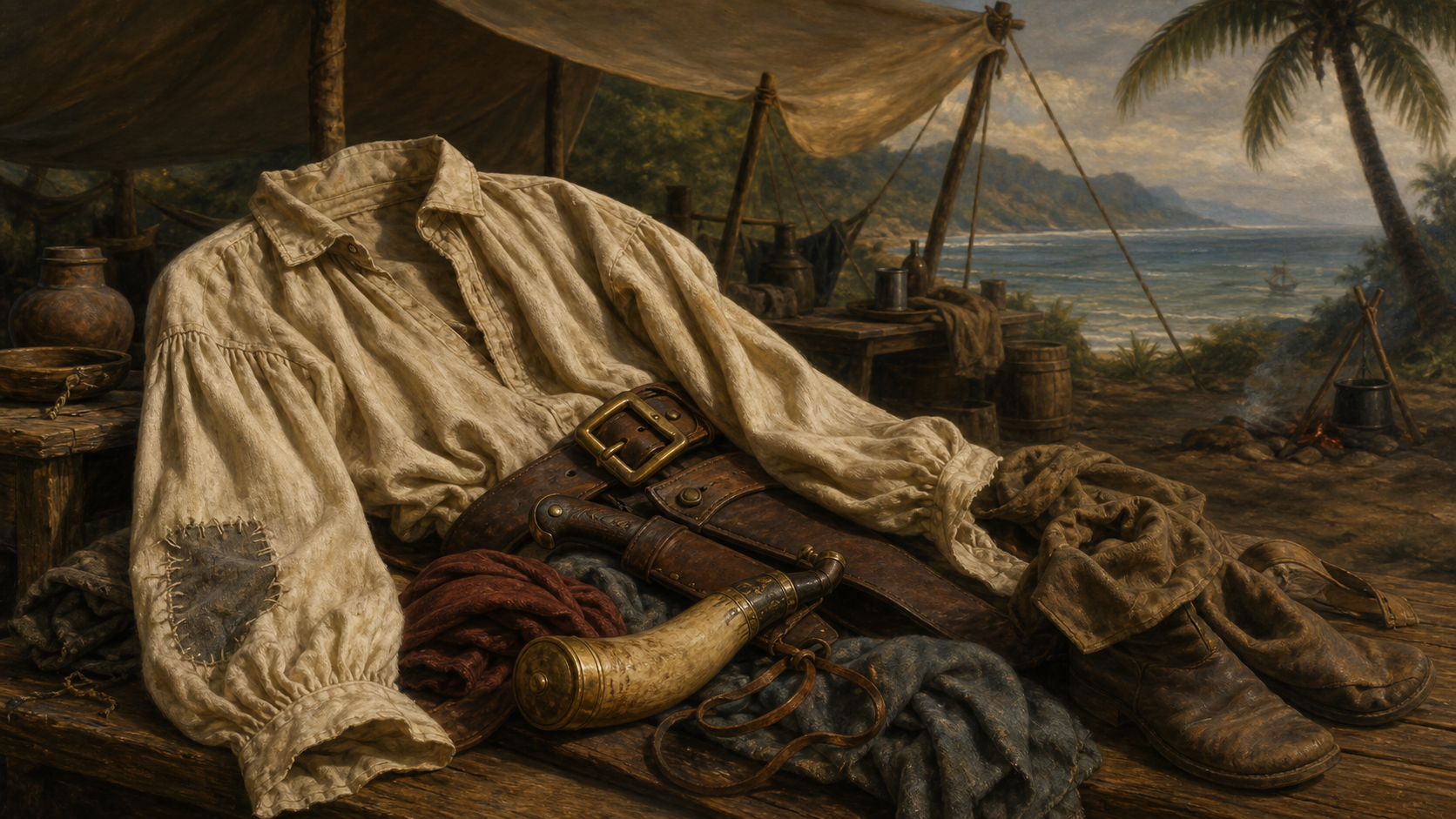
17th-century Caribbean buccaneers, originating as Haitian hunters, wore distinct clothing. Their attire, distinct from typical pirates, included long hunting shirts, similar to 18th-century backwoodsmen. Lacking breeches...
The buccaneer did not begin as a man in a clean hat waiting for a movie poster.
He began closer to smoke, meat, heat, knives, rough camps, stolen opportunity, and the hard economies of the seventeenth-century Caribbean. Buccaneers were hunters, raiders, smugglers, sailors, fighters, and imperial irritants before later romance turned them into decorative ancestors of the Golden Age pirate. Their clothing followed that world. It was practical first, theatrical much later.
That is why buccaneer dress can look different from the standard pirate costume. The roots were not only on the quarterdeck. They were also in hunting camps, coastal raids, small boats, rough terrain, and lives lived between Spanish power and rival European appetites.
Hunters Before Poster Pirates
The word buccaneer points back toward the hunters of Hispaniola and nearby Caribbean spaces, especially men associated with smoking meat and living on the hard edge of colonial settlement. Over time, many shifted toward raiding Spanish shipping and settlements. The clothing followed the life.
A hunter needed freedom of movement, protection from brush and sun, and garments that could survive sweat, dirt, smoke, blood, salt, and rough use. A long shirt or heavy overshirt, belted for movement, makes more sense in that world than a polished naval coat. Bare legs or minimal lower garments also appear in some period images and descriptions, matching a hot, rough environment where practicality beat dignity whenever dignity slowed the legs.
This is not the pirate of the ballroom. This is the pirate-adjacent raider whose clothing still smells of the camp.
The Smock and the Sash
One of the most striking buccaneer images is the long shirt or smock-like garment tied at the waist. It resembles other hunting workwear more than later naval fashion. The belt or narrow sash was not just decoration. It could gather loose fabric, keep a garment from tangling, and help hold tools or weapons.
That practical logic matters. Costume history often turns every sash into swagger. Sometimes the sash is simply the thing keeping your clothing from trying to kill you while you move through heat, brush, boats, and fight.
Buccaneers also carried practical equipment: knives, firearms, bags, hats or caps, and whatever they needed for hunting, raiding, and survival. The look could be distinctive, but distinction came from work and environment, not from a pirate fashion committee.
Caribbean Heat Changed the Wardrobe
The Caribbean punished European clothing assumptions. Heat, humidity, rain, insects, disease, mud, and salt did not care what a man would have worn in London, Amsterdam, or Paris. Clothing had to adapt or rot, sometimes both.
This is one reason buccaneer clothing should not be treated as simply “early pirate clothing.” It belongs to a particular environment. Men moving between hunting, small craft, coastal raiding, and rough settlement needed garments that could be worn hard. Some might later wear captured finery or better clothes ashore, but the working image is rougher.
That roughness is historically useful. It reminds readers that piracy and buccaneering did not begin as a costume culture. They grew from labor, violence, hunger, trade, empire, and opportunity.
Raiding Changed the Look Again
As buccaneers became more involved in raiding, their clothing could shift. Captured goods entered the wardrobe. Military and seamen’s garments mixed with hunting dress. Men who succeeded could acquire better fabric, weapons, hats, shoes, coats, and accessories. A raider who had just taken Spanish goods might look different from a hunter before the raid.
That does not erase the roots. It creates a layered appearance: practical base, stolen additions, regional adaptation, and occasional display. The result was not uniform, but it was readable as a life lived outside ordinary order.
The later pirate costume borrows the excitement and forgets the labor. Buccaneer clothing puts the labor back.
What the Costume Version Misses
A costume-shop buccaneer often looks like a Golden Age pirate with fewer rules. The real figure belongs to a specific seventeenth-century Caribbean world. He was shaped by Spanish colonial wealth, rival European powers, hunting economies, privateering claims, smuggling, coastal raiding, and the practical violence of frontier life.
Clothing cannot explain all of that by itself, but it can point toward it. A long smock, rough shirt, belt, knife, firearm, and worn hat say something different from a rich coat and theatrical boots. They say work. They say heat. They say movement. They say a man who may be one failed bargain or one successful raid away from a new label.
Why Buccaneer Clothing Still Matters
Buccaneer dress widens the reader’s idea of pirate clothing. It reminds us that not all sea raiders were Golden Age Atlantic pirates, and not all maritime violence came in the same outfit. The buccaneer belongs to a rougher, earlier, more land-and-sea world where hunting camps and raiding parties sat closer together than later romance admits.
For the wider clothing route, continue to the pirate attire overview. For the legal and historical background, follow buccaneers, privateers, and the Caribbean history pages. The important correction is simple: buccaneer clothing was not fancy pirate cosplay before its time. It was hard clothing for hard work in a violent Caribbean.
The later costume kept the danger. The original garments kept the sweat.


