History feature
Historical route
The enduring impact of piracy on culture and society is profound, reaching far beyond mere historical accounts. Its influence permeates literature, from timeless classics like "Treasure Island" to contemporary adaptation...
Pirates became famous for doing terrible things in memorable clothing.
That is not a complete explanation, but it is a useful start. A thief on land may vanish into a court record. A thief at sea becomes a shape on the horizon, a rumor in port, a warning to merchants, a tavern story, a children’s costume, a film franchise, and eventually a logo on a birthday napkin.
History does not usually reward criminals with such good branding. Pirates got lucky. Or rather, they occupied the exact place where fear, trade, law, empire, class resentment, exotic travel, and fantasy all collided. The result was cultural afterlife on a scale few criminals receive.
The real pirates were not harmless mascots. They stole, threatened, tortured, kidnapped, trafficked in fear, and sometimes murdered. But culture rarely preserves people as they were. It preserves what they can be made to mean. Pirates became useful symbols because they could carry almost any argument: freedom or lawlessness, rebellion or greed, courage or cruelty, escape or danger, romance or warning.
That is why they survived.
The sea made crime feel larger
A pirate attack was never only a private robbery. It interrupted trade, frightened investors, delayed cargo, endangered crews, embarrassed officials, and exposed how thin state power could look once the shoreline disappeared behind the mast.
The sea gave crime distance. Distance gave it imagination.
A highway robber might terrify a road. A pirate could haunt a route between empires. A captured ship could ripple through merchants, governors, insurers, naval officers, families, ports, courts, and newspapers. Even when the actual raid was small, the anxiety around it could grow. What if the next ship was taken? What if commerce stopped? What if the navy could not protect its own flag? What if the people at the edge of empire discovered that law had to travel by sail and sometimes arrived late?
Pirates became cultural figures partly because they exposed a truth polite societies disliked: civilization at sea was fragile. A ship was a workplace, a warehouse, a community, and a legal claim moving through danger. Once pirates appeared, all of those things could be challenged at once.
That made piracy useful to storytellers. It was not just theft. It was a test of the world.
Pirates became warnings before they became toys
Before pirates became Halloween, they were public warnings.
Executions, trial pamphlets, proclamations, gallows speeches, and displayed bodies all helped turn pirates into moral examples. Governments did not merely want pirates dead. They wanted pirates read correctly. A hanged pirate said: this is what happens when sailors reject lawful labor, attack commerce, and embarrass authority.
That message was not subtle. It was not meant to be.
Execution Dock in London, colonial trials in Jamaica or Charleston, and the display of severed heads or bodies all belonged to a culture of visible punishment. The state understood spectacle as well as any pirate captain. Pirates used flags, reputation, and intimidation to make victims surrender. Governments used courts, ropes, and bodies to make sailors think twice.
But warnings have a habit of becoming entertainment. The more dramatic the criminal, the more attractive the warning becomes. A pirate trial could be sold as moral instruction and read as adventure. A death scene could condemn the outlaw while making him unforgettable. The state wanted the pirate to become an example. The public kept the example and quietly improved the hat.
Literature polished the criminal into a character
Pirates entered literature because they solved several storytelling problems at once.
They gave writers movement: ships, islands, storms, ports, pursuit. They gave danger: weapons, betrayal, captivity, hidden goods. They gave moral argument: was the pirate a villain, a rebel, a victim of harsh labor, or a monster who deserved the rope? They gave visual shorthand: flag, cutlass, scar, coat, treasure chest. They gave the plot somewhere to sail.
Early pirate histories, criminal biographies, ballads, plays, novels, boys’ adventure books, and later films all contributed to the transformation. Each generation took what it needed. Some wanted moral warning. Some wanted empire and adventure. Some wanted antiheroes. Some wanted comedy. Some wanted the thrill of lawlessness without the smell of a real ship.
By the time the pirate reached modern popular culture, the image had been edited many times. The dirt was cleaned. The violence was stylized. The labor was hidden. The suffering of captives and victims often moved offstage. The pirate became more useful as a costume than as a person.
That does not mean the cultural pirate is worthless. It means the reader should know what has been sanded down.
The pirate became a fantasy of freedom
Pirates appeal because they appear to reject ordinary obedience.
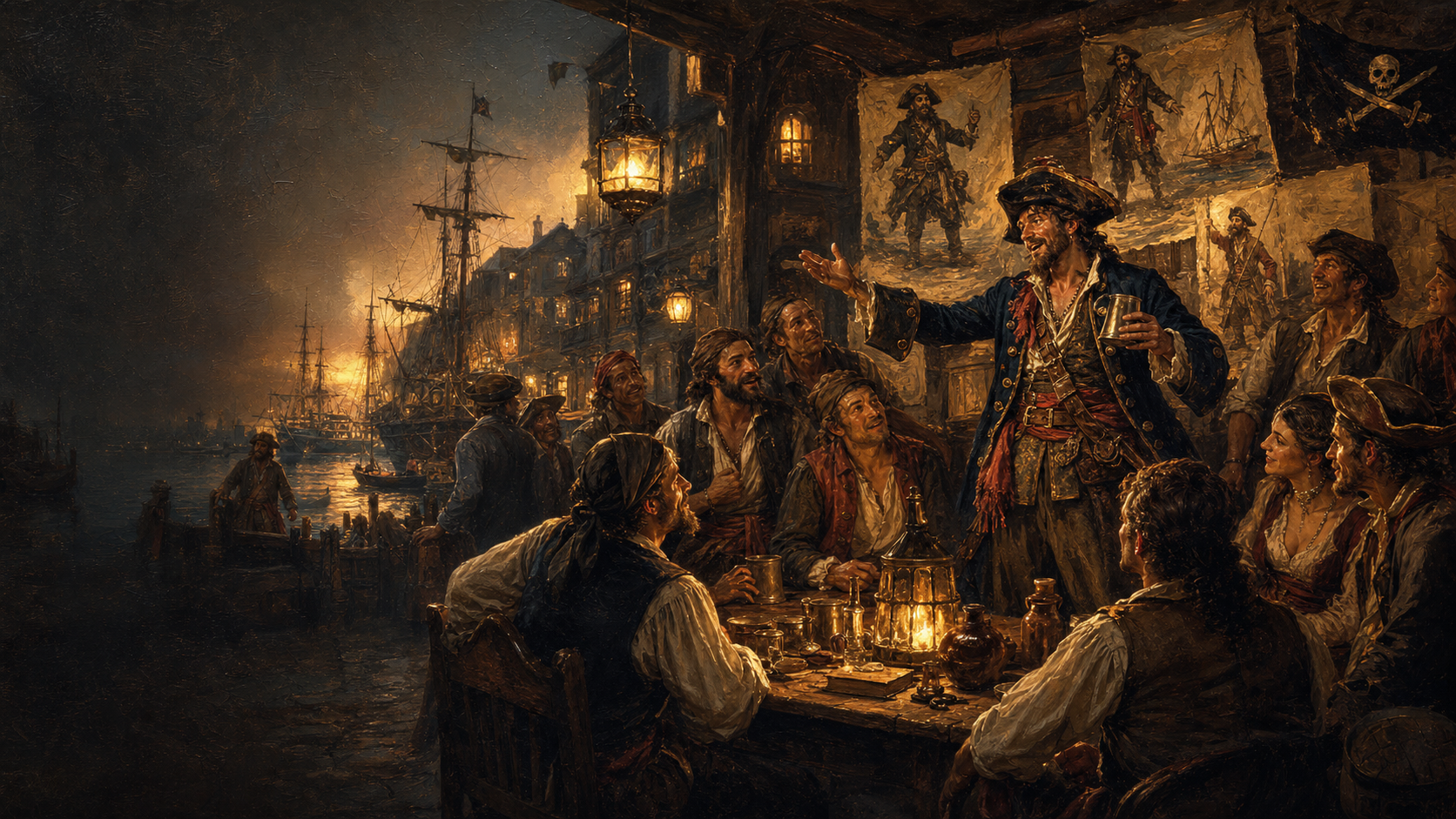
They do not sit in offices. They do not ask permission. They do not respect borders. They leave land, names, debts, masters, employers, and sometimes nations behind. In stories, they live by their own rules under a sky that looks suspiciously better lit than most historical weather.
That fantasy has power.
Real pirate life was not clean freedom. It was hunger, disease, fear, violence, injury, bad water, cramped quarters, and a high chance of hanging. But pirate crews sometimes did offer sailors things legal maritime labor did not: shares of plunder, elected authority, compensation for injury, and a rough voice in shipboard decisions. That internal bargain did not make piracy moral. It made the myth harder to dismiss.
A pirate could be both a predator and a symbol of resistance to brutal hierarchy. Those two truths sit uncomfortably together, which is why the figure keeps working. People are drawn to the rebellion and try not to look too long at the victims.
Culture loves that bargain. It lets the audience borrow rebellion without paying the historical cost.
The costume swallowed the complexity
The pirate costume is one of culture’s great compression machines.
Put a person in a tricorn hat, sash, boots, loose shirt, earring, and belt, and the audience knows the role before anyone speaks. Add a parrot if subtlety has abandoned ship. The costume gives instant permission: this person is outside rules, probably dangerous, possibly funny, and almost certainly about to make poor decisions with confidence.
The real clothing was messier. Sailors wore practical garments, stolen garments, damaged garments, regional garments, and whatever survived the sea. Some successful pirates dressed finely because plunder included clothing and status mattered. Others looked like working seamen because they were working seamen, even when the work was robbery.
Culture kept the most readable version. It needed a silhouette.
The same thing happened to language. A complex world of accents and languages became “arr.” A variety of flags became one universal skull. A diverse history of piracy across the Mediterranean, Indian Ocean, South China Sea, Caribbean, Atlantic, and modern shipping lanes became a Caribbean-flavored stage set.
The costume is fun. It is also a machine that flattens the map.
Pirates gave society a safe place to argue with itself
The pirate is useful because he, or she, can be made to represent whatever society wants to debate.
Law and crime. Work and freedom. Empire and rebellion. Masculinity and performance. Women crossing forbidden roles. Violence and glamour. Private profit and public order. State power and hypocrisy. The line between privateer and pirate. The uncomfortable fact that governments sometimes condemned robbery unless they had signed the paperwork first.
That is why the pirate refuses to stay only in children’s stories. The subject keeps opening into larger questions. Francis Drake can be hero in one national memory and pirate in another. Henry Morgan can be raider, privateer, knight, and rum mascot. Jean Laffite can be smuggler, patriot, criminal, and local legend. Zheng Yi Sao can force readers to widen the map beyond the Caribbean and admit that the most successful pirate commander does not fit the usual poster.
Pirates work culturally because they are not stable symbols. They are arguments in boots.
The afterlife is not innocent
Pirate entertainment can be delightful. It can also become a way of forgetting.
It forgets enslaved people whose labor created wealth moving across the Atlantic. It forgets captured sailors who did not experience piracy as adventure. It forgets coastal communities frightened by raids. It forgets the bodies used as warnings after trials. It forgets that some “treasure” was cargo, wages, medicine, tools, trade goods, or human suffering converted into money.
A better pirate culture does not require banning the fun. It requires giving the fun better footing.
Enjoy the flags, but know they were threats. Enjoy the treasure maps, but know they are mostly fiction. Enjoy the accents, but know they owe more to performance than the historical sea. Enjoy the stories, but remember that the real history is often stranger than the simplified version and less morally comfortable.
That is where PiratesInfo should live: not in the joyless business of ruining pirate culture, and not in the lazy business of repeating every shiny myth. The better route is to let the legend breathe while keeping the evidence visible.
Why pirates still hold the deck
Pirates remain culturally powerful because they give ordinary life a door marked escape.
Most people do not want real piracy. They want the fantasy of stepping outside routine for a moment. They want a flag on the wall, a story at night, a phrase with a little salt in it, a character who refuses the sensible path. They want rebellion without scurvy, freedom without trial, treasure without bookkeeping, and danger safely folded into entertainment.
Movies and novels did not invent the appeal. They amplified it.
The real pirates gave culture raw material: fear, law, trade, punishment, class resentment, maritime skill, and violent opportunity. Later culture added the parrot, the map, the charming rogue, the polished flag, the tavern song, and the wink. The result is not pure history, but it is not random either. It is a long argument between what pirates did and what people needed them to mean.
That is why the pirate will not stay buried.
He keeps climbing out of the chest, adjusting the hat, and asking society why it is still so interested in criminals who looked at the rules, found a ship, and sailed the other way.


