History feature
Historical route
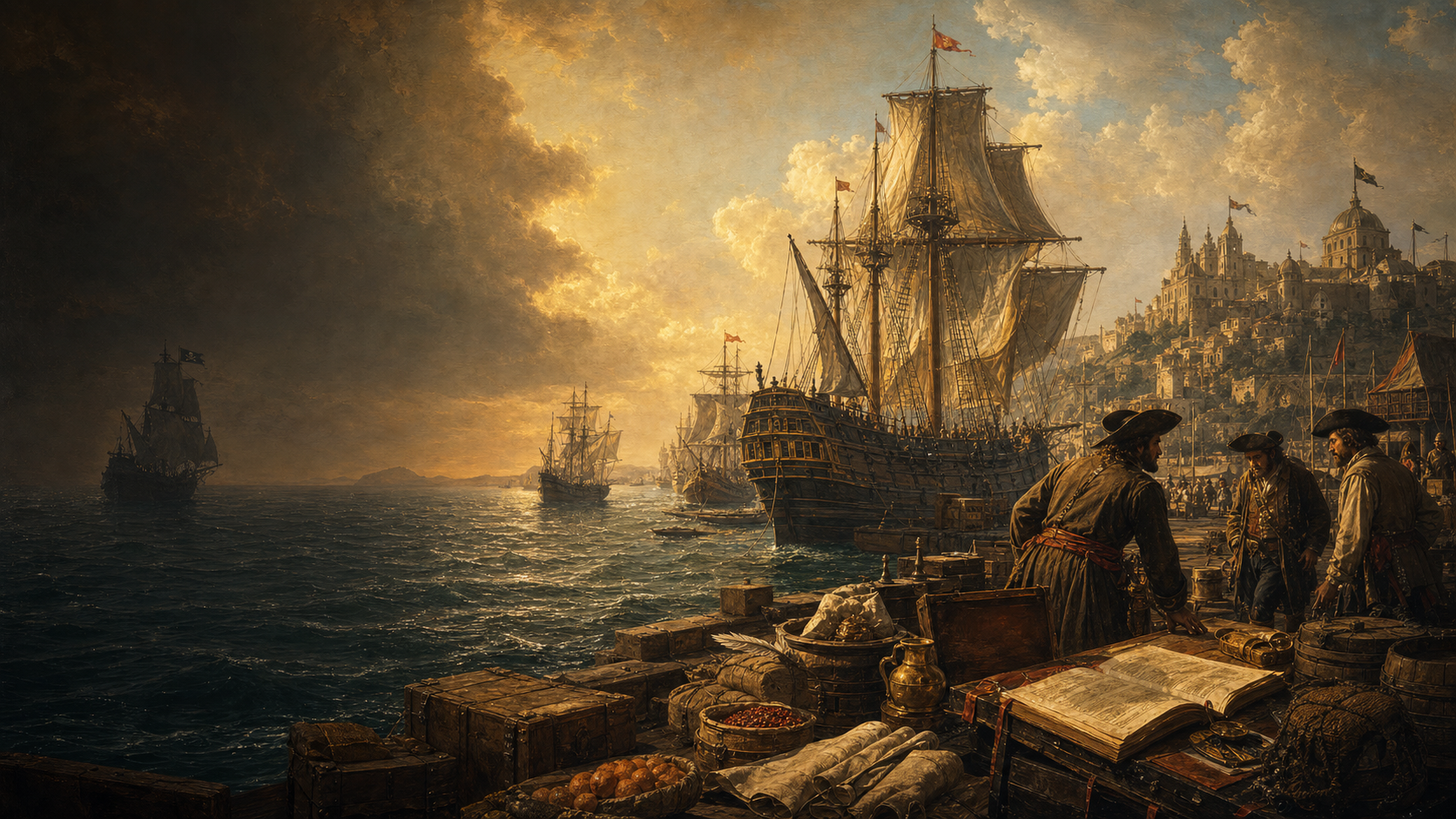
Piracy affected maritime trade by disrupting routes, raising costs, encouraging convoys, shaping insurance, and forcing state protection.
Maritime trade is a promise made across water: goods leave one shore and are expected to arrive somewhere else, preferably still dry, still owned by the same people, and not being worn by an armed stranger with a flexible view of property law.
Piracy attacked that promise.
It did not have to destroy all trade to matter. Pirates rarely needed to stop an entire ocean. They only needed merchants, captains, insurers, governors, and crews to ask the expensive question: is this route worth the risk?
That is where piracy changed maritime commerce. Not always by grand battles. Not always by spectacular treasure. Often by friction: higher costs, delayed ships, nervous investors, armed escorts, convoy systems, altered routes, larger crews, better intelligence, and governments forced to admit that trade did not protect itself.
Piracy was a tax without a receipt.
Risk Became Part of the Price
A merchant voyage was already a gamble. Weather could wreck a ship. War could close a port. Disease could thin a crew. Markets could change before the cargo arrived. Pirates added another moving danger: human beings actively trying to interrupt the calculation.
That danger moved into prices.
A ship sailing through dangerous waters might need more men, better weapons, an escort, a convoy, a safer but longer route, or insurance priced with a grim little eyebrow raised. Cargo did not become more expensive only because pirates took it. It became more expensive because people had to plan for pirates taking it.
The cost of piracy therefore spread beyond the ships actually captured. A single notorious raid could make merchants rethink a route. A cluster of attacks could make insurers adjust risk. A famous pirate could frighten vessels he never saw. Reputation traveled cheaper than cannon shot.
That is one of piracy's great practical effects: fear scaled better than violence.
Convoys Were Not Romance. They Were Accounting With Guns
Popular pirate stories love the lone ship, the horizon, the sudden black flag. Trade often preferred company.
Convoys were one answer to sea robbery and wartime raiding: gather merchant vessels together, protect them with armed ships, and make the target less tempting. This did not make shipping painless. Convoys could be slow, bureaucratic, expensive, and inconvenient. Ships had to wait, sail at shared pace, follow orders, and give up some freedom in exchange for safety.
But that was the calculation. Independent movement gave merchants speed and flexibility. Organized movement gave them a better chance of arrival.
Piracy helped make protection part of trade infrastructure. It pushed commerce toward systems: escorts, patrols, port intelligence, Admiralty courts, letters of marque, private security, and diplomatic pressure. The sea remained wide, but trade became less innocent about it.
A merchant ship was no longer only a floating warehouse. It was a moving legal, military, and financial problem.
Pirates Followed Trade Because Trade Carried the Money
Pirates did not raid at random, at least not if they were any good at staying alive. They followed routes where value moved: Caribbean sugar, Spanish silver, Mughal and Red Sea shipping, Atlantic slave-trade vessels, coastal commerce, fishing fleets, contraband networks, and poorly defended regional traffic.
The target could be gold. More often it was ordinary value: cloth, tools, weapons, food, medicine, tobacco, sugar, indigo, spices, coin, enslaved people, navigational instruments, or even the ship itself.
That matters because the movie version often imagines pirates chasing treasure chests as if the world economy had hidden itself under palm trees. Real maritime trade moved in bulk, paperwork, credit, cargo, and relationships. Pirates understood enough of that world to exploit it.
They did not need to be economists. They only needed to know which ships were worth stopping.
Ports Felt the Pressure Too
Piracy was not purely a shipboard problem. Ports felt it in interrupted arrivals, frightened merchants, ransom negotiations, demands for naval protection, and the uneasy presence of people willing to buy stolen goods.
Some ports suffered from piracy. Others profited from it. A port that could quietly receive goods, repair vessels, shelter suspicious crews, or look the other way at profitable cargo became part of the pirate economy. That did not make every resident a villain. It made the port a place where law, appetite, fear, and opportunity argued in public.
This is why pirates were often land problems as much as sea problems. They needed buyers, taverns, information, supplies, pilots, fences, corrupt officials, frightened officials, or officials too underfunded to do much beyond writing angry letters.
The stolen cargo had to go somewhere.
Empires Hated Piracy Most When It Embarrassed Them
Piracy became especially dangerous to trade when it touched diplomacy.
Henry Every's attack on the Mughal ship Ganj-i-Sawai in 1695 did not matter only because the prize was rich. It mattered because the attack endangered English commercial relations in India. Captain Kidd's case became more than a simple pirate trial because commission, prize law, politics, and powerful investors all collided. Barbary corsairing mattered not only because of captured ships, but because ransom, tribute, diplomacy, and national honor all entered the same account book.
A pirate raid could become a diplomatic complaint. A diplomatic complaint could become a trade crisis. A trade crisis could force states to prove they were not secretly benefiting from the same violence they condemned.
That is when piracy became most revealing. It showed how much maritime commerce depended on trust between people who often did not trust each other very much.
The Real Loot Economy Was Bigger Than Treasure
The buried-chest myth has done enormous damage to how people imagine pirate economics. It makes piracy look like a search for glitter.
The real loot economy was broader and more practical. Pirates wanted anything that could be used, sold, traded, divided, or converted into influence. Food kept crews alive. Medicine mattered after disease and injury. Cloth and clothing were valuable. Weapons and powder extended the next cruise. Skilled captives could be useful. Ships could be kept, stripped, burned, ransomed, or used as temporary tools.
Piracy was not a treasure hunt. It was violent redistribution through maritime opportunity.
That is less charming. It is also much more interesting.
Why Piracy Still Matters to Trade History
Piracy reveals the weak points in maritime systems. It shows where patrols were thin, where trade was rich, where law was slow, where officials were corrupt or underpowered, and where commercial appetite outran protection.
It also shows that trade is never only trade. A cargo route carries politics. A ship carries labor. A port carries law and bribery, family fortunes and imperial ambitions, honest business and quiet theft. Pirates entered those systems by force, but they did not invent the greed inside them.
The better story is not that pirates ruined trade everywhere. They did not. Maritime commerce survived them, adapted to them, hired against them, insured against them, and eventually folded their danger into larger systems of naval power and commercial law.
But pirates changed the cost of moving goods across water.
They made merchants pay for fear. They made governments prove authority. They made ports choose between profit and order. They made sea trade admit what every sailor already knew: the ocean is not empty space between markets. It is a dangerous workplace, and sometimes the workplace has enemies waiting on the horizon.


