History feature
Historical route
Piracy influenced naval warfare through convoy systems, patrols, anti-boarding measures, intelligence, legal authority, and coastal defense.
Pirates did not disappear because sailors suddenly became more obedient.
They disappeared, or at least faded in certain waters, when governments made piracy harder to survive. That meant ships. It also meant patrols, pardons, informers, courts, gallows, convoy systems, harbor control, diplomacy, prize law, and the deeply unromantic daily work of keeping sea lanes boring enough for commerce.
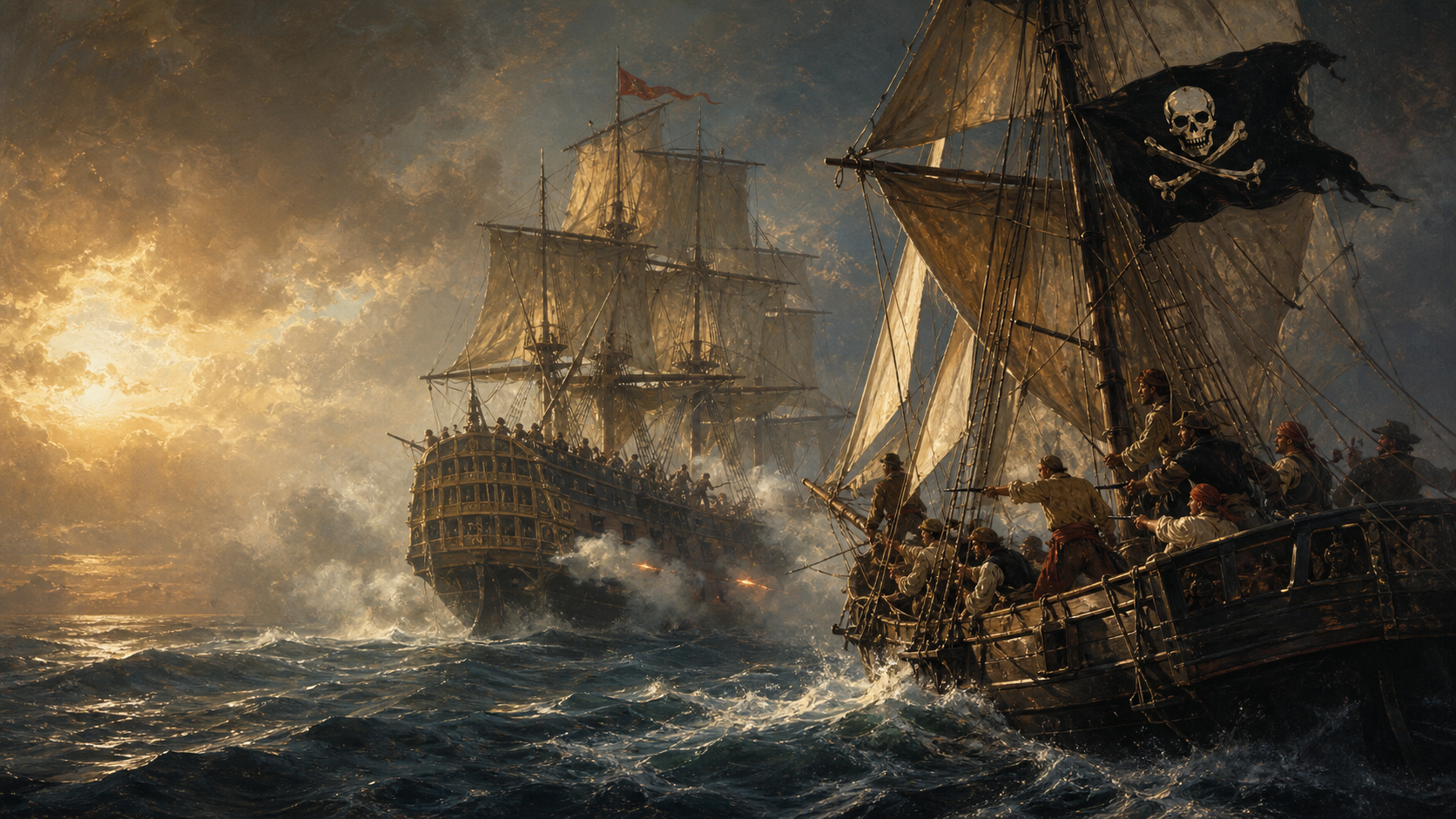
Pirate stories prefer the duel: pirate captain against naval officer, black flag against national ensign, sword against sword, smoke in the morning. Those scenes happened, and some were dramatic enough to deserve their afterlife. But anti-piracy usually worked through something less theatrical and more effective.
Presence.
A warship in the right place at the right time could save a route. A warship in the wrong place was only a rumor with sails.
Sea control is not a painting
Naval history loves grand battles. Lines of ships. Famous admirals. Cannon smoke. A horizon full of national destiny and very confident uniforms.
Piracy forced navies into less glamorous work.
Escort merchantmen. Patrol inlets. Chase small vessels through shoals. Gather intelligence from captains, merchants, governors, and informers. Protect convoys. Inspect papers. Move prisoners. Coordinate with courts. Keep pressure on pirate havens. Make it harder to sell stolen goods. Make it harder for crews to believe the next prize would be worth the risk.
That is sea control in practice. Not simply winning battles, but making movement predictable for lawful trade and dangerous for outlaw trade.
Pirates exposed the gap between naval prestige and naval reach. A state might own impressive ships and still fail to protect a merchant route if those ships were absent, badly supplied, politically misdirected, or too deep-drafted for the waters where pirates actually hid. Piracy asked a rude question: can your power be found where commerce needs it?
Often, at first, the answer was embarrassing.
Pirates thrived in the spaces between wars
Many famous outbreaks of Atlantic piracy grew in the messy aftermath of war.
Wartime trained sailors, normalized private violence, armed ships, and created men accustomed to prize-taking. Peace reduced legal opportunities. Some sailors returned to merchant work. Some found wages poor, discipline brutal, and prospects thin. Some crossed the line into piracy because the skills were familiar and the rewards looked faster.
Navies also contracted or shifted attention after wars. Governments tired of expense. Officials hoped danger had passed. Armed men and hungry sailors did not always share the optimism.
This is one reason the Golden Age of piracy after the War of the Spanish Succession had such force. The Atlantic had ships, trained seamen, weak spots, rich commerce, and enough distance between official intention and actual enforcement for pirates to build careers.
A navy could not defeat that with one heroic sortie. It had to become persistent.
Pardons were weapons too
Not every anti-piracy tool fired a cannon.
Royal pardons were designed to break pirate communities from within. Offer a way back, and some men would take it. Refuse, and remaining pirates could be marked more clearly as hardened enemies. A pardon divided the wavering from the committed. It gave exhausted sailors a reason to leave and authorities a way to reduce numbers without fighting every ship.
Woodes Rogers used this strategy in the Bahamas after arriving as governor in 1718. Nassau had become famous as a pirate refuge, a place where former privateers, outlaws, traders, and opportunists could gather in the gaps of imperial control. Rogers brought pardon, authority, and pressure. Some pirates accepted. Others returned to crime or refused.
The pardon was not sentimental. It was practical. A pirate crew was a labor force, a threat, and a social network. Break the network, and the ships become easier to chase.
Havens had to be made uncomfortable
Pirates needed more than ships.
They needed anchorages, fresh water, repairs, information, buyers, taverns, local allies, corrupt officials, frightened communities, and places where stolen goods could become usable value. A pirate who could not resupply was not a romantic outlaw. He was a logistical problem with scurvy approaching.
That means anti-piracy was also shore work. Governors had to assert control. Merchants had to stop buying stolen goods. Local officials had to become less tolerant. Naval officers had to watch inlets, not just oceans. Courts had to make examples. Diplomacy had to pressure places where pirates found shelter.
Nassau mattered because it offered a base. Madagascar mattered in earlier pirate imagination and activity because distance and weak control made refuge plausible. North Carolina’s inlets mattered to Blackbeard because shallow, complex waters could frustrate pursuers and support gray relationships on shore.
To suppress pirates, states had to attack the ecosystem, not merely the ships.
Convoys changed the odds
Pirates liked isolated prey.
A lone merchantman could be chased, intimidated, boarded, robbed, or taken. A convoy changed the arithmetic. Ships sailing together under escort were harder targets. Naval protection did not have to make piracy impossible. It only had to make the next prize look too expensive.
Convoy systems were not always convenient. Merchants disliked delays. Sailing schedules became more complicated. Escorts could be insufficient. Storms could scatter ships. But convoying recognized a basic truth: commerce protection required organization, not just courage.
Pirates often relied on fear to avoid costly fights. Convoys and escorts pushed fear back in the other direction. A pirate captain had to ask whether the prize was worth the risk of guns, witnesses, pursuit, and damage. When enough targets became harder, piracy became less attractive as a career.
That is how suppression often works. Not by making crime unimaginable, but by making it a bad business decision.
Trials finished what patrols started
Naval force could capture pirates. Courts turned capture into public meaning.
A pirate trial was not only a legal process. It was theater for authority. Witnesses spoke. Charges were read. Defendants claimed coercion, innocence, pardon, mistake, or bad luck. Judges sorted men into categories that could decide whether they lived. Executions then carried the message beyond the courtroom.
The state wanted sailors to see the price. Blackbeard’s severed head, Captain Kidd’s displayed body, Bartholomew Roberts’s captured crew facing trial, Stede Bonnet’s Charleston prosecution: these endings were not private. They were warnings aimed at men still deciding whether a black flag was worth the gamble.
Pirates understood reputation. Governments understood it too.
A navy that captured pirates but failed to punish them visibly might not change the calculation. A court that punished pirates without naval pressure might look weak if more ships kept appearing. Suppression required both: force at sea and consequence on shore.
The smaller boats mattered
Pirate suppression was not always a matter of giant warships hunting giant pirate ships.
Many pirate vessels were small, fast, shallow-drafted, and suited to coasts, inlets, and quick attacks. Heavier naval vessels could be powerful and still awkward in the places pirates used. This is one reason anti-piracy campaigns often needed sloops, local pilots, tenders, intelligence, and men willing to fight in cramped waters.
Robert Maynard’s expedition against Blackbeard at Ocracoke shows the point. The drama of the final fight is famous, but the practical setup matters: shallow waters, smaller vessels, surprise, local navigation, and an officer adapting to the terrain. Pirate geography was part of pirate power. Suppression had to learn that geography or fail in impressive uniforms.
The same principle appears in many anti-piracy efforts across history. A navy must fit the water it wants to control. Deep authority in shallow channels is mostly decoration.
Piracy faded where states became inconvenient
Pirates did not vanish everywhere at once. They rose and fell in different regions for different reasons: trade patterns, wars, weak enforcement, political tolerance, geography, local economies, and the availability of buyers and recruits.
But the pattern is clear. Piracy became harder where states could combine naval presence, legal authority, intelligence, political will, and economic pressure. It survived where those things were absent, weak, corrupt, distracted, or too expensive to maintain.
This is why piracy is not simply an old-time problem with old-time clothes. Modern piracy also follows opportunity: weak coastal control, valuable shipping, political instability, ransom economies, and gaps between local conditions and international trade. The weapons change. The logic remains uncomfortable.
A pirate outbreak is often a symptom. It tells you something about the sea lanes, the state, the economy, and the people who have decided that risk is worth more than obedience.
The navy did not make the sea safe. It made piracy harder
No navy ever made the ocean harmless.
Storms still wrecked ships. Disease still moved through crews. War still interrupted trade. Privateers, smugglers, raiders, and pirates still found gaps. But sustained naval pressure changed the odds. It made pirate bases less comfortable, prizes less predictable, crews less confident, and endings more likely to involve courts.
That is why the end of a pirate age is rarely one clean event. It is a tightening.
A pardon here. A captured captain there. A governor with resources. A patrol on the right route. A buyer frightened into caution. A harbor watched more closely. A convoy system that denies easy prey. A trial that turns a famous name into a warning. The work accumulates until piracy becomes less like freedom and more like a narrowing room.
Pirate legend likes the moment of battle because battle has noise.
Suppression was quieter. It was administration with teeth.
And once the navy, the courts, the merchants, and the governors all started biting in the same direction, the black flag had less room to breathe.


