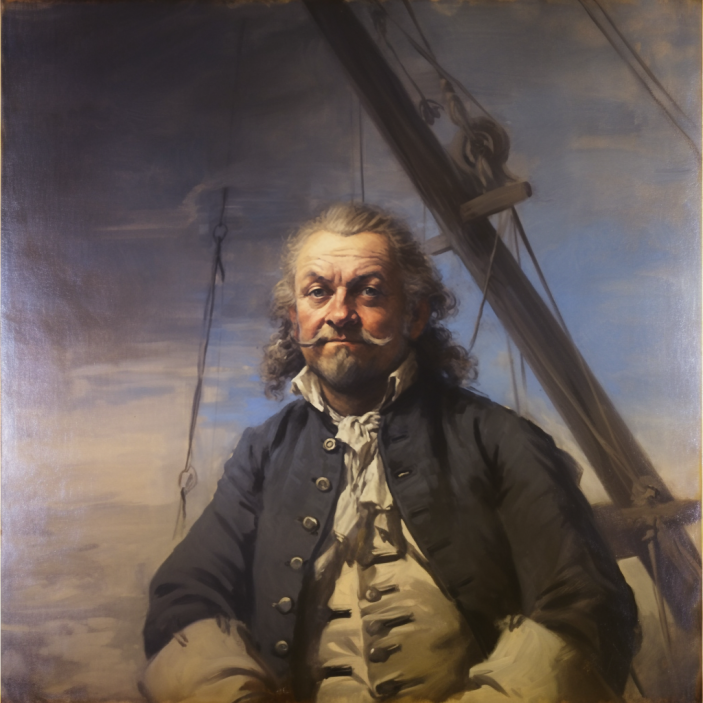
The story
Thomas Jones and the Problem of the Pirate Who Barely Survives the Record
Thomas Jones does not stride into pirate history under a famous flag.
He does not arrive with a flagship, a dramatic nickname, a neat last battle, and a portrait waiting to be put on a mug. He arrives as something more difficult: a name in a subject full of common names, partial records, aliases, fragments, and later writers who sometimes want more certainty than the evidence can responsibly provide.
That may sound like a weak pirate profile.
It is actually a useful one.
Pirate history is not made only of Blackbeard, Anne Bonny, Zheng Yi Sao, and the people who left enough smoke for later culture to smell. It is also made of thin files: sailors named once, men caught in trial records, possible aliases, crew members listed without biography, captives misremembered as criminals, and ordinary seamen who entered the record only when law, violence, or disaster made someone write their name down.
Thomas Jones belongs to that problem.
Common names are dangerous cargo
A common name can trick a reader faster than a fake treasure map.
Thomas Jones could refer to more than one man in maritime records. Without enough identifying detail — a ship, date, court, port, captain, crew list, pardon, execution record, newspaper notice, or official report — a common name can become a trap. One Jones may be confused with another. A sailor may become a pirate by association. A witness may be mistaken for a participant. A later tradition may glue fragments together because the resulting biography feels more satisfying.
History likes names.
Evidence likes context.
A responsible page should not invent a dramatic life simply because the slot marked "Famous Pirates" feels lonely. If the surviving source trail is thin, the article should say so. That is not failure. That is the trust device.
Pirate history already contains enough fog. Adding decorative smoke only makes the rocks harder to see.
What would make the case stronger
A strong pirate profile needs anchors.
The first anchor is identification. Which Thomas Jones? Where does he appear? In what year? On what ship? Under which captain? In which court, report, newspaper, or narrative?
The second anchor is role. Was he a captain, crewman, forced man, witness, privateer, mutineer, smuggler, prisoner, or simply a sailor whose name drifted too close to a pirate event?
The third anchor is consequence. Was he tried, pardoned, executed, transported, released, named in a proclamation, mentioned in a prize case, or remembered only by later writers?
Without those anchors, the page should stay honest and modest.
That does not make it useless. It teaches readers how pirate evidence works. The famous figures often feel solid because their stories have been repeated for centuries. But many pirates and pirate-adjacent sailors survive only because someone in authority had a reason to record them at a moment of crisis.
Trial records preserve defendants.
Newspapers preserve alarm.
Official correspondence preserves irritation.
Pamphlets preserve morality and salesmanship.
None of those sources is the same thing as a full life.
The thin record is part of the story
The temptation is to compensate for missing evidence with energy.
Give Thomas Jones a rough childhood. Put him in a tavern. Add a ship, a knife, a storm, a betrayal, and a final sentence that sounds like it was carved into oak. The page would become more exciting and less true.
A better article lets the gap remain visible.
The gap tells readers that pirate history is uneven. Governments preserved the names they needed. Printers preserved the stories that sold. Later culture preserved the figures that looked good in silhouette. Many ordinary people slipped through. Some left only a name, and sometimes even that name cannot be safely attached to one clean biography.
This is not dry bookkeeping. It changes how the whole subject should be read.
If a famous pirate story sounds too smooth, ask who smoothed it. If a minor pirate profile sounds too certain, ask what it is standing on. If a common name appears without enough detail, do not make the name carry more cargo than it can bear.
The sea is hard enough. The evidence should not be forced to swim beyond its strength.
Why keep Thomas Jones at all?
Because not every useful page has to be a trophy case.
A Thomas Jones profile can function as a reader's guide to uncertainty. It can show why lesser-known pirate figures are difficult, why aliases matter, why common names need care, and why historical honesty sometimes means saying, "We know less than the legend wants us to know."
That is especially valuable on a site that also wants to be fun.
The fun is stronger when the reader trusts the floorboards. A page that refuses to overclaim earns the right for another page to wink. A profile that says "the evidence is thin" protects the whole site from becoming an attractive fog machine.
Jones can also sit beside other small or difficult profiles. John King, the boy associated with the Whydah, shows how a small place in the record can raise large questions. William Fly shows how a minor pirate can reveal labor conditions at sea. William Dampier shows the opposite problem: a maritime figure with plenty of writing but an identity too wide for the pirate label alone.
Thomas Jones teaches the name problem.
That is enough reason to keep him, if the page is written honestly.
How to read minor pirate names
When a lesser-known pirate name appears, ask five questions.
What is the earliest source?
What does the source actually say?
Does the source identify the ship, captain, date, and place?
Are later writers copying one another?
Is the person being described as a pirate by enemies, courts, newspapers, crew members, or modern summaries?
Those questions do not kill the story. They sharpen it. They help separate documented fact from reported tradition, tradition from speculation, and speculation from the costume rack.
Pirate history lives in that distinction.
Not every uncertain figure should be thrown out. Some should be kept precisely because they teach the reader how uncertainty behaves.
The better truth
Thomas Jones may never become one of the great pirate names, and the page should not pretend otherwise.
His value lies in the difficulty. He reminds readers that history is not a ranked list of colorful villains. It is a record built by courts, clerks, enemies, survivors, printers, collectors, and later editors trying to make sense of fragments left by people who did not know they were supposed to become content.
A thin record is not an invitation to invent.
It is an invitation to read better.
Thomas Jones belongs on PiratesInfo if he is treated as what he is: not a polished legend, but a useful caution from the edge of the archive. The famous pirates show what happens when the record and the myth both shout.
Jones shows what happens when the record whispers, and the honest answer is to lean closer without putting words in its mouth.


