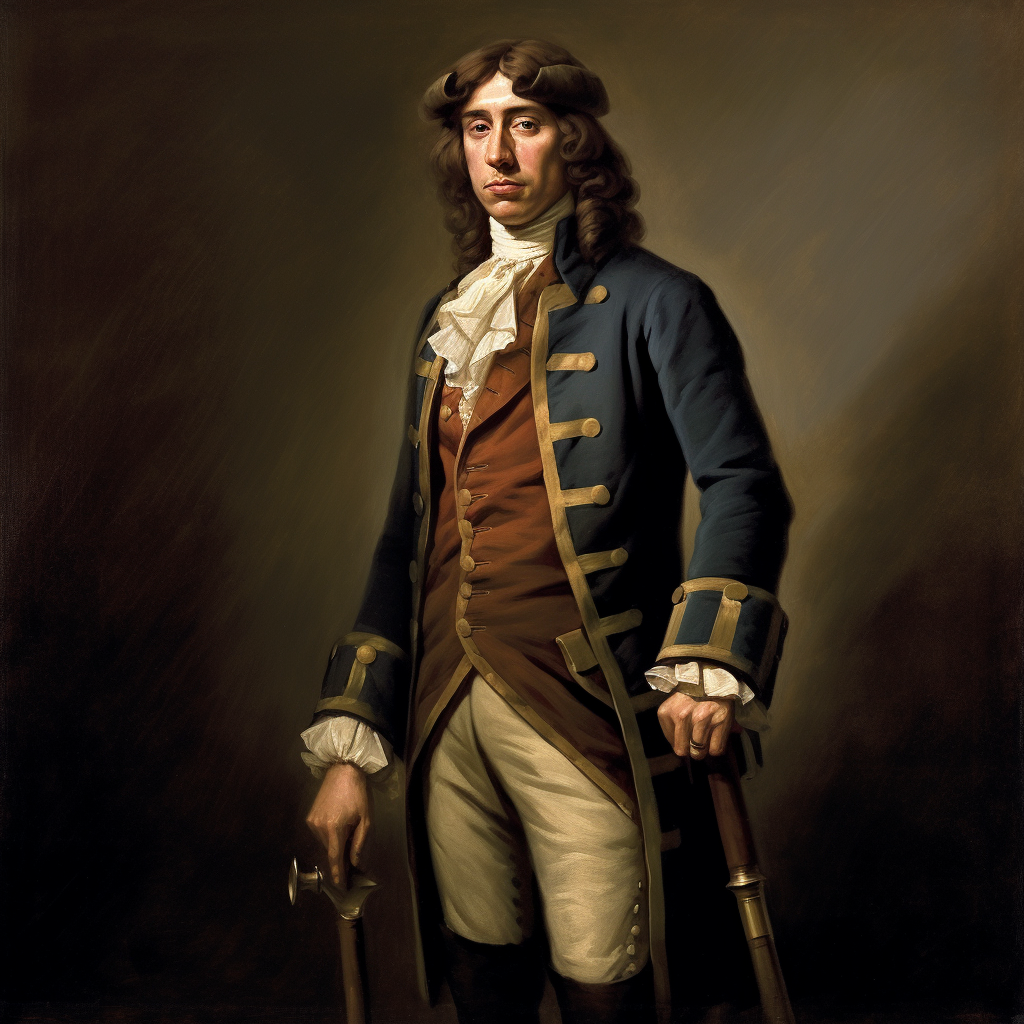
The story
William Dampier Was the Pirate-Adjacent Observer Who Brought Footnotes to the Fight
William Dampier is what happens when the pirate table accidentally seats a naturalist.
He moved with buccaneers, sailed in violent company, circled the world, wrote influential books, described winds and currents, recorded plants and animals, and somehow made the rough sea-roving world arrive with weather notes. He is not a clean pirate captain in the Blackbeard mold. He is more inconvenient than that.
Dampier was pirate-adjacent, privateer-adjacent, explorer-adjacent, scientist-adjacent, and empire-adjacent.
History hates a tidy shelf, and Dampier spent his life knocking them over.
He belonged to the late seventeenth-century world where buccaneering, privateering, exploration, commerce, and opportunistic violence could share the same deck. But his lasting importance comes from observation. Many sea raiders looked at a coastline and saw targets. Dampier also saw wind systems, plants, animals, currents, languages, food, coastlines, and notes worth keeping.
The cutlass was not the only sharp thing aboard.
Buccaneering with a notebook
Dampier's early maritime life connected him to the buccaneering world of the Caribbean and Pacific, where English, French, Dutch, Spanish, Indigenous, African, and mixed colonial histories collided in violent ways. Buccaneers attacked Spanish interests, moved through weakly controlled spaces, relied on local knowledge, and often lived in the gray zone between sanctioned raiding and outright piracy.
Dampier participated in that world.
The page should not clean him into a harmless gentleman scientist who merely wandered through unfortunate company with a quill. He traveled with raiders and benefited from voyages that were part of imperial competition and maritime violence. Ships were taken. Communities were threatened. The buccaneer world was not a research cruise with worse catering.
But Dampier also paid attention in ways many companions did not.
He wrote about winds, currents, rainfall, coastlines, people, foods, plants, animals, and practical navigation. That writing made him valuable to later readers. His books gave English audiences information about places many had never seen and few could imagine without borrowing someone else's eyes.
Dampier's gift was not innocence.
It was observation under morally crowded conditions.
Why his writing mattered
Dampier's published accounts outlived the buccaneer moment around him.
Travel writing in his period could do many things at once. It could entertain, inform, promote empire, guide navigation, encourage trade, satisfy curiosity, and turn rough experience into printed authority. Dampier's work mattered because he had an unusual eye for detail. He noticed the world beyond plunder.
That detail influenced later navigators, naturalists, and readers interested in the wider globe. His descriptions of Australia, the Pacific, winds, currents, and natural history helped shape English knowledge. In a period before modern scientific specialization, the observant traveler could become a collector of useful facts simply by surviving long enough to write them down.
That is the strange tension.
Dampier's knowledge came from voyages tied to violence and empire. The information was real, useful, and often carefully observed. The context was not clean.
A good profile keeps both truths in the same room.
The notes do not erase the raiding.
The raiding does not make the notes worthless.
Explorer, privateer, pirate, or something else?
Dampier is difficult because none of the labels fully contains him.
Call him a pirate, and the page becomes too simple. He was not primarily remembered as a captain of a notorious pirate ship who built fame from robbery alone.
Call him an explorer, and the violence around his world gets too polite.
Call him a naturalist, and the buccaneer deck disappears under specimens.
Call him a privateer, and the legal language does too much laundering.
The better answer is to let the labels argue. Dampier moved through maritime systems where state power, private profit, raiding, observation, and publication overlapped. He shows how one life could carry piracy's rough company and science's quiet attention without becoming morally simple.
This is why he belongs on PiratesInfo as an edge case.
Edge cases are useful. Francis Drake shows how one country's privateer could be another country's pirate. Henry Morgan shows how sanctioned raiding could become colonial respectability. Jean Laffite shows how smuggling and patriotism can rearrange each other when war arrives. Dampier shows how raiding, exploration, and knowledge production could sail together, even when nobody aboard had the courtesy to become a clean category.
The observing eye
Dampier's eye is the reason his name still matters.
He wrote about weather because weather mattered. He wrote about currents because currents pushed ships, trade, and danger. He wrote about foods and local practices because survival at sea depended on finding what could be eaten, traded, stored, or understood. He wrote about natural history because curiosity survived even in a violent world.
This makes him different from the pirate who appears only at trial or in a victim's complaint.
Dampier speaks from the page as an observer. That does not make him neutral. Travel writers had motives, assumptions, prejudices, and audiences. They simplified peoples, ranked cultures, served imperial curiosity, and sometimes turned other people's homes into useful information for outsiders.
Still, the writing matters.
Pirate history often reaches us through people who hated pirates, hunted pirates, tried pirates, or sold pirate stories. Dampier offers another kind of evidence: the sea-rover as recorder. His books show how a man from a violent maritime world could become a source for geography and natural history.
The ocean produced thieves.
It also produced notebooks.
Sometimes the same voyage carried both.
The three circumnavigations problem
Dampier is often remembered as the first Englishman known to have circumnavigated the world three times. That claim should be fact-checked carefully in final publication, but it points toward the scale of his maritime life.
He was not a one-cruise curiosity.
His career stretched across oceans and decades. He moved through the Caribbean, Pacific, Indian Ocean, and Australian waters in a period when global navigation was difficult, dangerous, and bound to empire. Long-distance voyaging required seamanship, endurance, adaptation, and luck. Dampier had enough of each to leave a trail much larger than the usual pirate cameo.
But scale should not become hero worship.
A man can travel far and still travel inside violent systems. Exploration often arrived with claims, maps, extraction, and future intrusion. Dampier's observations could help later navigators, traders, and imperial projects. Knowledge was not politically innocent just because it was written in careful prose.
Again, that is the point.
Dampier is fascinating because the useful and the troubling travel together.
Why Dampier still matters
William Dampier matters because he widens the pirate frame without making the word meaningless.
He was not a standard pirate mascot. He was a buccaneer-associated traveler, privateer, explorer, writer, and observer whose work outlived the violent world that helped produce it. He shows that maritime history was not separated into neat boxes labeled crime, science, empire, travel, and literature. The same deck could carry all of them, whether the historian likes the arrangement or not.
For readers coming from famous pirates, Dampier offers a different route through the sea. Less black flag, more barometer. Less gallows drama, more uneasy footnote. But the danger is still there. The ships, raids, imperial competition, and rough company do not vanish because the prose becomes observant.
The better truth is that Dampier's life is not made smaller by refusing to call him simply pirate.
It becomes larger.
He was the man at the edge of the pirate story taking notes while the world burned, blew, traded, fought, fed him, confused him, and gave him material. The ink and the blade both belong to the age.
Dampier's profile should keep them both visible.


