History feature
Historical route
Ever pondered the entwined tales of piracy and America's dawn? Pirates, those elusive sea rovers, didn't just scour Caribbean waters; they left an indelible mark on colonial America. From shaping economic policies to swa...
America did not meet piracy from a clean shore.
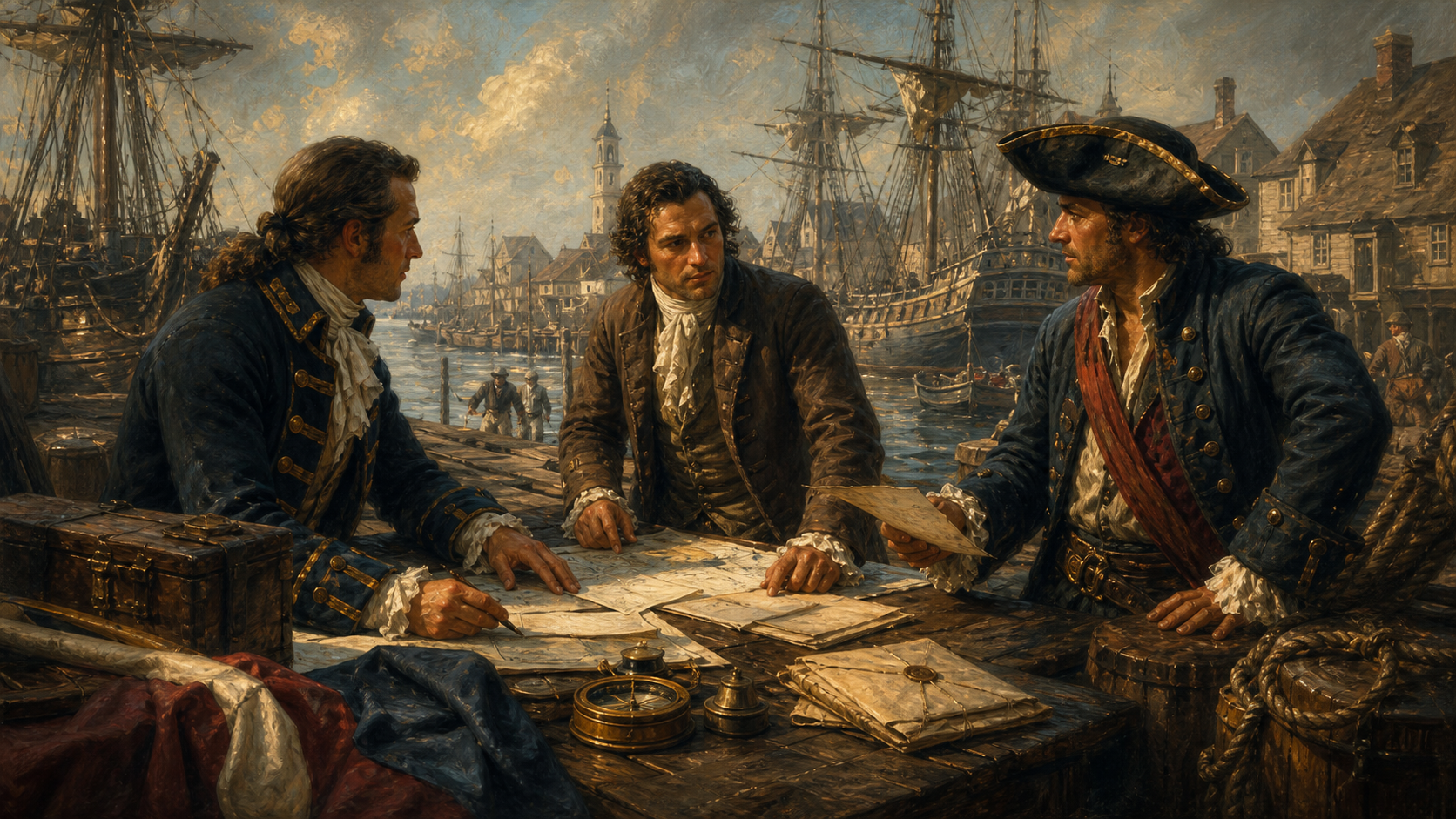
It grew up beside privateers, smugglers, raiders, naval patrols, illegal trade, useful rogues, and ports where the law sometimes arrived after the goods had already been sold. Long before the United States became a naval power, North American coasts and colonial economies were tied to the same dangerous Atlantic world that produced pirates, privateers, slavers, merchants, and imperial wars.
That is why the American relationship with piracy is complicated. The easy version says pirates were criminals and America helped suppress them. That is true in places. It is also incomplete. The harder version says Americans inherited a maritime world where illegal violence, licensed violence, and profitable gray-market trade often lived uncomfortably close together.
The new republic did not stand outside that world. It was built with salt on its shoes.
Colonial America and the useful pirate problem
Colonial ports depended on the sea.
Ships brought goods, news, people, disease, wealth, labor, and war. They also brought temptation. A captured cargo could become cheap goods. A privateer could become a local hero if he hurt the right enemy. A smuggler could look less like a criminal when his customers preferred prices to principles. A pirate could be condemned in law and quietly useful in practice until he became too dangerous to tolerate.
This was not uniquely American. It was Atlantic.
European empires used privateering when it suited them. A commission could turn one crown’s raider into another crown’s pirate. Colonies near trade routes and imperial rivals often benefited from violence that officials later wished looked cleaner in the paperwork. The difference between patriotism and piracy could depend heavily on flags, timing, and who was writing the complaint.
North American communities lived inside those contradictions.
Privateering gave violence a respectable hat
Privateering is essential to the story because it shows how governments made sea robbery polite.
A privateer sailed under authorization to attack enemy shipping. In theory, the rules mattered: commissions, legal targets, prize courts, and recognized shares. In practice, the sea was wide, information was slow, and opportunity did not always wait for a lawyer to feel comfortable. Privateering trained men in armed maritime violence and gave colonial economies a taste for prize money.
During wars, privateers could be celebrated. After wars, the same skills could become inconvenient. Men who knew ships, weapons, boarding, cargo, and risk did not stop existing when treaties were signed. Some returned to lawful trade. Some drifted into smuggling. Some crossed into piracy. The line did not erase the habits.
For America, this mattered because privateering remained a tool before the country had the naval power to protect every interest by state ships alone. It was cheaper, flexible, and morally easier to defend when the target was an enemy. It also kept the old problem alive: once violence is useful, everyone starts arguing about when it stops being respectable.
Smuggling was the shore-side cousin
Piracy is usually imagined offshore, but much of its power came from land.
Goods had to be sold. Ships had to be repaired. Crews needed water, food, information, shelter, and buyers. Smuggling networks turned coastlines into arguments. A federal law might say one thing. Local appetite might say another. A merchant, planter, or household that benefited from contraband was not always eager to help enforcement.
This is where figures like Jean Laffite become useful. Laffite’s Barataria network near New Orleans was not simply a pirate hideout with better scenery. It was a commercial system tied to customers, channels, auctions, privateering claims, war, and weak enforcement. When the War of 1812 arrived, the same network that looked criminal in peacetime became attractive for its men, supplies, and local knowledge.
Few things clarify morality like an approaching enemy fleet.
Laffite’s assistance in the defense of New Orleans helped polish his American reputation. The old crimes did not vanish. The lighting changed.
The Barbary Wars forced the issue overseas
The early United States also faced piracy and corsair power beyond its own coast.
North African corsair states had long operated in a Mediterranean world of tribute, ransom, diplomacy, captivity, and maritime violence. European powers had made payments, negotiated, fought, and complained for generations. When the United States became independent, it lost the protection that had come with British arrangements and had to decide how to handle the problem itself.
The Barbary Wars helped push the young republic toward a more assertive naval identity. They were not a simple cartoon of pirates versus freedom. They belonged to a wider Mediterranean system in which states, corsairs, captives, treaties, tribute, and naval force all interacted. But for American political memory, the confrontation became a lesson: commerce needed protection, and a republic that wanted trade across oceans needed ships capable of backing its words.
Piracy, in that sense, helped teach America that independence had a maritime price.
Law followed the fear
Piracy also shaped American law because sea crime forced governments to define jurisdiction, punishment, and authority beyond ordinary borders.
A crime at sea is awkward. Where did it happen? Whose law applies? Who has power to capture, try, punish, or pardon? What counts as piracy rather than privateering, mutiny, smuggling, or wartime seizure? These questions were not academic decorations. They decided who lived, who hanged, who kept cargo, and who could claim innocence under paperwork.
The United States inherited and adapted older legal traditions around piracy. The category became part of federal power because piracy threatened commerce, diplomacy, and national credibility. A government that could not protect trade or punish sea robbers looked weaker than its flag promised.
That is why piracy sits close to the history of state-building. The pirate is not only an outlaw. He is also a test of whether law can travel.
America kept the romance too
The legal story is only half the afterlife.
America also inherited and helped spread the romantic pirate. Treasure legends, coastal ghost stories, buried loot, lost ships, tavern rogues, and later films all gave piracy a second career in imagination. The same country that built naval power and anti-piracy law also sold pirate adventure to children, tourists, readers, and moviegoers.
That contradiction is not hypocrisy so much as memory doing what memory often does. Once the danger is safely distant, it becomes available for play.
The result is a strange double inheritance. Piracy helped shape American maritime policy, coastal enforcement, privateering debates, and naval identity. It also helped build a fantasy of rebellion, treasure, and frontier freedom that still shows up at parties with a plastic sword.
Both versions matter. One explains the republic’s relationship to commerce and law. The other explains why the subject refuses to stay in the archive.
The water was never clean
Piracy and America are linked by more than a few famous names.
They meet in colonial ports, privateering ventures, smuggling networks, revolutionary-era violence, the Barbary Wars, New Orleans, maritime law, naval growth, and the long cultural habit of turning dangerous sea criminals into useful symbols after enough time has passed.
The clean version says America fought pirates.
The better version says America grew up in a world where piracy, privateering, smuggling, trade, law, and patriotism often argued from the same dock.
That does not make pirates heroes. It makes the history harder to flatten.
For a practical comparison, follow Jean Laffite and the Gulf Coast gray zone. For the legal background, continue to letters of marque and privateering. For the broader arc of suppression, move to the Navy and the end of the Golden Age.
America was never far from the water. Neither was the argument over what kinds of violence the water was allowed to carry.


