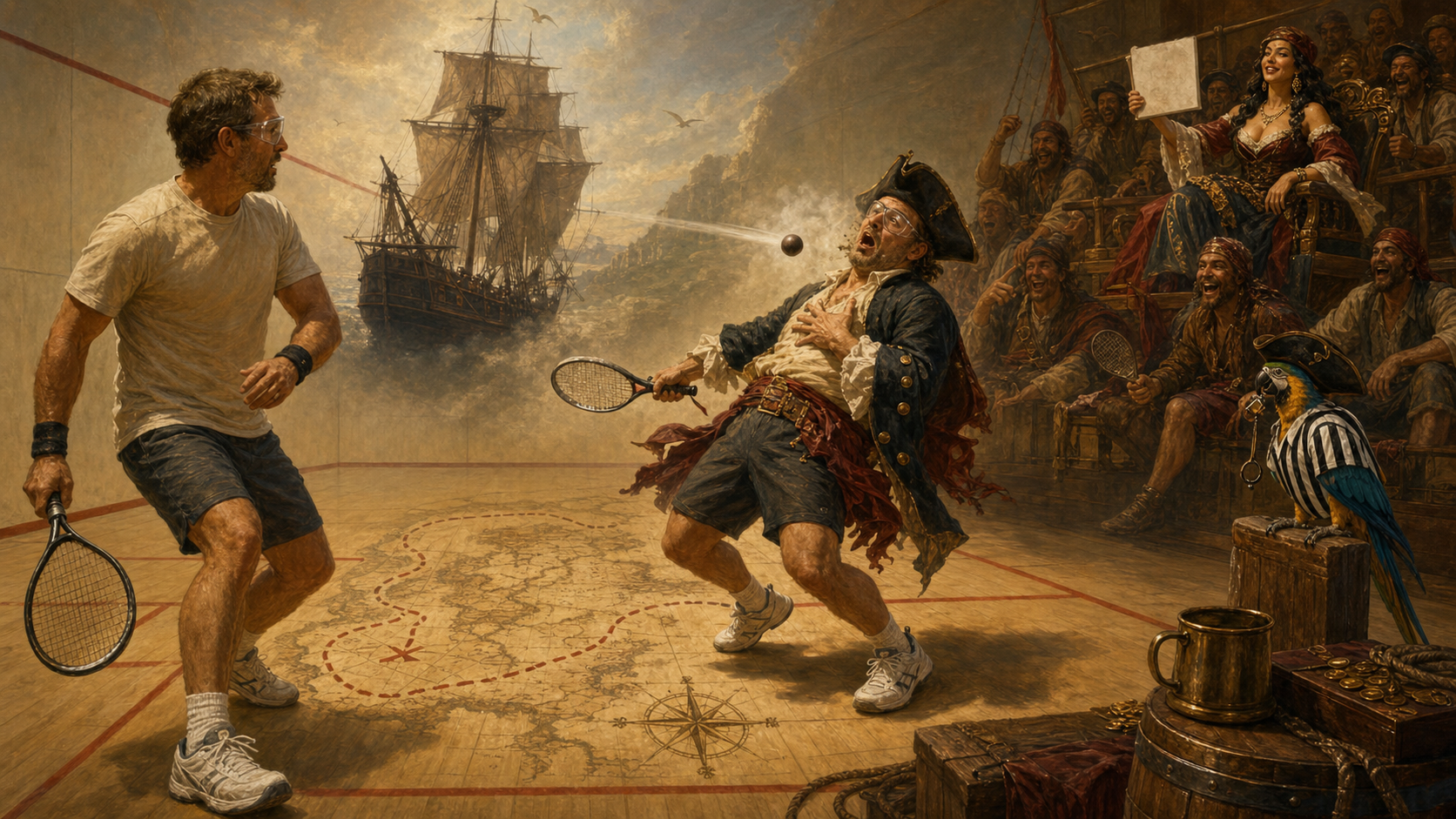
Talk Like a Pirate Day is not a solemn cultural observance.
No one should stand under a flag, place a hand on a cannon, and insist that September 19 is when the ancient maritime brotherhood renews its sacred vowels. It began as a joke, escaped into public, and became one of the internet’s better excuses to annoy coworkers, children, spouses, teachers, pets, and customer service systems that did nothing to deserve it.
That is the charm.
Talk Like a Pirate Day works because it gives ordinary people permission to be briefly ridiculous in a shared costume of sound. The historical accuracy is not the main cargo. The fun is.
But the fun gets better when the history is not forced to walk the plank.
Where the holiday came from
The modern holiday is usually traced to John Baur and Mark Summers, who came up with the idea in the 1990s after a joke during a racquetball game. It later reached a much larger audience after humorist Dave Barry wrote about it, and from there the internet did what the internet does best: seized a joke, dressed it badly, and made it impossible to ignore.
That origin story matters because it tells us what the holiday is.
It is not a recovered pirate ritual.
It is not a linguistic museum.
It is not proof that pirates spoke in the voice of a man threatening soup.
It is modern play, built from fiction, film, performance, shared silliness, and the deep human need to occasionally answer email with “Ahoy.”
That makes it lightweight, but not worthless. Play is one of the ways history stays visible in public life, even when the play version is wearing a hat three sizes too large.
The pirate voice is mostly performance
The classic “arrr, matey” voice belongs more to modern pirate performance than to documented pirate speech.
Real pirate crews did not share one official accent. They came from different ports, languages, classes, and sea careers. Some were English, Irish, Welsh, Scots, Dutch, French, Spanish, Portuguese, African, Caribbean, Indigenous, or colonial American. Some had naval backgrounds. Some had merchant experience. Some were forced aboard. Some joined willingly. Their speech would have been as mixed as their routes.
The voice most people imitate comes from later culture: novels, theater, film, cartoons, games, and especially memorable screen performances that taught audiences what a pirate should sound like.
That does not ruin the holiday.
It explains it.
Talk Like a Pirate Day is not really about how pirates spoke. It is about how modern people agreed to sound pirate-ish for one day because the performance voice is funny, durable, and easy to recognize.
A skull flag for the throat.
How to enjoy it without lying to history
The simplest rule is this: call the performance a performance.
Say “arrr.” Say “ahoy.” Call your friend a scallywag if the friendship is strong enough to survive it. Rename your lunch “plunder” if morale requires. But do not tell children, readers, or yourself that every pirate in the historical record sounded like a cartoon innkeeper with a sword.
The difference matters.
History gives us real piracy: maritime labor, brutal discipline, stolen cargo, law, trade, empire, privateering, slavery, shipboard hardship, executions, mutiny, weather, hunger, and crews trying to survive in dangerous economies.
Talk Like a Pirate Day gives us harmless social nonsense.
Both can exist, provided one does not pretend to be the other.
The holiday is a party mask, not a passport into the archive.
Good pirate talk is clearer than you think
The funniest pirate lines are often not the most heavily decorated ones.
A line stuffed with “ye,” “arr,” “matey,” “scurvy,” “booty,” and “shiver me timbers” may announce pirate flavor, but it also makes the reader work too hard. Good pirate-flavored speech usually works better with strong verbs, concrete sea words, and a little restraint.
“Hand over the chart before the tide changes.”
“Keep watch. The harbor has too many eyes.”
“Avast. That fuse is shorter than your confidence.”
Those lines have more life than a sentence drowned in fake spelling. They feel salty because they have action, pressure, and a world under them.
If you want to talk like a pirate for fun, start with rhythm. Use one or two recognizable markers. Then let the sentence move.
The goal is not to defeat English.
The goal is to make English walk with a suspicious limp for a day.
A few safe ingredients
Use ahoy as a hail.
Use aye for agreement.
Use avast when something should stop.
Use matey when the tone is obviously playful.
Use deck, mast, sail, line, hold, helm, watch, harbor, broadside, quartermaster, and prize when the sentence actually needs a shipboard world.
Use “arrr” sparingly unless the joke is that you are overusing it.
Avoid turning every word into a phonetic puzzle. Apostrophes are not barnacles; they do not need to cover every surface.
And remember that some words people call pirate words are just sailor words, while others are later fiction or modern party language. That does not make them illegal. It simply means they should wear the right label.
Why the holiday keeps working
Talk Like a Pirate Day survives because pirates occupy a strange place in popular imagination.
They are dangerous enough to feel rebellious, distant enough to feel safe, and fictionalized enough to borrow for comedy. The real pirates would mostly be terrible party guests. The imaginary ones are excellent for one day of language mischief.
The holiday lets adults play without much equipment. No ship required. No costume required. No scholarship required. Just a willingness to sound briefly foolish with other people who have agreed to the rules.
That shared permission is the treasure.
For a day, the office becomes a deck, the family group chat becomes a crew, and the ordinary sentence gets pushed through a theatrical storm.
No one is claiming this is how Bartholomew Roberts discussed prize shares.
At least, no one should.
The better truth
Talk Like a Pirate Day is ridiculous.
That is not a criticism. That is its business model.
The day works best when it is treated as modern performance: a joke with sea legs, a shared costume of speech, a chance to play with pirate myth without pretending the myth is clean history. Use it to have fun. Use it to teach the difference between sailor language, stage-pirate language, and historical uncertainty. Use it to send one absurd message to someone who will forgive you.
Then, when the day is over, let the real pirates return to being stranger than the party version.
They usually are.


