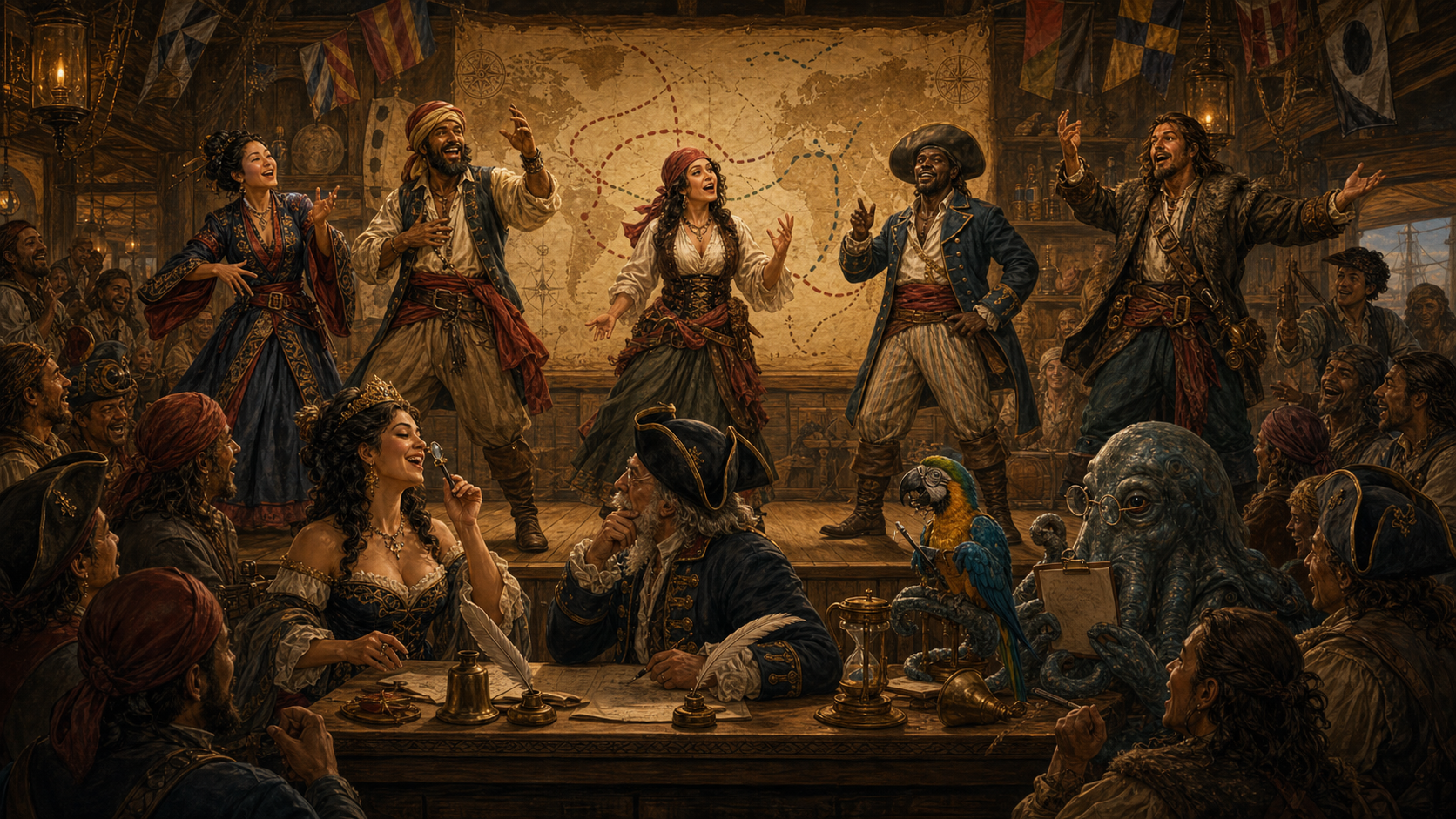
The pirate voice in most people’s heads has gravel in its throat and a theatrical debt it has never repaid.
It rolls its r’s. It says “matey” with suspicious confidence. It sounds as if every pirate in the Atlantic came from the same village, attended the same drama school, and agreed to pronounce every sentence like a man ordering fish beside a storm drain.
It is fun.
It is also a beautiful fraud.
Real pirate crews were not voice clones. They were temporary, violent, multilingual workplaces made from sailors, forced recruits, deserters, privateers, fishermen, pilots, enslaved and formerly enslaved people, coastal laborers, smugglers, and men who had learned the sea in different ports before they ever saw a black flag. The true sound of piracy was not one accent. It was a crowded deck trying to work, threaten, bargain, curse, and survive over wind.
The stage voice can stay at the party. History just needs it to stop pretending it owns the ship.
The pirate accent everyone recognizes
The familiar pirate accent is a performance tradition, not a universal historical fact.
The modern “arrr, matey” sound owes a great deal to stage and screen, especially the West Country-flavored performances that made Long John Silver and his descendants sound permanently ready to steal a ham. Once film, television, cartoons, games, and Halloween aisles repeated that voice enough times, it became what people expected pirates to sound like.
That is how culture works. It does not ask the archive for permission before putting on a hat.
The voice is useful because it is instantly recognizable. One drawn-out “arrr” tells an audience that the scene has opened the pirate box. It works like a skull flag for the ear. But recognition is not evidence. A modern performance voice tells us a great deal about how later audiences imagined pirates, and much less about the speech of a mixed crew in Nassau, Madagascar, the Caribbean, West Africa, the Indian Ocean, or the South China Sea.
The better approach is simple: enjoy the voice as theater, label it as theater, and do not shrink the real sea to fit the costume.
What real pirate crews probably sounded like
A pirate ship could gather voices from several worlds at once.
Golden Age Atlantic crews might include English, Irish, Welsh, Scots, Dutch, French, Spanish, Portuguese, African, Caribbean, Indigenous, and colonial American seamen. Some had served in navies. Some came out of merchant voyages. Some had privateering experience. Some were captured and pressured into service. Some joined because shares, revenge, escape, or simple survival looked better than the legal alternative.
Their speech would have carried region, class, race, language, work history, and violence.
That does not mean every ship sounded like a cheerful international language festival. Pirate crews were dangerous groups under pressure. They needed orders understood quickly. Work language probably became practical fast: names for lines, sails, guns, watches, prizes, food, water, wounds, weather, and discipline. A ship does not care whether a man’s accent is romantic when the sail is tearing and the coast is too close.
The sound of piracy was probably less “one official accent” and more “whatever let armed men do dangerous work together.”
Sailor language is not the same as pirate language
Many words people think of as pirate words are really sailor words.
Deck, mast, line, helm, hold, watch, broadside, prize, quartermaster, galley, reef, anchor, sail, and powder belong to the working world of ships. Pirates used ships, so pirate stories can use those words. But they are not magical proof that someone is speaking pirate. They are signs of maritime life.
That distinction matters because it makes the writing better. A pirate-flavored line works best when the nautical word does a job.
“Keep watch from the quarterdeck” gives duty and location.
“Hide the treasure, ye barnacled scallywag” gives the reader a costume and possibly a headache.
A useful pirate accent begins with work. What is the speaker doing? Giving an order? Threatening a merchant captain? Dividing shares? Lying to an official? Mocking a rival? Telling a story after too much drink? The situation should shape the sound before the spelling does.
Do not write the accent so hard the reader drowns
Phonetic spelling is the quickest way to make a pirate voice unreadable.
A little flavor can help. Too much turns the sentence into wreckage. Readers should hear the voice, not fight the typography. If every word is bent, clipped, apostrophed, and dragged through a barrel, the page stops sounding historical and starts sounding like a ransom note from a costume shop.
Better pirate voice usually comes from rhythm.
Short commands. Hard verbs. Concrete nouns. Physical stakes.
“Bring her alongside.”
“Cut the cable before the tide takes us.”
“Keep your voice low. The harbor has ears.”
Those lines have salt without needing to misspell the alphabet. They feel older and sharper because they move with purpose.
A good rule: use accent lightly, sailor language carefully, and pressure constantly.
How to make a pirate voice feel global
If the page, game, story, or toy uses pirate voices, do not make every pirate sound like the same tavern actor.
A Caribbean sailor, a Welsh privateer, a Dutch gunner, a French pilot, a North African corsair, a Chinese pirate commander, and an English merchant deserter should not automatically share one stage growl. Even if the final prose remains in readable English, the rhythm can change. Some voices can be clipped and practical. Some can be formal. Some can be multilingual. Some can be blunt because command leaves no room for poetry.
The goal is not to write caricatures of national accents. That is usually ugly and often lazy. The goal is to remember that the sea was connected. Piracy followed trade, war, empire, coastal weakness, forced labor, and opportunity. Those systems moved people, and people moved speech.
A global pirate voice begins by refusing the idea that the world’s pirates all sounded like the same man selling a novelty mug.
The better truth
Pirate accents are fun because they give the imagination a door.
History asks us not to mistake the door for the whole ship.
The famous stage voice belongs to modern pirate play, and there is nothing wrong with enjoying it there. Say “arrr” on Talk Like a Pirate Day. Answer the phone like a doomed quartermaster. Threaten the office printer if morale requires it.
Just know what you are doing.
You are not reconstructing the universal sound of piracy. You are joining a performance tradition built from novels, theater, film, jokes, and repetition. The real ocean was louder, broader, and less obedient. It carried many voices: practical, frightened, angry, multilingual, regional, forced, ambitious, hungry, and dangerous.
The pirate voice was never one voice.
The sea was too crowded for that.


