History feature
Historical route
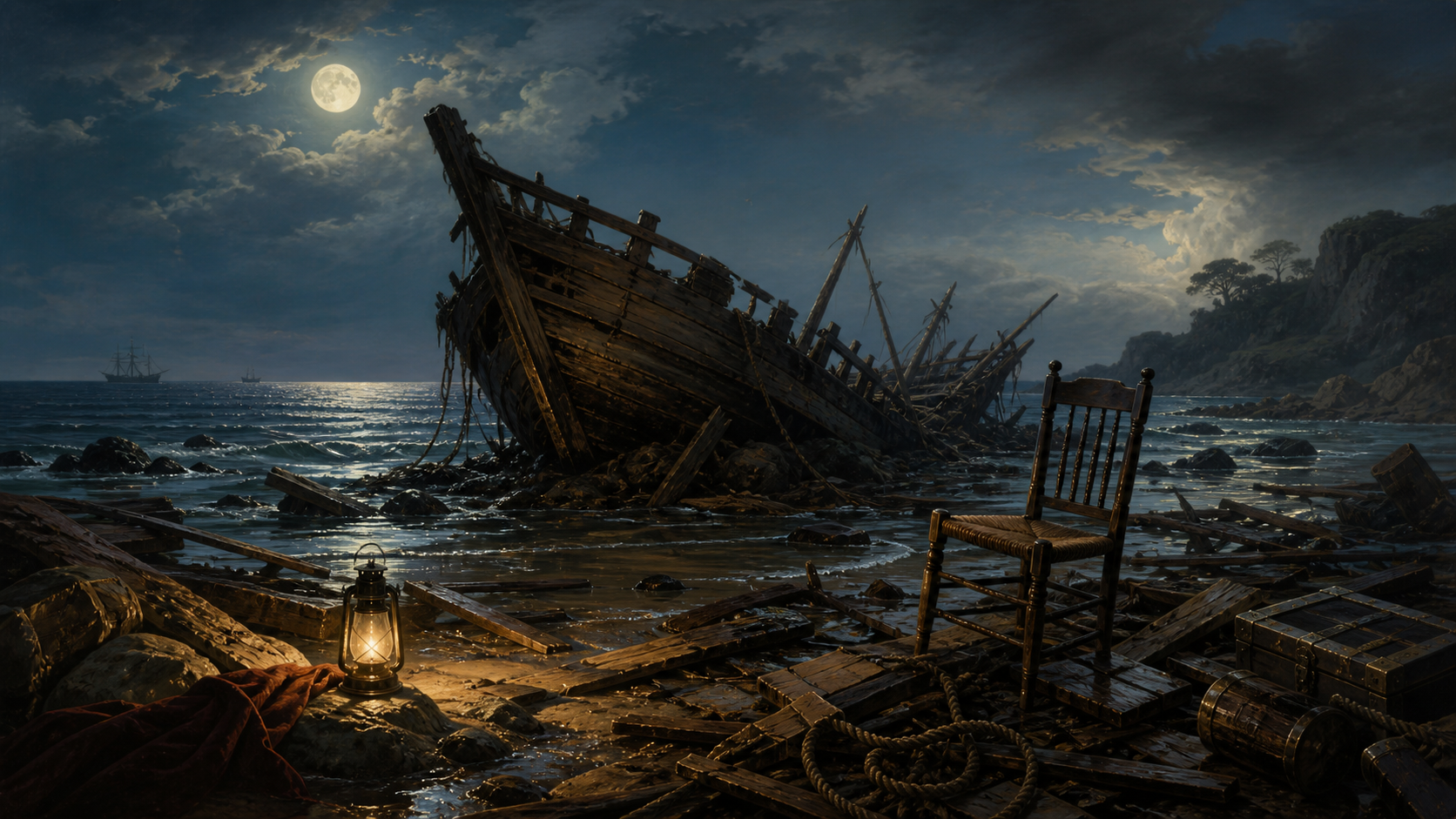
The Mary Celeste was found abandoned in 1872, and the absence of an answer let bad theories board faster than any pirate crew.
The Mary Celeste is not a pirate story.
That is the first thing to get right.
No skull flag. No stolen treasure. No blood on the deck. No triumphant pirate crew vanishing over the horizon with barrels of loot and a parrot who knew too much.
On December 4, 1872, the brigantine Dei Gratia came upon the Mary Celeste in the Atlantic. The ship was under sail, but abandoned. Captain Benjamin Briggs, his wife and daughter, and the crew were gone. The cargo of industrial alcohol remained. The lifeboat was missing. The people were never found.
That emptiness did what pirates usually do in fiction.
It boarded the imagination.
When a ship is found floating without its people, the mind goes looking for a villain. Pirates are convenient. They arrive with motive, violence, and a story-shaped explanation. But the Mary Celeste offers a harder lesson: sometimes the most haunting maritime mysteries are not the ones with a dramatic attacker.
Sometimes the terrifying thing is absence.
Why pirates get blamed
Pirates are useful whenever evidence is thin.
They explain missing people. They explain fear. They explain a ship without a crew. They give the mystery a human enemy, and human enemies are easier to understand than bad weather, bad readings, panic, faulty equipment, alcohol vapor, structural concern, or cascading small decisions made under pressure.
But piracy usually leaves signs.
Cargo disappears. Goods are disturbed. Survivors tell stories. Attack patterns emerge. Authorities hear reports. Ships show violence, theft, or damage that fits the theory. Pirates are criminals, not ghosts with excellent housekeeping.
The Mary Celeste was found with cargo still aboard. There was no clear evidence of a bloody boarding. The missing lifeboat suggests evacuation, not theatrical kidnapping. Some papers and instruments were gone, which fits people leaving in a hurry and taking what they thought they needed.
A pirate theory is dramatic.
It is not the best fit.
The ship as a working system
The Mary Celeste was not a haunted prop.
She was a working vessel.
That matters because ships create their own kinds of fear. A crew at sea lives inside a system of hull, rigging, cargo, weather, pumps, instruments, judgment, and trust. If enough parts of that system seem to be failing, even a ship that later looks survivable may feel deadly in the moment.
People abandon ships for reasons that can look strange afterward.
They may fear sinking. They may misread flooding. They may worry about explosion. They may believe weather is about to worsen. They may have faulty information. They may be exhausted, frightened, or trying to solve several small problems that combine into one large mistake.
That is not a tidy ending.
It is better maritime history.
A ship does not need pirates to become dangerous. It only needs people to believe, rightly or wrongly, that staying aboard is worse than leaving.
The alcohol cargo
The Mary Celeste carried industrial alcohol, which has helped feed theories about fumes, leakage, explosion fear, or panic over cargo danger.
That kind of explanation has the advantage of being less colorful and more plausible than sea monsters, murderous conspiracies, or invisible pirates. It also shows why maritime mysteries rarely reduce to one clean answer. Cargo was part of the ship's environment. If the crew believed the cargo posed danger, their choices may have made sense in the moment even if later investigators could not reconstruct the pressure precisely.
The important point is not to declare one simple solution with a captain's certainty the evidence does not deserve.
The important point is to refuse the lazy one.
A missing crew is not proof of pirates.
It is proof that something happened the surviving record cannot fully recover.
Why the theories got worse
The Mary Celeste became famous because she denied readers the one thing they wanted most: a final witness.
No survivor explained the decision. No pirate confessed. No captain's letter floated ashore. No courtroom sorted the evidence into a verdict. The ship kept moving, but the human story had been cut out.
That gap became an open berth for bad theories.
Fraud. Mutiny. Murder. Piracy. Alcohol explosion. Waterspout. Seaquake. Madness. Giant squid. Supernatural visitation. Theories arrived because silence is difficult to leave alone.
The stranger theories tell us less about the ship than about the audience. People do not like uncertainty, especially when uncertainty floats neatly into view under sail. An abandoned ship looks like a question somebody built out of wood.
So the answers multiplied.
The more the evidence resisted closure, the more confidently imagination climbed aboard.
What the Mary Celeste teaches pirate history
This page belongs on PiratesInfo not because the Mary Celeste was pirate history.
It belongs here because pirate history is full of the same problem: a thin record, a dramatic gap, and later storytellers arriving with boots full of certainty.
Pirate legends grow in empty spaces. A missing treasure becomes a map. An unexplained death becomes a curse. A vanished captain becomes a king in Madagascar. A ship with no crew becomes a pirate victim because the alternative is more frustrating: maybe the truth was ordinary, urgent, and lost.
The Mary Celeste is a warning against overfeeding the story.
Absence is not evidence for whatever theory looks best by lantern light.
The better truth
The Mary Celeste was found abandoned, not solved.
That is the honest sentence.
The pirate theory is attractive because it gives the mystery a villain. But the evidence points more strongly toward evacuation under circumstances we cannot fully reconstruct. The ship's emptiness is haunting enough without dressing it in a black flag.
Pirate stories have plenty of real violence.
They do not need to steal this one.


