History feature
Historical route
Oak Island's treasure story has survived floods, shafts, lawsuits, machinery, and disappointment because uncertainty can be more profitable than proof.
Oak Island is what happens when a hole in the ground learns to tell a story.
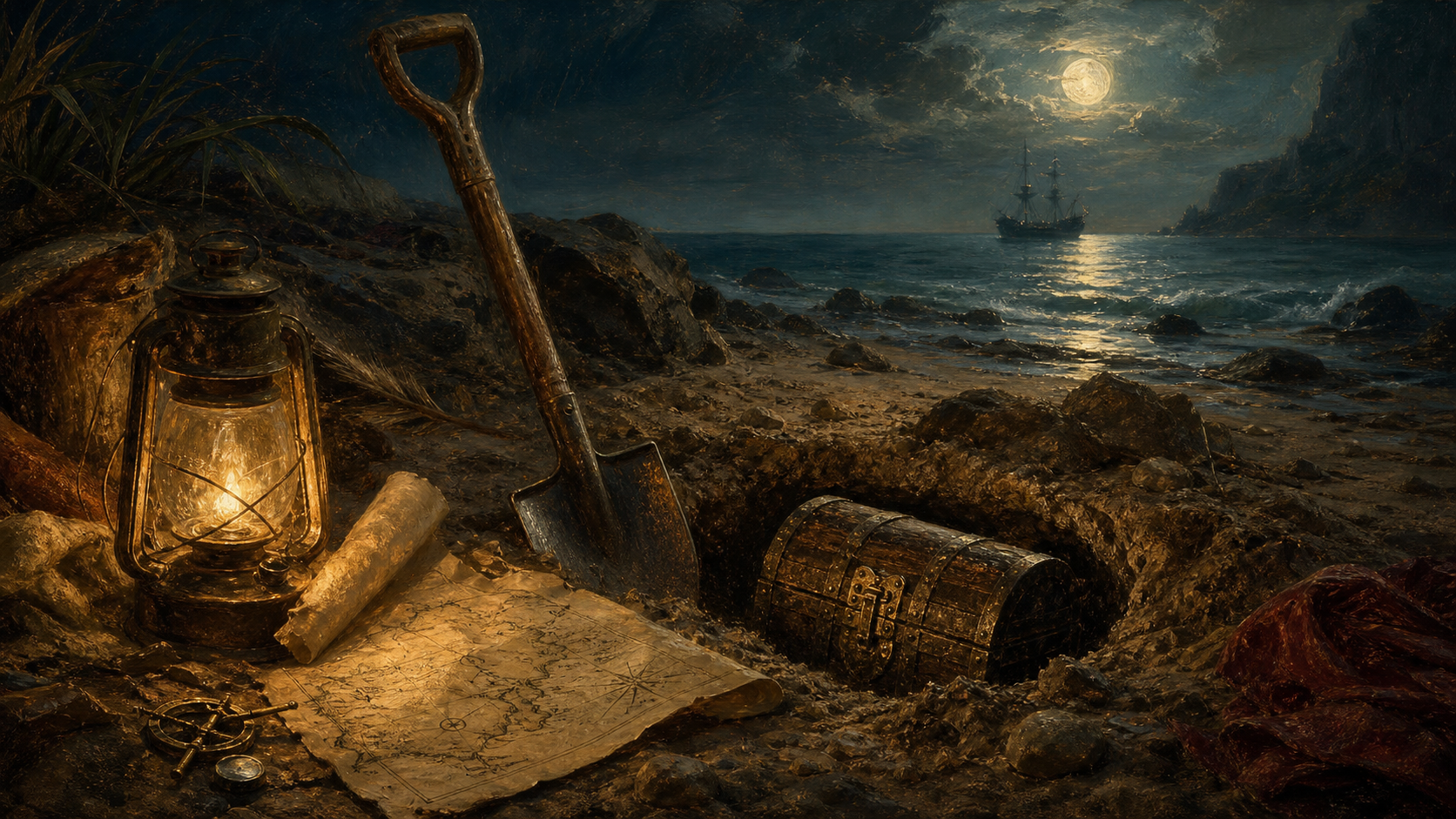
The familiar version begins in the late eighteenth century, on a small island off Nova Scotia, where searchers noticed a depression and imagined something hidden beneath it. From there the legend grew downward: shafts, platforms, flood tunnels, strange layers, supposed clues, machinery, investors, lawsuits, television, and disappointment wearing a new hat every decade.
Captain Kidd's name was dragged in, because pirate names often are when a mystery needs instant costume.
But the best way to read Oak Island is not as a proven pirate treasure site.
It is as a masterpiece of almost-proof.
Almost a clue. Almost a pattern. Almost a breakthrough. Almost the moment the island finally admits what it has been hiding.
Almost is a very profitable word.
The Money Pit story
The central Oak Island legend revolves around the so-called Money Pit. Searchers dug. Water intruded. Layers and objects were interpreted. Theories multiplied. Each failure became strangely useful because it suggested the treasure was not absent, only better protected.
That is the genius of the myth.
A simple empty hole is boring. A hole that fights back becomes a character.
Flooding shafts, difficult ground, fragmentary objects, and repeated engineering failures made the search feel less like a mistake and more like a contest against someone cleverer than the searchers. The island became an opponent. The deeper the work went, the easier it became to imagine design behind every obstruction.
That does not prove a treasure.
It proves that humans are very good at turning resistance into meaning.
Why pirates got invited
Pirates are useful to treasure legends because they bring a ready-made explanation.
Who would bury wealth in a strange place? Pirates. Who would make the hiding place elaborate? Pirates. Who would leave just enough mystery to drive respectable people into expensive digging? Pirates, naturally, because dead criminals are rarely available to object.
Captain Kidd is especially useful because he really does have a documented connection to buried valuables. Before his arrest in 1699, Kidd placed goods on Gardiners Island, and that cache was recovered. This gives later treasure stories one hard seed of truth.
But a real deposit in one place does not prove every rumored deposit elsewhere.
Kidd became the patron saint of suspicious holes because his story had the perfect ingredients: commission, accusation, trial, execution, treasure, politics, and a reputation that refused to stay buried. Oak Island borrowed the name because it helped the mystery stand up straighter.
A famous pirate is not evidence.
He is often just a costume the mystery puts on.
What good evidence would need
A strong pirate-treasure claim needs more than a shaft, a legend, and a famous name.
It needs a chain: specific people, specific dates, specific objects, specific records, and a plausible reason why valuables would be hidden there and not recovered. It should explain how the treasure got there, who placed it, why it stayed hidden, why no reliable contemporary record settled the matter, and why later finds connect to that story rather than to ordinary settlement, search activity, or later disturbance.
Oak Island has produced claims, objects, interpretations, and enormous effort.
What it has not produced is the kind of clear evidence that lets the pirate story walk out of legend and stand in daylight.
That does not make the story useless. It makes it a treasure legend rather than a treasure ledger.
The difference matters.
The search became the treasure
Oak Island's most reliable product has been not gold, but attention.
People invested money, time, labor, machinery, hope, and reputation into the search. The island consumed fortunes because it promised that the next attempt might be different. Every ambiguous object became a possible signal. Every flooded shaft became possible proof of a trap. Every failed dig created a new theory explaining why failure was exactly what should have happened.
A confirmed empty pit would kill the story.
A fully recovered treasure would end it.
Oak Island thrives in between.
That middle space is powerful because it lets every generation participate. Searchers can inherit the old mystery and add their own layer: a new drill, a new scan, a new interpretation, a new expert, a new theory involving pirates, Templars, manuscripts, Spanish treasure, British military activity, or whatever else the age finds irresistible.
The island is a machine for converting uncertainty into narrative.
Why the myth is so hard to kill
Treasure stories survive because they offer a kinder version of history.
In real pirate history, treasure was often cargo. It was divided, spent, sold, wasted, seized, recovered, or lost in ways that do not require a dramatic map. Pirates usually wanted usable wealth, not a long-term construction project designed to confuse future television producers.
But buried treasure gives the past a secret waiting for us personally.
It says history did not finish. Something remains. The dead left a puzzle. The modern searcher can still become the chosen reader of the clue.
That is emotionally stronger than a warehouse inventory.
Oak Island survives because it promises that the world still contains hidden design. Not just money underground, but intention. Someone clever made this. Someone left it. Someone almost found it. Perhaps the next person will.
The myth flatters hope.
Hope is very hard to fact-check out of existence.
The pirate version is the most entertaining, not the strongest
The pirate explanation has style. It gives the island a black flag, a dead captain, and a reason for secrecy.
It is not the strongest explanation simply because it is the most entertaining one.
Oak Island sits in a region with ordinary settlement, maritime activity, military history, natural processes, previous digging, and layers of human disturbance. Not every object in the ground has to be part of one grand pirate mechanism. Sometimes wood is wood. Sometimes water is water. Sometimes a clue is only a thing that survived long enough for people to disagree over it.
A skeptical article does not need to sneer at the searchers. Many were serious, determined, and technically ambitious. Some risked and lost a great deal. The human story is real even when the pirate treasure remains unproven.
That is the better angle.
Oak Island is not compelling because it proves pirates hid a fortune there.
It is compelling because people kept behaving as if proof was one more shaft away.
What Oak Island teaches about pirate myths
Oak Island shows how pirate legend works.
Start with a gap. Add a famous name. Add a few objects. Add danger. Add repetition. Add money. Add failure that can be reinterpreted as difficulty. Then let each generation inherit the story with just enough doubt to keep digging.
This is how a rumor becomes a tradition.
It does not need to be fully false. It only needs to remain unresolved.
Pirate history is full of real drama: trials, wrecks, raids, pardons, mutinies, vanished captains, and ships whose archaeology can be touched. Oak Island belongs beside those stories as a warning and a fascination. It reminds readers that mystery is not the same thing as evidence, and evidence is not less interesting because it refuses to become treasure.
The island has swallowed fortunes.
The treasure may be the story it learned to sell back to the diggers.


